
The Challenge
A marketing agency in Dubai was drowning in first drafts.
The agency managed over 40 brand accounts across the GCC region3 luxury hospitality, financial services, healthcare, retail, real estate. Each brand had its own voice, its own compliance rules, its own cultural sensitivities. And 12 content writers were spending 60–70% of their time producing first drafts social posts, Google ad copy, email campaigns, landing page content, WhatsApp messages, press releases.
The remaining 30% the part requiringz genuine creative strategy, campaign thinking, and brand judgment was being squeezed to the margin. The best work was being crowded out by the most repetitive work.
The obvious solution was AI. But the obvious solution didn't work.
ChatGPT and similar tools existed. The agency tried them. The output was generic it sounded like AI, not like the brand. A luxury hotel chain doesn't sound like a fintech startup. A healthcare provider in Abu Dhabi doesn't sound like a streetwear brand in Dubai. Every generated piece required heavy editing to match the brand's specific vocabulary, formality level, and messaging hierarchy. The editing negated time saving.
And for regulated industries financial services and healthcare clients the problem was worse. These clients had strict content rules: prohibited claims, required disclaimers, specific language around returns, guarantees, and medical outcomes. No AI tool enforced these rules automatically. One compliance violation in a social post could cost the brand its regulatory standing.
The founder: a digital marketing agency owner who had spent years building client relationships on trust and quality. Her conviction was specific she didn't need AI that generated content. She needed AI that generated content her clients would approve without redlines.
She came to TechEniac with a clear requirement: build a platform where the AI learns each brand's voice, follows each brand's rules, and produces content that reads like it was written by someone who has worked on that account for years not by a machine that just learned the brand exists.
Product Discovery & Architecture Design
Before writing a single line of code, TechEniac spent two weeks with the founder mapping how content actually moved through her agency from brief to approved draft to published piece.
The discovery process revealed five problems that no off-the-shelf AI tool addressed:
Brand voice is not a single setting it's a system. Each brand has a tone spectrum, vocabulary preferences, messaging pillars, compliance rules, and a library of previously approved content. Generic AI treats every brand the same. Production AI needs to treat every brand as its own world.
Compliance is non-negotiable in the GCC. Financial services clients in the UAE have strict rules about promotional language, return guarantees, and risk disclosures. Healthcare clients have advertising standards around treatment claims. The AI couldn't just generate content and hope for the best it needed to check its own output against each brand's compliance rules before anyone saw it.
Arabic is not English translated. GCC campaigns require content in both Modern Standard Arabic and English. But Arabic content for a Ramadan campaign doesn't sound like Arabic content for a National Day campaign. Cultural adaptation not translation was required. And the AI needed to understand GCC-specific seasonal norms, Gulf dialect preferences, and UAE advertising standards around gender-inclusive language.
Twelve content formats, each with different rules. A LinkedIn post is not an email is not a WhatsApp message is not a press release. Each format has its own length constraints, structural expectations, and platform-native conventions. The AI needed to generate format-aware content, not generic text the writer then reformats.
The agency used six different tools. Content briefs, drafting, editing, client approval, and scheduling each lived in a different system. Version control was chaotic. Approval cycles took days because feedback happened over email chains. The platform needed to consolidate the entire content workflow not just the generation step.
Based on this discovery, TechEniac designed a multi-model content architecture: GPT-4o for creative long-form and persuasive copy, Claude Sonnet for compliance-sensitive regulated content, AraBART for Arabic generation with cultural adaptation all coordinated through LangChain and governed by a per-brand voice enforcement system that shapes every generation request.
Technical Solution
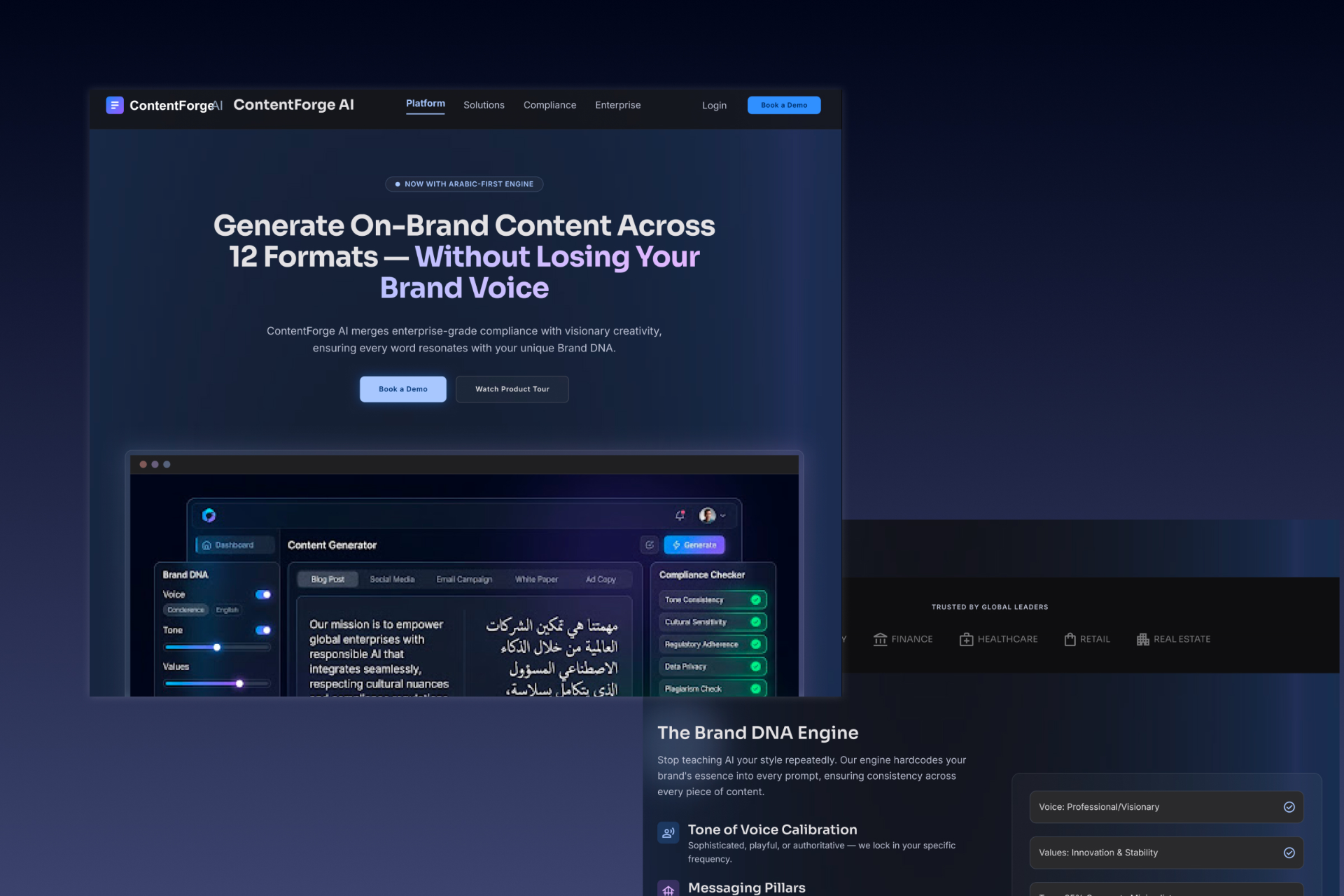
Brand Voice Engine (Persistent Brand DNA)
This is the system that makes ContentForge AI fundamentally different from ChatGPT with a branded prompt.
For each client brand, the agency configures a Brand DNA profile:
Tone spectrum: A 5-point scale from formal to conversational, calibrating the AI's language register per brand.
Vocabulary whitelists and blacklists: Words the brand always uses and words it never uses.
Messaging pillars: Up to 5 priority themes that should appear consistently across all content.
Approved content library: Examples of previously approved content that define what "good" looks like for this brand.
Compliance rules: Prohibited claims, required disclaimers, and regulatory restrictions specific to the brand's industry.
Brand DNA is persisted in PostgreSQL and stored as structured vectors in Pinecone. On every generation request, the relevant brand rules are retrieved fresh and injected as a structured system prompt layer ensuring the AI never drifts from the brand's voice, even across thousands of generation requests.
This is not prompt engineering. This is prompt architecture : A structured retrieval system that ensures brand consistency at scale, not a single prompt that gets diluted over long conversations.
Multi-Format Content Generation
ContentForge AI generates production-ready content across 12 formats from a single brief input: social media posts, Google ad copy, email campaigns, landing pages, SMS messages, WhatsApp content, press releases, product descriptions, blog outlines, video scripts, newsletter sections, and client reports.
Each format has its own structural template, length constraints, and platform-native conventions enforced at the generation layer. A LinkedIn post is generated with hook-body-CTA structure within 1,300 characters. A Google ad is generated with headline character limits and description constraints. A WhatsApp message respects conversational brevity.
The generation layer uses a model-routing strategy: GPT-4o handles long-form content and persuasive ad copy where creative quality matters most. Claude Sonnet handles compliance-sensitive regulated content where instruction-following precision matters more than creative flair. The routing is automatic the content writer selects the format and brand, and the system selects the optimal model.
AI Compliance Checker
Every piece of generated content passes through a three-stage compliance pipeline before anyone sees it:
Stage 1: Rule-based detection. A regex-based checker scans for prohibited terms, missing required disclaimers, and brand blacklist violations. Fast, deterministic, catches the obvious violations.
Stage 2: Semantic compliance analysis. GPT-4o evaluates the content for implied claims, misleading suggestions, and compliance-adjacent language that the regex layer can't catch. "Guaranteed results" is caught by Stage 1. "You'll see results faster than you expect" an implied guarantee is caught by Stage 2.
Stage 3: Human-in-the-loop flagging. Responses below 85% compliance confidence are flagged for human review rather than delivered automatically. The system knows its limits.
Results are displayed with inline annotations highlighting the specific compliance issue, the rule violated, and a suggested alternative. The content writer fixes violations before the client ever sees the draft.
97% of regulatory violations caught before client submission in testing.
Arabic Language & Cultural Adaptation
ContentForge AI doesn't translate English content into Arabic. It generates Arabic content natively with cultural context built into the generation layer.
The Arabic pipeline uses AraBART fine-tuned on GCC marketing content, supplemented by GPT-4o with a cultural context system prompt that accounts for Ramadan messaging norms, Gulf dialect preferences, National Day campaign conventions, and gender-inclusive language requirements in UAE advertising standards.
A post-generation normalisation step using CAMeL Tools standardises Arabic diacritisation, fixes common AI-generated grammar errors, and enforces right-to-left formatting consistency.
Content is generated in both languages simultaneously with cultural equivalence maintained, not literal translation. A Ramadan campaign in Arabic carries the appropriate reverence and warmth. The same campaign in English carries the appropriate cultural awareness without overcorrection.
Native Arabic speaker panel rated AI-generated Arabic content as acceptable without edits in 88% of samples.
Collaborative Content Workspace
ContentForge AI replaces six fragmented tools with a single workspace:
Brand-separated project folders: Each brand's content lives in its own workspace with its own Brand DNA, team, and approval chain.
Inline comment threads: Feedback happens on the content itself, not in email chains.
One-click content variations: Generate 3 alternatives of any piece with a single click, maintaining brand voice across all variations.
Approval workflow: Submit → review → approve/reject with email notifications at each stage. Role-based permissions control who can generate, who can edit, and who can approve.
Full version history with diff view: Every edit, every generation, every approval logged and comparable.
Performance tagging: Published content is tagged with performance data so the AI learns which content patterns historically performed best for each brand.
Average approval cycle reduced by 2 business days: From email chain chaos to structured, tracked approvals.
Challenge 1
Brand Voice Drift Over Long Sessions During testing, brand voice accuracy degraded over extended content sessions. As the conversation history grew, the brand DNA instructions were being pushed further from the model's attention window a known issue with long-context LLM interactions.
TechEniac solved this by moving from static system prompts to a retrieval-augmented prompt architecture. Brand DNA rules are stored as structured vectors in Pinecone and retrieved fresh per generation request not carried forward in conversation history. Every generation starts with the full, undiluted brand context, regardless of how many pieces have been generated in the session.
Brand consistency is now maintained across the 1st piece and the 100th piece in a single session.
Challenge 2
Arabic Diacritisation and Formatting Inconsistency
GPT-4o and AraBART generated Arabic content with inconsistent diacritisation (vowel marks), occasional grammar errors specific to AI-generated Arabic, and right-to-left formatting issues when Arabic and English were mixed in the same document.
TechEniac added a post-generation Arabic normalisation layer using CAMeL Tools a dedicated NLP toolkit for Arabic. Every Arabic generation passes through diacritisation standardisation, grammar correction, and formatting enforcement before the content writer sees it.
This normalisation step is invisible to the user they see clean, publication-ready Arabic content.
Challenge 3
GPT-4o Ignoring Compliance Rules at High Temperature
At higher temperature settings (which produce more creative, varied output), GPT-4o occasionally generated content that crossed compliance boundaries using language that implied guarantees, made unsubstantiated claims, or omitted required disclaimers. The model was prioritising creative quality over rule adherence.
TechEniac implemented a dual strategy: all compliance-sensitive content is generated at temperature 0.3 (more deterministic, more rule-adherent), and every piece regardless of temperature passes through the three-stage compliance pipeline before display.
The combination of constrained generation + post-generation validation eliminated compliance violations in production. Creative content stays creative. Regulated content stays compliant. The system knows the difference.
Challenge 4
Scaling to 40+ Brands Without Cross-Contamination
With 40+ brand profiles active simultaneously, a critical risk was cross-contamination Brand A's vocabulary appearing in Brand B's content, or compliance rules from one industry leaking into another.
TechEniac enforced strict brand data isolation at every layer: separate PostgreSQL schemas per workspace, isolated Pinecone namespaces per brand, and brand-scoped API keys ensuring that no generation request can access another brand's DNA.
Zero cross-contamination incidents in production across 40+ concurrent brand profiles.