half-logo
AI Agent Development Services

AI Agents That Reason, Decide, and Act Not Just Respond

TechEniac’s AI agent development services go beyond chatbots and automation scripts. We build multi-agent systems where specialised AI agents collaborate on complex tasks reasoning through decisions, executing multi-step workflows, and escalating to humans at exactly the right moment. Built with LangGraph. Battle-tested in production.

Our multi-agent AI systems don’t just generate text they complete work. Process insurance claims end-to-end. Coordinate hospital operations across 800+ beds. Screen and schedule candidates autonomously. Monitor regulatory changes across 60+ sources. Six multi-agent systems in production across healthcare, fintech, recruiting, and enterprise automation more than any boutique AI agency.

6
Multi-agent systems in production
95%
Medical accuracy achieved (SolidHealth AI)
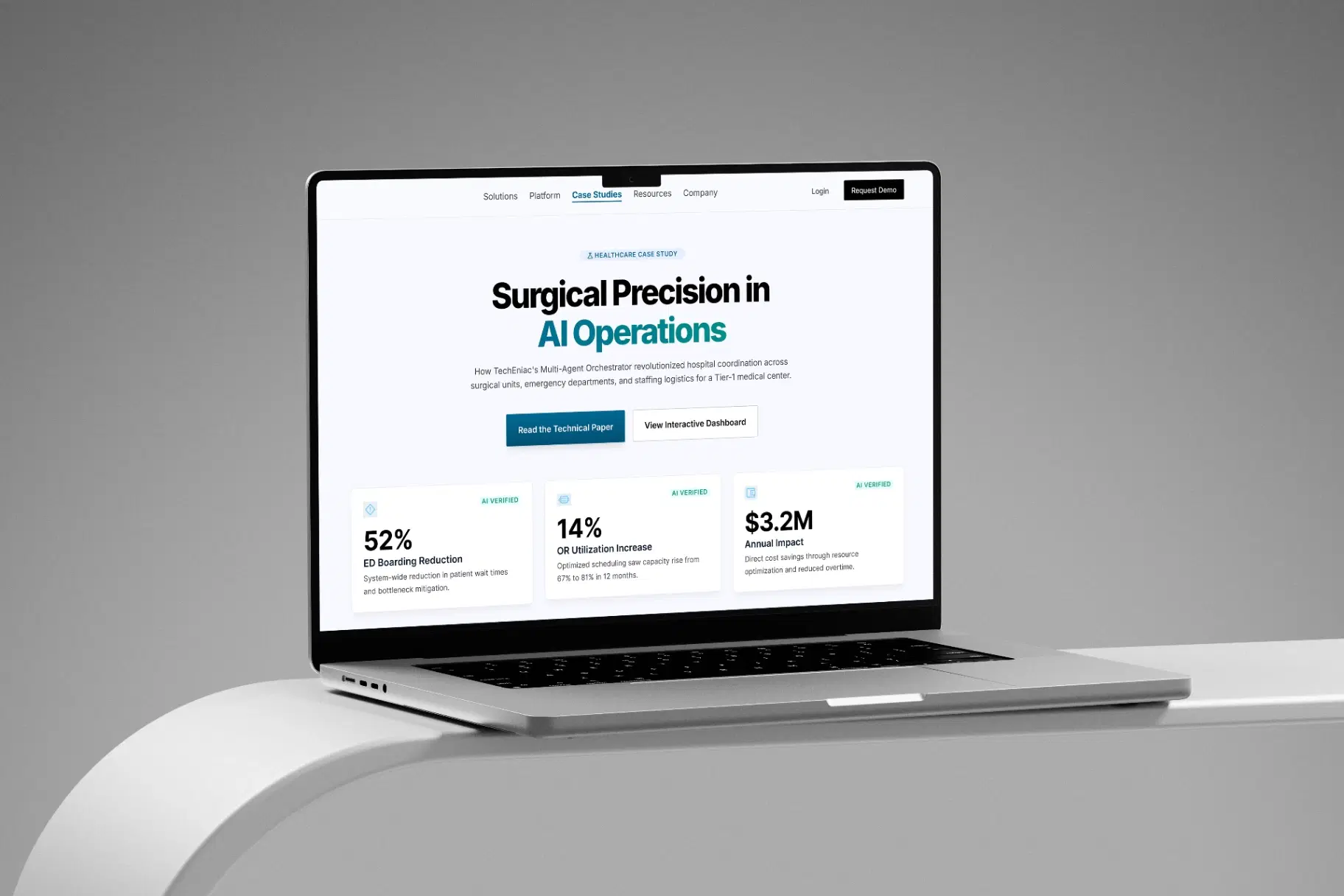
$3.2M
Annual revenue impact (PatientFlow AI)
68%
Admin time saved (TalentSync AI)

Describe your complex workflow. We’ll assess whether multi-agent architecture is the right approach or whether a simpler solution would serve you better.

Trusted in production

SolidHealth AIPatientFlow AITalentSync AIComplianceGuard AIWealthPilot AIWorkflowAI9 verified Clutch reviews · 4.9 / 5

AI Agent Development Services

From Single-Model AI to Autonomous Multi-Agent Systems We Build Agents That Do the Work

Chatbots respond to queries. Automation scripts follow predefined rules. AI agents reason through complex situations, make decisions, execute actions across multiple systems, and adapt their behaviour based on outcomes. We build all three but this page is about the agents.

The shift from single-model AI to multi-agent systems is the most significant architectural evolution in AI product development. Single models hit an accuracy ceiling around 75–85% for complex domain-specific tasks. Multi-agent systems break through that ceiling by decomposing complex reasoning into specialised sub-tasks, each handled by an agent optimised for that specific operation.

TechEniac has 6 multi-agent systems in production — SolidHealth AI (5 agents), PatientFlow AI (4 agents), TalentSync AI (5 agents), ComplianceGuard AI (2+ agents), WealthPilot AI (4 agents), and WorkflowAI (decision nodes). These are production platforms serving real users and processing real decisions daily.

What separates agents from chatbots

Three capabilities that define AI agents

  • Multi-step reasoning. Agents decompose complex problems, reason through each sub-task, and chain results together.
  • Tool execution. Agents call APIs, query databases, trigger workflows, and update systems not just generate text.
  • Human oversight. High-stakes decisions require human confirmation. The agent assists. The human decides.

Our AI Agent Development Services

Comprehensive AI Agent Development Services

Six capability areas spanning multi-agent orchestration, autonomous task execution, verification systems, regulatory monitoring, workflow decision-making, and human-in-the-loop design each engineered for production reliability in complex, high-stakes domains.

Multi-Agent Orchestration

Systems where multiple specialised AI agents work together on complex tasks each agent handling one responsibility within a larger coordinated workflow. Sequential pipelines, hub-and-spoke dispatch, or supervised autonomous operation. The architecture matches the problem.

Production proof

SolidHealth AI uses 5 agents in a sequential pipeline to achieve 95% medical accuracy through self-correcting verification loops. PatientFlow AI uses a hub-and-spoke orchestrator dispatching 4 specialised agents based on real-time hospital state.

Autonomous Task Execution

Agents that don't just generate text they complete work. Process insurance claims end-to-end. Coordinate hospital bed assignments across departments. Screen candidates and schedule interviews. Trigger APIs, update databases, and route decisions all autonomously within defined boundaries.

Production proof

TalentSync AI's 5 agents handle the complete pre-screening workflow from job posting to qualified shortlist saving recruiters 68% of their administrative time. 50+ companies onboarded in 3 months.

Verification & Self-Correction Agents

Single-model AI hits an accuracy ceiling around 75–85% for complex domain tasks. We break through that ceiling by adding verification, fact-checking, and self-correction agents around the primary generation agent. The AI checks its own work before delivering results.

Production proof

SolidHealth AI's self-attention feedback loop catches 23% of accuracy issues before responses reach patients pushing accuracy from ~80% to 95%+. The verification agents are the difference between a demo and a product patients can trust.

Regulatory Monitoring Agents

Agents that continuously scan regulatory sources, detect relevant changes, and assess impact on your business automatically. New regulations are detected within hours, not weeks. Impact assessments run per-client without manual review.

Production proof

ComplianceGuard AI monitors 60+ regulatory sources and assesses impact across 35 fintech client companies with 89% assessment accuracy. New documents detected within 4 hours of publication.

AI Decision Nodes for Workflows

AI decision-making embedded directly into enterprise workflows agents that receive execution context, make structured routing decisions, and log their reasoning to an audit trail. Lead qualification, risk scoring, ticket categorisation, and escalation triggers handled by AI, verified by humans.

Production proof

WorkflowAI's decision nodes automate an average of 22 hours per week of operations team time per client across 120+ enterprise beta clients. 97.3% workflow success rate with 100% audit logging.

Human-in-the-Loop Agent Systems

We never build fully autonomous agents for high-stakes domains. Every system includes human oversight mechanisms appropriate to the risk level physician confirmation, recruiter override, approver validation. The agent assists. The human decides. Always.

Production proof

PatientFlow AI generates bed assignment recommendations but requires attending physician confirmation for high-acuity transfers. TalentSync AI gives recruiters one-click override on every agent decision. WorkflowAI pauses at configured approval nodes.

Industries We Serve

AI Agent Solutions Across Industries

Our AI agent development services are tailored to the specific workflow complexity, accuracy requirements, and compliance frameworks of each industry.

Healthcare

Multi-agent medical verification systems and hospital operations coordination. Patient-facing health guidance with 95%+ accuracy. Multi-facility agent orchestration across 800+ beds. HIPAA-compliant with FHIR integration.

In production: SolidHealth AI · PatientFlow AI

Financial Services & Compliance

Regulatory monitoring agents scanning 60+ sources. Impact assessment automation across multiple client companies. FCA-compliant financial analysis with boundary management. Open Banking integration.

In production: ComplianceGuard AI · WealthPilot AI

Recruiting & HR

Autonomous pre-screening workflows job decomposition, resume parsing, candidate scoring, personalised outreach, and interview scheduling. Multi-model strategies (Gemini for parsing, GPT-4o for scoring).

In production: TalentSync AI

Enterprise Operations

AI decision nodes embedded in workflow platforms. Lead qualification, risk scoring, compliance checking, ticket categorisation, and automated routing with human-in-the-loop approval at configured checkpoints.

In production: WorkflowAI

Insurance

Conversational AI agents for claims intake and processing. Multi-turn data collection, policy validation, CMS population, and FCA-compliant communication record generation all within a single agent-driven workflow.

In production: ClaimBot

Our Development Approach

How TechEniac Builds Multi-Agent AI Systems

Building a multi-agent system isn’t like building a chatbot. Each agent is designed, developed, and tested individually then integrated into an orchestrated pipeline and tested again as a system. Here is how we approach every multi-agent engagement.

01

Agent Architecture Design

What you receive

A complete agent architecture document defining each agent's responsibility, data requirements, tool access permissions, communication patterns, and human oversight checkpoints.

We decompose the complex task into discrete sub-tasks, each becoming a candidate agent. What does each agent do? What data does it need? What tools can it access? How do agents communicate? Where does human oversight fit? SolidHealth AI's decomposition produced 5 agents each with a single, well-defined responsibility making the system debuggable, testable, and improvable at the individual agent level.

02

Agent Orchestration with LangGraph

What you receive

A production-ready orchestration layer using LangGraph with explicit state management, conditional branching, and persistent context across sessions.

Three orchestration patterns cover most production use cases. Sequential Pipeline: agents execute in a fixed order, each output feeding the next (SolidHealth AI: validate → retrieve → generate → verify → format). Hub-and-Spoke: a central orchestrator dispatches specialised agents based on dynamic conditions (PatientFlow AI: orchestrator dispatches bed, surgical, discharge, and forecasting agents based on real-time hospital state). Supervised Autonomous: agents operate independently within boundaries, escalating at configured checkpoints (TalentSync AI: agents handle pre-screening end-to-end, recruiters review summary cards with one-click override).

03

Individual Agent Development

What you receive

Individually developed, tested, and validated agents each with its own system prompt, tool permissions, input/output schema, quality criteria, and the optimal LLM for its specific task.

Each agent gets the right model: GPT-4o for complex reasoning (screening scoring, impact assessment, clinical NLP). Claude Sonnet for compliance-sensitive tasks (regulatory classification, FCA boundary management). Gemini for document understanding (resume parsing, damage assessment). ComplianceGuard AI's Impact Assessment Agent was tested against 200 known regulatory changes refined until it achieved 89% accuracy independently before integration.

04

Multi-Agent Integration Testing

What you receive

A fully integrated multi-agent pipeline tested for state propagation, conflicting decisions, circular dependencies, latency accumulation, and end-to-end accuracy with LangSmith observability tracing every agent call.

Individual agents working perfectly can still fail as a system. Integration testing catches issues single-agent testing cannot. LangSmith provides per-agent tracing input, output, latency, token usage, and decision rationale per step. When a pipeline produces an incorrect result, we pinpoint exactly which agent made the error reducing debugging from hours to minutes. A 5-agent pipeline where each agent takes 2 seconds = 10-second total response time. We optimise at integration to bring this within acceptable bounds.

05

Human-in-the-Loop Integration

What you receive

Human oversight mechanisms appropriate to your domain's risk level configured, tested, and integrated into the agent pipeline with clear escalation paths and override capabilities.

Every production agent system we build includes human oversight. TalentSync AI gives recruiters structured screening summaries with one-click override agents act autonomously, every decision is reversible. WorkflowAI pauses execution at configured approval nodes and routes to designated approvers via Slack or email. PatientFlow AI requires attending physician confirmation for high-acuity bed transfers. The agent assists. The human decides. Always.

Not every product needs multi-agent AI. Let’s figure out if yours does.

About 80% of AI products work perfectly with a single model and good prompt engineering. The 20% that need agents products where accuracy above 90% isn’t optional, where tasks span multiple systems, where mistakes carry real consequences — that’s where we operate.

Technology

The AI Agent Stack We Trust in Production

Orchestration
LangGraph

Stateful multi-agent workflows with explicit state management, conditional branching, and persistent context across sessions. The production standard for multi-agent orchestration.

LangSmith

Agent observability, debugging, and performance monitoring. Per-agent tracing with input, output, latency, token usage, and decision rationale.

LLMs per agent
GPT-4o

Complex reasoning agents screening scoring, impact assessment, clinical NLP, multi-step analysis.

Claude Sonnet

Compliance-sensitive agents regulatory classification, FCA boundary management, structured data extraction.

Gemini

Document understanding agents resume parsing, damage assessment, multimodal analysis.

Per-agent model selection

Each agent gets the LLM best suited to its specific task not a single model for everything.

Tool integration
Databases

Agents read and write to PostgreSQL, MongoDB, and Qdrant with explicit per-agent permissions.

External APIs

Google Calendar, Guidewire, TrueLayer, Epic FHIR each integration production-hardened with retry logic and dead-letter queues.

Least-privilege access

An agent that reads from the vector database cannot write to the CMS. Principle of least privilege, applied to AI.

State management
LangGraph MemorySaver

Per-user thread isolation for conversation-oriented agents.

PostgreSQL

Persistent state for long-running workflows that span hours or days.

Redis

Real-time coordination signals between agents operating simultaneously.

Questions Founders Ask About AI Agent Development

Agent architecture, orchestration patterns, accuracy control, running costs the questions every founder asks before building a multi-agent system.

What's the difference between an AI agent and a chatbot?

When should I use multi-agent versus single-model AI?

How do you prevent agents from making mistakes?

How long does it take to build a multi-agent system?

Your product has a workflow too complex for a single model. Let’s break it down.

Not every product needs multi-agent AI. But the products that do where accuracy above 90% isn’t optional, where tasks span multiple systems, where mistakes carry real consequences that’s exactly where we operate. If you’re not sure which category your product falls into, that’s exactly the conversation we should have.