How TechEniac engineered a HIPAA-compliant multi-agent AI platform for a 4-hospital regional health system cutting ED boarding by 52%, lifting OR utilisation from 67% to 81%, and delivering $3.2M in estimated annual revenue impact.
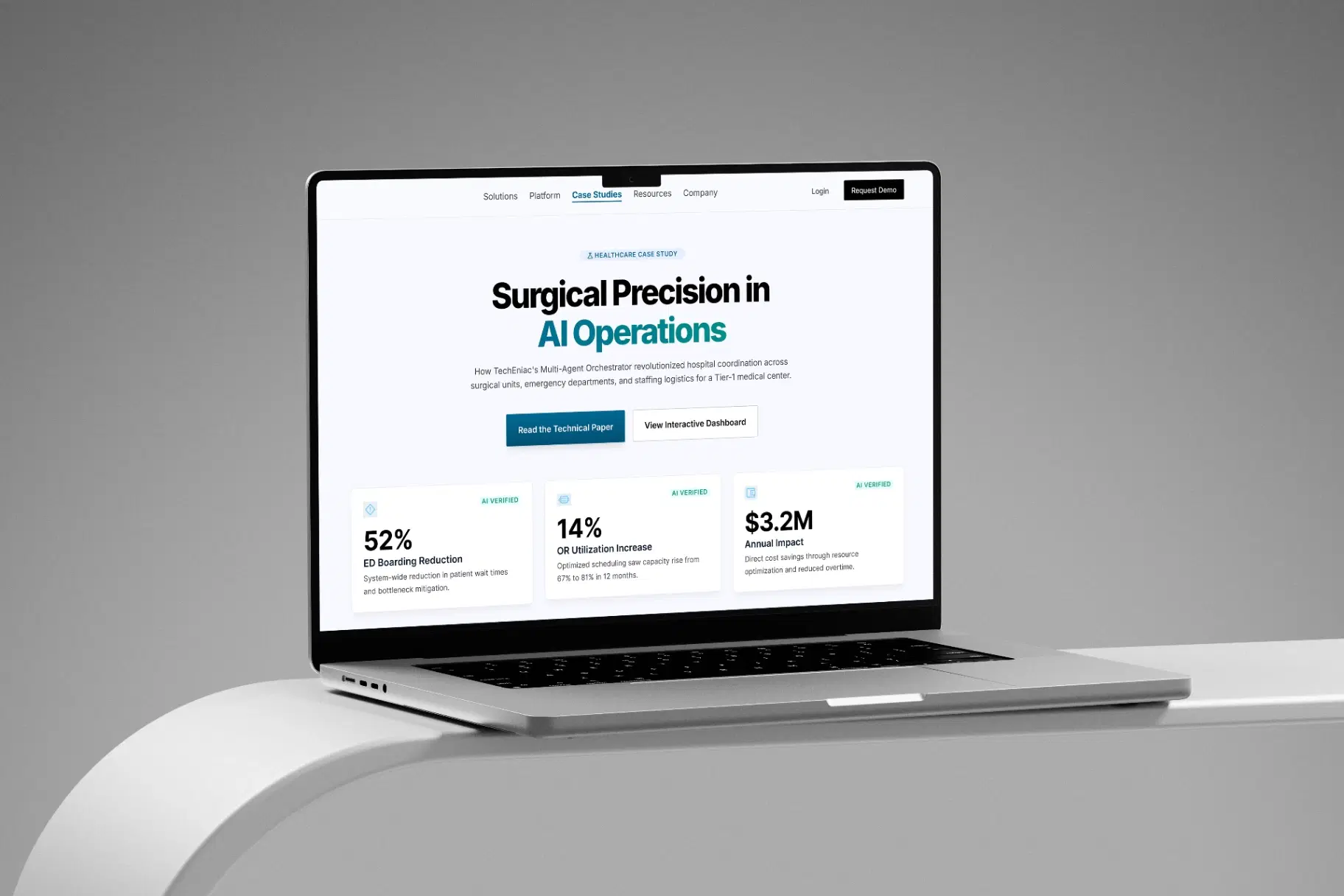
The founder brought 20 years of hospital operations experience and identified a recurring issue: hospital inefficiency was often a coordination problem, not a clinical one. She envisioned an AI-powered multi-agent platform to automate bed management, OR scheduling, discharge coordination, and capacity forecasting—integrated with Epic via SMART on FHIR, HIPAA-compliant, and scalable across 4 hospitals and 800+ beds.
The founder identified five compounding operational failures driving millions in annual waste:
Admitted patients waited an average 4.2 hours for inpatient beds, more than double the CMS benchmark. Manual coordination between nursing, bed management, and housekeeping created delays that tied up ED capacity.
OR utilisation averaged just 67%, with sterilisation, patient prep, and anaesthesiology coordination causing avoidable delays, cancellations, and inefficient scheduling.
Patients waited an average 6.8 hours after medical clearance as eight departments coordinated discharge tasks manually, keeping beds occupied and worsening ED boarding.
Surges caught leadership unprepared, with no predictive visibility into capacity needs. Staffing and resource decisions were made reactively instead of within a critical 72-hour planning window.
Automating operations required seamless Epic integration, but complex SMART on FHIR authentication and compliance requirements made reliable, continuous automation difficult.
Multi-agent architecture where specialized autonomous agents handle bed management, surgical coordination, discharge facilitation, and capacity forecasting independently yet coordinated.
Real-time integration with Epic via SMART on FHIR R4 with reliable token management and no mid-session authentication failures.
Physician autonomy preserved—agents accelerate human decisions, never override physician judgment.
Full HIPAA compliance with complete audit trail of every agent action and decision.
Scalability from single-hospital pilot to 4-hospital regional system (800+ beds) without architectural rewrite.
Capacity forecasting model generating 72-hour advance warnings vs. reactive same-day decisions.
TechEniac designed a hub-and-spoke multi-agent architecture using LangGraph with GPT-4o powering decision reasoning. A central Hospital Operations Orchestrator agent monitors overall facility state and dispatches work to four specialized sub-agents, each responsible for a single operational domain: bed management, surgical coordination, discharge facilitation, and capacity forecasting. The orchestrator maintains a shared operations context store that each agent can read and update, enabling coordinated decision-making without silos. Each agent can invoke Epic API calls, trigger notifications to clinical staff, and escalate issues autonomously within defined approval thresholds. High-stakes decisions (bed reassignment during a surge, surgical cancellation) require human confirmation before execution, preserving physician and operational leadership autonomy over critical choices. The architecture is designed to scale from a single hospital to multiple facilities: each facility has its own agent instances for operational isolation, while a system-level forecasting layer aggregates data and insights across the full health system.
The Bed Management Agent monitors real-time bed status from Epic and incoming admission requests continuously. When an admission request arrives, the agent evaluates available beds across multiple criteria simultaneously: unit type match (ICU vs. med-surg), patient acuity level, isolation requirements, current nursing staff ratios, and geographic location. The agent proposes an optimal bed assignment with a confidence-scored rationale explaining why that specific bed is the best match, automatically notifies housekeeping via API for cleaning prioritization, and confirms the assignment to the admitting team. This eliminates the manual phone calls and back-and-forth coordination that previously consumed 30+ minutes per bed assignment. Outcome: human bed management calls reduced by 74%, average bed assignment time decreased from 45 minutes to 8 minutes, and ED boarding times dropped accordingly.
The Surgical Coordination Agent monitors the surgical schedule 72 hours forward and identifies at-risk cases in real time: missing pre-operative orders, unconfirmed sterilization requests, pending anesthesiology assignments, and unscheduled patient transport. For each at-risk case, the agent initiates targeted outreach via PerfectServe (clinical messaging integration) to the responsible departments, escalating unresolved issues to the OR charge nurse 24 hours before case start. This proactive identification and intervention model catches coordination failures before they become cancellations. Previously, coordination failures were discovered on case start day, forcing last-minute decisions. Now, the agent provides 24 hours' notice for problem-solving. Outcome: OR utilization increased from 67% to 81% within the first quarter, representing recovery of 14 percentage points and hundreds of thousands in annual revenue from prevented cancellations and optimized case scheduling.
When a physician marks a patient as medically ready for discharge, the Discharge Facilitation Agent launches a parallel coordination workflow that simultaneously triggers up to eight separate departmental tasks: pharmacy expedites discharge prescription processing, transport books departure with required window, family receives automated SMS notification, community care schedules follow-up appointments, social work confirms discharge planning completion, case management verifies insurance, billing processes final charges, and medical records prepares documentation. Previously, these tasks were coordinated sequentially by human staff, with delays and handoff failures at each step. The parallel agent-driven model executes all tasks simultaneously. The agent monitors each task's completion status and re-escalates stalled tasks every 45 minutes, preventing single-department delays from blocking the entire discharge. Outcome: discharge delay reduced from 6.8 hours to 1.9 hours post-medical-clearance—a 71% reduction. This freed up bed capacity, reduced ED boarding, and improved patient satisfaction by eliminating post-clearance waiting.
TechEniac built a capacity forecasting model using Scikit-learn and Prophet, trained on historical admission patterns, seasonal disease surveillance data (CDC FluView API, local health department feeds), scheduled elective admissions, and current facility occupancy. The model generates 72-hour rolling bed demand forecasts by unit type with confidence intervals, incorporating predictable patterns (weekend vs. weekday, seasonal flu/RSV spikes) and externally observable signals (disease outbreaks, local events). When forecast demand is projected to exceed 90% capacity, the system triggers a proactive alert to staffing, supply chain, and executive leadership with specific recommended interventions. Outcome: surge events are now anticipated 72 hours in advance rather than discovered at crisis point. Leadership can activate additional staffing, secure additional supplies, coordinate with partner facilities, and implement capacity protocols before the system becomes stressed. The forecasting model has identified 95% of actual capacity spikes with an average 68-hour advance warning.
Epic SMART on FHIR Token Management
Built a token lifecycle manager that proactively refreshes tokens 5 minutes before expiry (giving a buffer before actual expiration), maintains a token pool for concurrent agent requests across multiple hospital instances, and logs all token events for HIPAA audit compliance. Outcome: zero mid-session authentication failures in production. Agents maintain continuity through long-running operations without losing context or requiring human re-authentication.
Agent Conflict on Shared Resources
Implemented optimistic locking on bed resources in the shared operations context store. When the first agent claims a bed, it locks it for 90 seconds during which time competing agents are automatically rerouted to available alternatives. If a competing agent attempts to claim the same bed, the system detects the lock, immediately offers alternative beds, and avoids the conflict. Outcome: eliminated all agent-to-agent conflicts on shared resources. Agents resolve simultaneous requests autonomously without escalation.
Physician Resistance to Automated Discharge Triggers
Redesigned the trigger model from automatic to opt-in. The discharge agent only fires when the physician explicitly marks a patient as discharge-ready in Epic. The physician retains full decision authority over the discharge decision; the agent simply accelerates all the downstream coordination that follows. This preserved physician autonomy completely while still dramatically accelerating the post-clearance process. Outcome: physician adoption increased significantly. Doctors understood the agent was accelerating their decisions (not making decisions for them) and enthusiastically engaged with the platform.
Multi-Hospital Scaling and Facility Isolation
Deployed multi-availability-zone infrastructure on AWS for hospital-grade reliability and implemented per-facility agent instances with complete operational isolation—each hospital runs its own bed management, surgical coordination, and discharge agents. Simultaneously, implemented a shared forecasting layer that aggregates anonymized admission patterns, occupancy data, and surge signals across all four facilities, enabling system-level capacity planning. Outcome: the platform scales seamlessly from 1 hospital to 4 hospitals (800+ beds) without architectural changes. Hospital-level isolation is guaranteed; system-level forecasting coordinates resources across the network.
ED Boarding Time
from 4.2 hours to 2.0 hours, meeting CMS benchmark
OR Utilisation
14-point increase from proactive coordination
Discharge Delay
from 6.8 hours to 1.9 hours post-medical-clearance
Capacity Forecast Lead
advance warning vs. same-day reactive decisions
Regional Deployment
covering 800+ beds across one health system
Est. Annual Revenue Impact
from boarding, OR utilisation, and discharge gains
Bed Management Calls
reduction in manual coordination calls
AI / ML
Backend
Frontend
Healthcare Integration
Cloud & DevOps
Security & Compliance
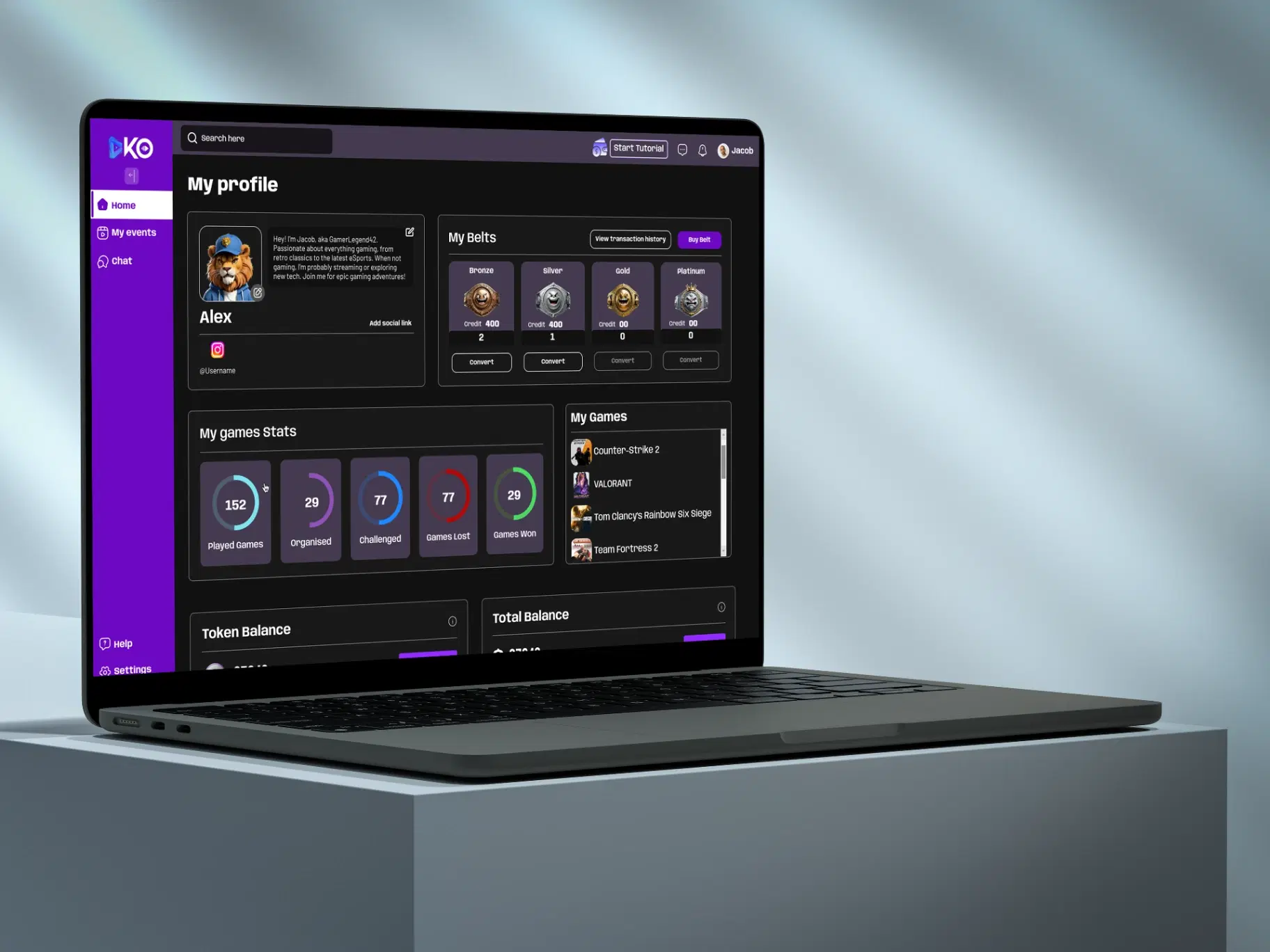
GamingTech
Live competitive gaming platform combining player-created matches, ranked belt wagering, low-latency streaming, real-time interaction, and secure result settlement.
MediaTech / EntertainmentTech
AI-powered music interpretation platform helping Spanish-speaking audiences discover songs, explore lyrics, and understand the stories behind them.