Every AI-powered product in 2026 runs on a large language model. The question that determines whether that product is trustworthy isn't which model you choose it's whether the model answers from its training data or from yours.
LLMs like GPT-4o, Claude, and Gemini are trained on billions of words from the internet. They understand language, generate text, reason through complex problems, and hold conversations. For tasks where broad knowledge is sufficient writing a blog post, debugging code, summarizing a document they work remarkably well on their own.
But for tasks where accuracy depends on specific, current, proprietary information answering a patient's health question from their medical record, checking a mortgage guideline that updated last month, or responding to a customer from your product's help docs the model's training data isn't enough. It fills the gap by guessing. Confidently. Often incorrectly.
RAG (Retrieval Augmented Generation) solves this by adding a retrieval step before generation. The AI searches your specific data first, retrieves the relevant documents, and generates a response grounded in what it found. An LLM without RAG answers from memory. An LLM with RAG answers from your documents.
This guide covers the key differences between RAG and LLM, when to use each, and how production AI teams combine both based on 5 production RAG systems and 15+ AI products we've shipped at TechEniac.
The difference between RAG and LLM isn't competing approaches it's the difference between an AI that guesses from memory and an AI that checks the documents before answering.
What Is an LLM?
A Large Language Model is an AI system trained on billions of words from the internet, books, and documents. It understands language, generates text, reasons through complex problems, writes code, and holds conversations. GPT-4o, Claude Sonnet, Gemini, and Llama are all LLMs.
What LLMs do well: creative writing, complex reasoning, summarization, code generation, translation, and general-purpose conversation. For tasks where the LLM's broad training knowledge is sufficient, they work remarkably well without any additional infrastructure.
What LLMs do badly: answering questions about your specific data. An LLM doesn't know your product documentation, your patient records, your lending guidelines, or your company's policies. Its knowledge is frozen at the training cutoff months or years old and when it doesn't know the answer, it generates a plausible-sounding response instead of saying "I don't know." That's hallucination, and in regulated industries it's not just unhelpful, it's potentially dangerous.
What Is RAG?
Retrieval Augmented Generation is a technique where the AI searches for your specific data before generating a response. Instead of relying on what the LLM learned during training, RAG retrieves relevant documents from your knowledge base and injects them into the LLM's context, so the answer is grounded in your verified data not the internet.
Think of it this way: without RAG, you're asking a well-read friend a question from memory. With RAG, they check your documents first and answer based on what they found. The answer is sourced, specific, and verifiable.
The RAG pipeline works in four steps: the user asks a question, the system retrieves relevant documents from your knowledge base (using vector similarity search), the retrieved documents are assembled into context, and the LLM generates a response grounded in that context with citations to the source documents.
What RAG solves:
Hallucination: answers are grounded in verified data.
Outdated knowledge: your knowledge base updates in hours, not months.
Domain-specific accuracy: the AI answers from your data, not generic training.
Auditability: every answer cites its source.
RAG vs LLM: The Key Differences
Dimension | LLM (Standalone) | RAG (LLM + Retrieval) |
|---|---|---|
Knowledge source | General internet training data broad but frozen at cutoff | Your specific documents current, domain-specific, updateable |
Accuracy on your data | Unreliable guesses from general knowledge | High retrieves from verified source documents |
Hallucination risk | High generates plausible but incorrect answers | Low grounded in retrieved data, declines when data isn't available |
Data freshness | Frozen at training cutoff (months old) | As current as your knowledge base (updated in hours) |
Citations | Cannot cite sources no traceability | Every answer cites specific document, section, and page |
Setup complexity | API call minutes to integrate | Pipeline days to weeks to build properly (chunking, embedding, retrieval, validation) |
Cost structure | Inference cost only ($2.50–$15/1M tokens) | Inference + embedding + vector database + storage |
Customisation | Fine-tuning ($5K–$20K) or prompt engineering | Add or remove documents from knowledge base (no retraining required) |
Best for | Creative generation, reasoning, code, conversation | Domain Q&A, compliance, knowledge retrieval, support, regulated content |
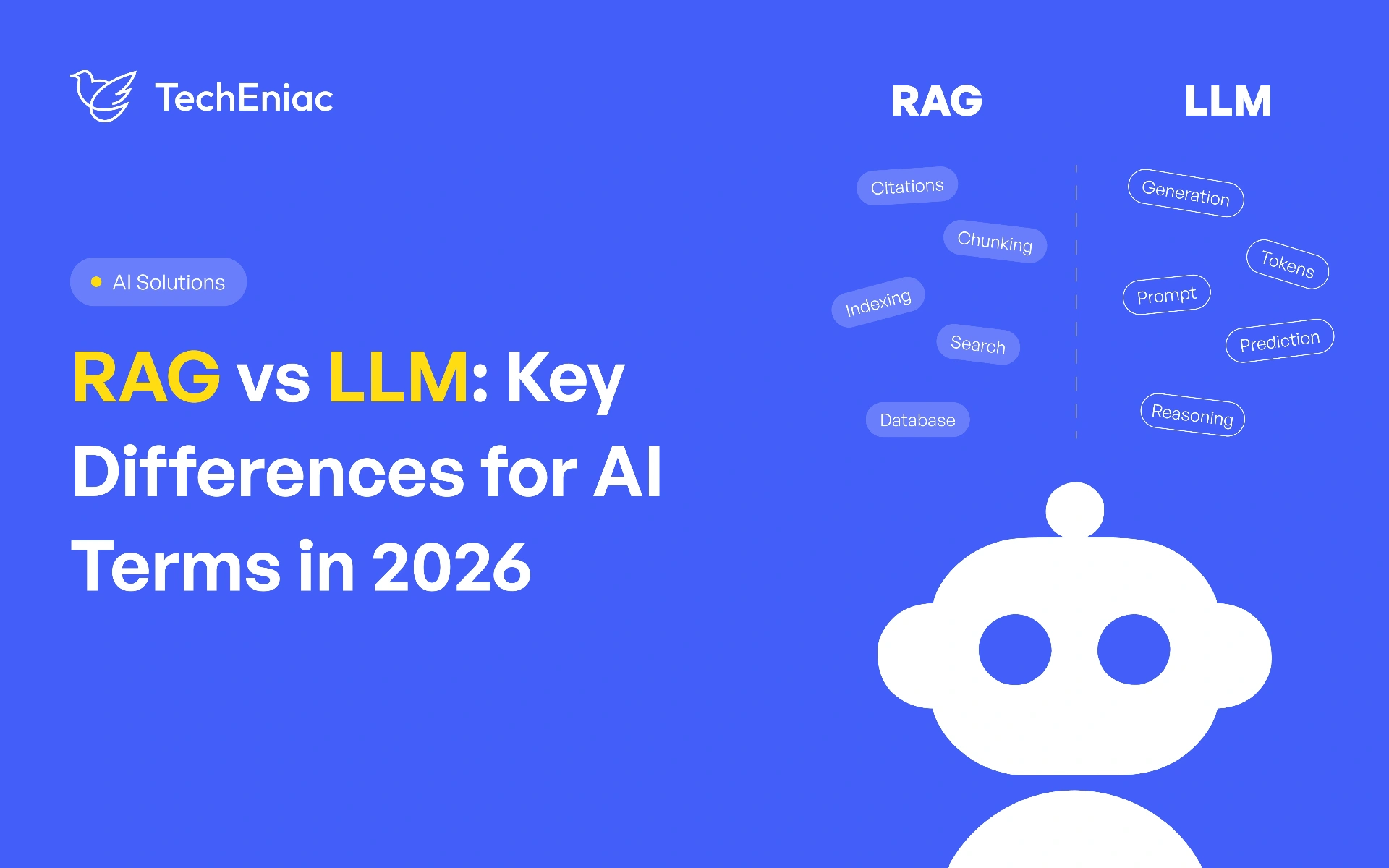
The one-liner summary: LLMs think. RAG remembers. Production AI needs both.
When to Use LLM Alone
An LLM without RAG is the right choice when the task doesn't require domain-specific knowledge from your proprietary data when the LLM's general training is sufficient.
Creative content generation works well with standalone LLMs. Blog writing, marketing copy, ad text, and social media content draw on the LLM's broad knowledge of language, style, and persuasion not on specific documents. Our generative AI development projects use GPT-4o for creative long-form content precisely because creative quality matters more than domain retrieval for these use cases.
Code generation and debugging rely on the LLM's training on millions of code repositories. General-purpose chatbots and virtual assistants that handle broad conversational queries work well without retrieval the LLM's general knowledge covers the question space. Summarization of provided text (where the user pastes the content) doesn't need retrieval because the source material is already in the prompt. Translation and language tasks draw on linguistic patterns, not domain data.
The deciding question: does the task require knowledge that lives in YOUR data? If no, LLM alone is sufficient and simpler to implement.
When to Use RAG
RAG becomes essential the moment your AI needs to answer from specific, proprietary, or frequently updated data and especially when a wrong answer has consequences.
Domain-specific Q&A is the clearest RAG use case. We built MortgageLens AI to answer mortgage compliance questions from actual lending guidelines. Without RAG, the LLM would hallucinate guideline references that sound correct but aren't a compliance violation in regulated lending.
Customer support grounded in product documentation ensures the AI answers from your actual help docs, API documentation, and troubleshooting guides not from the LLM's general knowledge about similar products. Internal knowledge management makes institutional knowledge searchable and accessible company policies, process documentation, onboarding materials without retraining the LLM every time a policy changes.
Compliance and regulatory queries require answers that are traceable to specific source documents. A compliance officer needs to verify the AI's answer against the original regulation. RAG provides the citation trail that standalone LLMs cannot.
Our RAG pipeline development service has shipped 5 production RAG systems. Across all five, the pattern holds: RAG is essential whenever accuracy matters more than creativity, when data updates frequently, or when wrong answers have consequences.
Product | Domain | RAG Accuracy | Key Metric |
|---|---|---|---|
MortgageLens AI | Mortgage compliance | 90%+ recall | 100% citation rate |
EduAssist AI | University tutoring | 94% recall@5 | 99.3% out-of-scope decline |
SolidHealth AI | Patient health | 92% retrieval | 95% medical accuracy |
ContentForge AI | Brand content | 89% recall@5 | 40+ brand profiles |
ClaimBot | Insurance claims | 87% recall@5 | 94% CMS auto-population |
When to Use Both Together
This is the section most "RAG vs LLM" articles miss. Production AI products almost always use both RAG retrieves the relevant data, and the LLM reasons over it to generate the response.
The architecture pattern that works across our 15+ products follows a clear flow: the user submits a query, the system retrieves relevant documents from the knowledge base via hybrid search (dense embeddings + BM25 keyword matching), the retrieved context is assembled with the query, the LLM generates a grounded response, and output validation checks the response for accuracy and compliance before delivery.
Model routing adds a cost optimization layer on top. Simple lookups route to a cheap model (Llama 3.3 at $0.59/1M tokens). Complex reasoning routes to a frontier model (GPT-4o at $2.50/1M or Gemini at $2.00/1M). This is how SolidHealth AI reduced inference costs by 40% 40% of queries were simple lookups that Llama handled perfectly at one-third the cost of Gemini. The remaining 60% required medical reasoning and routed to the frontier model.
Combining RAG with model routing gives you the best of both: domain-grounded accuracy from RAG + cost-efficient inference from smart routing. Neither alone achieves both.
RAG vs Fine-Tuning: The Other Comparison
People searching for "RAG vs LLM" often also want to know about fine-tuning the third option for making LLMs domain-specific.
Fine-tuning trains the model on your data. It changes the model's behavior, writing style, or domain expertise by updating its weights through additional training. This costs $5,000–$20,000 and takes 2–4 weeks.
RAG grounds the model in your data. It doesn't change the model at all it provides relevant documents as context at query time. The model's weights are unchanged, but its answers are grounded in your specific data. RAG is cheaper to build, easier to update (add documents, no retraining), and faster to deploy.
The rule of thumb we apply across our AI SaaS product development services: start with RAG, measure accuracy, and fine-tune only if RAG can't reach your accuracy target. Across 15 products, 12 use RAG without fine-tuning. The three that required fine-tuning had specific behavioral requirements consistent output formatting patterns and domain-specific language conventions that prompt engineering and RAG couldn't achieve alone.
Common Mistakes AI Teams Make
Using LLM alone for domain-specific Q&A. If the AI needs to answer from your data and you're not using RAG, you're guaranteeing hallucination. The LLM will generate plausible answers from general knowledge rather than admitting it doesn't know. Add retrieval.
Building RAG without measuring retrieval accuracy. If you don't know your recall@5 or recall@10 scores, you can't improve retrieval quality. Build an evaluation pipeline with 50–100 golden query-document pairs before you ship. We start every RAG project with the evaluation set the pipeline is built to optimize against it.
Using dense retrieval only. Embedding-based similarity search handles natural language questions well but misses exact-match queries ("Section 4.2.3.1" or "Policy BRK-2025-78432"). Add BM25 keyword matching alongside dense retrieval for hybrid search. Our mortgage product's accuracy jumped 6 points when we added hybrid search.
No "I don't know" gate. When the retrieved documents don't contain a relevant answer, the AI should decline rather than fabricate. EduAssist AI declines out-of-scope questions 99.3% of the time because one fabricated answer in an academic context destroys trust in every accurate answer that came before it.
Frequently Asked Questions
What is the difference between RAG and LLM?
An LLM is a language model trained on general internet data that generates responses from its training knowledge broad but frozen and prone to hallucination on domain-specific questions. RAG adds a retrieval step before generation the AI searches your specific documents, injects them as context, and generates a response grounded in that retrieved data. The LLM provides reasoning and generation capability. RAG provides knowledge grounding and accuracy. Production AI typically uses both together.
Can RAG work with any LLM?
Yes. RAG is provider-agnostic it works with GPT-4o, Claude, Gemini, Llama, and any other LLM. The retrieval pipeline (document ingestion, embedding, vector search) operates independently of the generation model. This means you can switch LLMs without rebuilding your RAG pipeline a provider abstraction layer lets you route to different models based on query complexity and cost.
Is RAG better than fine-tuning?
They solve different problems. RAG grounds the LLM in specific documents best for domain Q&A, compliance queries, and knowledge retrieval where data updates frequently. Fine-tuning changes the LLM's behavior best for consistent output style, domain-specific language patterns, and tasks where the model needs to adopt a specific persona. Start with RAG. Measure accuracy. Fine-tune only if RAG can't reach your target. 12 of 15 products we've shipped use RAG without fine-tuning.
How much does a RAG pipeline cost to build?
A basic RAG integration costs $15,000–$30,000 (single knowledge base, standard retrieval). A production RAG system with hybrid search, evaluation pipeline, confident refusal, and compliance architecture costs $35,000–$60,000. Ongoing costs include vector database hosting ($50–$500/month), inference ($500–$4,000/month depending on volume), and maintenance (10–15 hours/month for knowledge base updates and accuracy monitoring).
When should I use RAG vs LLM?
Use LLM alone when the task relies on general knowledge creative writing, code generation, summarization, conversation. Use RAG when the AI must answer from YOUR specific data product documentation, medical records, legal guidelines, company policies and when wrong answers have consequences. Use both together (which is what most production AI products do) when you need domain-grounded accuracy with the LLM's reasoning and generation capability.