Gartner predicts that 40% of enterprise applications will include task-specific AI agents by the end of 2026, up from less than 5% in 2025. Meanwhile, PwC's 2025 AI Agent Survey found that 79% of companies are already adopting AI agents, and 66% of adopters report measurable productivity gains.
What most of that conversation skips over is that "AI agent" isn't one thing. A rule-based bot that flags a suspicious transaction and a five-agent pipeline that coordinates an entire hospital's bed management are both, technically, AI agents and they have almost nothing in common in how they're built, what they cost, or what can go wrong with them.
We've built six multi-agent systems that are live in production today, alongside a handful of simpler agents that don't need anywhere near that complexity. This guide walks through the different types of AI agents in the order most teams should think about them from the simplest rule-based agent to fully autonomous multi-agent systems with what each one is actually good for, where it breaks down, and a real example from something we've shipped.
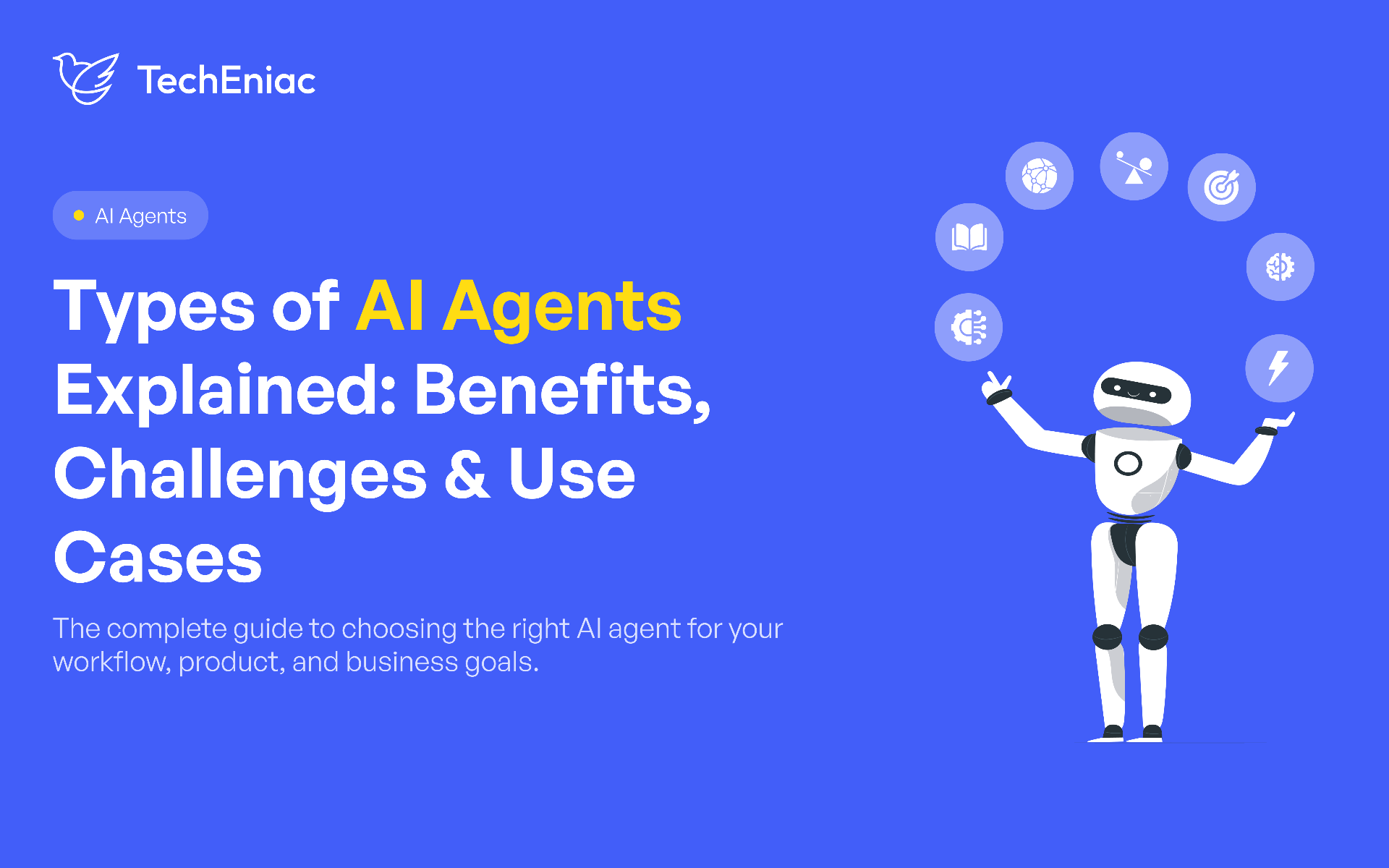
The 7 Types of AI Agents
1. Simple Reflex Agents
A simple reflex agent reacts to whatever it's looking at right now, using a fixed set of if-this-then-that rules. It has no memory of what happened a moment ago and no concept of a goal beyond the rule that just fired. This is the oldest and least complicated category of the different types of AI agents, and it's still the right choice for a large share of real problems.
How it works: the agent checks its current input against a list of predefined conditions. The moment one matches, the linked action fires. There's no internal state to update and nothing carried forward to the next decision.
Where it fits in production: we use this pattern as a guardrail layer inside bigger systems rather than as a standalone product. Inside ClaimBot, our AI insurance intake platform, a set of simple reflex checks flags obvious red flags a policy number that doesn't match any format on file, a claim date that predates the policy's start before the conversation ever reaches a more expensive reasoning step. It's the cheapest layer in the stack, and it should stay that way.
Benefits: near-instant response time, very low compute cost, and completely predictable behavior as long as the environment stays static.
Where it breaks: the moment the environment shifts in a way the rules didn't anticipate, the agent has no way to notice or adapt. It will keep applying the old rule with total confidence.
2. Model-Based Reflex Agents
A model-based reflex agent adds one thing the simple version doesn't have: a running internal picture of the world that isn't fully visible from the current input alone. It still acts on rules, but the rules now consider what the agent believes is true based on everything it's seen so far, not just this instant.
How it works: each new observation updates an internal model. The action rule then fires against that updated model rather than the raw input alone, which lets the agent handle situations where important information isn't directly observable at the moment of decision.
Where it fits in production: this is the backbone of any conversational system that needs to remember what was already said. On ClaimBot's voice and chat channels, the agent tracks what's already been collected in a claim policy number confirmed, incident date logged, photos received so it doesn't ask the same question twice or contradict something the claimant already told it three messages ago.
Benefits: handles partial visibility gracefully, keeps context across a multi-turn interaction, and produces noticeably fewer wrong or repetitive actions than a purely reactive agent.
Where it breaks: the internal model can go stale. If the underlying data changes and the agent's picture doesn't get refreshed, it starts making confidently wrong calls based on outdated context.
3. Goal-Based Agents
A goal-based agent doesn't just react it evaluates its options against a specific objective and picks the path that gets closest to it. This is where the different types of AI agents start to look less like a rulebook and more like actual reasoning.
How it works: given a defined goal, the agent considers the actions available to it, often searching or planning several steps ahead, and selects whichever sequence is most likely to reach that goal.
Where it fits in production: PatientFlow AI's bed management agent is a clean example. Given an incoming admission request, it isn't just matching a rule it's evaluating available beds against unit type, patient acuity, isolation requirements, and staffing ratios, and choosing the assignment that actually gets the hospital closer to its goal of minimizing ED boarding time.
Benefits: far more flexible than reflex-based approaches, well suited to multi-step planning problems, and every action it takes is explainable in terms of the goal it's chasing.
Where it breaks: as the number of possible actions grows, the planning step gets expensive. A goal-based agent evaluating too many options can become the slowest part of the whole system if it isn't scoped carefully.
4. Utility-Based Agents
A utility-based agent goes one step further than a goal-based one. Reaching the goal isn't enough on its own there are usually several ways to get there, and some are clearly better than others. This type assigns a value to each option and picks the one that scores highest, not just the first one that technically works.
How it works: the agent scores each candidate action against a utility function that weighs the trade-offs that matter for the situation cost, risk, speed, confidence and selects whichever option produces the best overall score.
Where it fits in production: this is exactly the logic behind model routing on SolidHealth AI. A query doesn't just need “an answer” it needs the right balance of accuracy and cost. Simple queries route to a cheaper model that scores well enough on utility for that context; complex medical reasoning routes to a more expensive model because the utility calculation shifts once accuracy risk goes up. That routing decision cut inference cost by roughly 40% with no drop in accuracy, precisely because it was weighing trade-offs instead of applying one rule to every query.
Benefits: produces genuinely optimized decisions rather than merely acceptable ones, and it's the right structure whenever a system has to balance competing priorities instead of chasing a single goal.
Where it breaks: defining the utility function honestly is hard. If the weights are wrong if cost is overweighted against accuracy, for instance the agent will optimize confidently toward the wrong outcome.
5. Learning Agents
A learning agent is built to get better at its job over time, using the outcomes of its own past decisions as training signal rather than relying entirely on rules someone wrote in advance.
How it works: a learning agent pairs a performance element, which acts on what it currently knows, with a learning element, which updates that knowledge based on feedback whether that's a labelled evaluation set, a reinforcement signal, or real usage data.
Where it fits in production: our evaluation pipeline is the clearest version of this we run. The system launched at 91% medical accuracy against a verified test set, and improved to 95% within three months not because someone manually rewrote the model, but because every drop in accuracy was traced back to a specific retrieval or prompting issue and fixed, week over week, using production feedback as the signal.
Benefits: performance improves without a developer manually rewriting the rulebook every time, and it's the only practical way to keep an agent accurate in an environment that keeps changing.
Where it breaks: a learning agent's early behavior can't be fully trusted. It needs a controlled evaluation period before it's making high-stakes calls unsupervised, and it needs a genuinely useful feedback signal bad or sparse feedback teaches it the wrong lessons just as confidently as good feedback teaches the right ones.
6. Multi-Agent Systems
A multi-agent system is what you get when several specialized agents, each responsible for one narrow piece of a larger problem, work inside a shared environment and coordinate toward an outcome none of them could produce alone.
How it works: each agent has its own role and its own decision logic. A coordinator in our stack, this is almost always LangGraph manages the sequence between them, passing state and triggering the next agent once the current one's task is complete.
Where it fits in production: TalentSync AI runs five agents across a recruiting pipeline job decomposition, resume parsing, candidate scoring, outreach drafting, and interview scheduling each doing one job well, coordinated through a shared pipeline with a human reviewing at the points where a wrong call would actually cost the client something. That structure is what gets it to 68% administrative time saved without removing the recruiter from decisions that matter.
Benefits: work distributes cleanly across specialized agents instead of forcing one model to be good at everything, the system keeps functioning if one agent's task fails or stalls, and the whole pipeline can run pieces in parallel rather than one long sequential chain.
Where it breaks: coordination itself becomes a real engineering problem. Two agents can end up claiming the same resource, disagreeing about state, or simply not handing off cleanly and debugging that requires visibility into the whole pipeline, not just one agent's output.
7. Hybrid and Autonomous Agents
A hybrid agent doesn't pick one of the six patterns above and stop there it combines rule-based guardrails, goal evaluation, utility trade-offs, and learning-based improvement inside a single system, so the agent can carry a task from start to finish with minimal handoff back to a human.
How it works: simple reflex rules typically sit at the edges, catching obvious errors cheaply. Goal and utility logic sit in the middle, handling actual decision-making. A learning loop sits underneath, continuously refining the whole system based on outcomes.
Where it fits in production: inside ClaimBot, a utility-based decision determines when a case is confident enough to resolve automatically versus when it should escalate. And the whole system improves its escalation judgment over time based on which auto-resolved claims later needed human correction. Roughly 69% of standard claims are now fully resolved without a human touching them with the remaining 31% escalated with complete context, not a dropped conversation.
Benefits: capable of owning an entire workflow rather than one narrow piece of it, which is what most founders picture when they say "AI agent" in the first place.
Where it breaks: it's the most expensive category to build well, and the temptation to reach for a fully hybrid system when a simpler agent type would do the job is one of the more common ways AI budgets get wasted.
Comparing the Types of AI Agents
Agent Type | Core Principle | Has Memory | Decides Based On | Best Fit | Watch Out For |
|---|---|---|---|---|---|
Simple Reflex | Condition → action rule | No | Current input only | Stable, fully visible environments | Breaks silently when conditions change |
Model-Based Reflex | Rules + internal state | Yes | Current input + updated model | Partially visible environments | Internal model can go stale |
Goal-Based | Actions chosen toward an objective | Sometimes | Distance to the goal | Multi-step planning tasks | Slower as options multiply |
Utility-Based | Actions scored and ranked | Yes | Weighted trade-offs | Competing priorities (cost vs. accuracy, speed vs. risk) | Utility function must be honestly defined |
Learning | Improves from feedback | Yes, continuously updated | Past outcomes + new signal | Environments that keep shifting | Needs a controlled ramp-up period |
Multi-Agent | Specialised agents, coordinated | Distributed across agents | Shared state + individual roles | Large, decomposable workflows | Coordination overhead and debugging complexity |
Hybrid/Autonomous | All of the above, combined | Yes | Rules, goals, utility, and learning together | Owning an entire workflow end-to-end | Most expensive to build well; easy to over-scope |
Common Challenges by Agent Type and What We Do About Them
Simple reflex agents fail the moment reality drifts from the rules they were written against. The fix isn't to abandon the pattern it's to keep the rule set narrow, monitor for the specific inputs it wasn't designed for, and escalate to a smarter agent type the moment volume in that category justifies it.
Model-based reflex agents can act confidently on a stale picture of the world. We treat the internal state as something to refresh aggressively, particularly in conversational products where a claim, a booking, or a record can change mid-interaction.
Goal-based agents slow down when the option space gets too wide. Narrowing what the agent is allowed to consider rather than letting it search everything is usually the fix, not adding more compute.
Utility-based agents are only as good as the trade-offs baked into their scoring. We build the utility function with the domain expert in the room, not just the engineering team, and revisit it once real usage data shows where the weights were wrong.
Learning agents shouldn't be trusted with high-stakes decisions on Day 1. Every learning agent we ship runs against a golden evaluation set before it goes anywhere near a real user, and stays on a tight human-review loop until its accuracy holds steady over weeks, not days.
Multi-agent systems run into coordination failures two agents claiming the same resource, or one waiting on state another never delivered. We handle this with explicit locking on shared resources and a shared state store every agent reads from and writes to, rather than letting agents pass information informally between themselves.
Hybrid and autonomous agents are the easiest category to over-build. Before committing to a fully hybrid system, we ask whether a simpler agent type reflex, goal-based, or a small multi-agent pipeline would actually solve the problem at a fraction of the cost.
AI Agent Use Cases by Type
Simple reflex agents: fraud rule triggers on obvious mismatches, automated alerting when a metric crosses a threshold, first-line spam or content filtering, basic FAQ deflection before a conversation reaches a real model.
Model-based reflex agents: conversational support that remembers earlier turns in the same session, claims or onboarding intake that tracks what's already been collected, monitoring tools comparing current system state against a recent baseline.
Goal-based agents: resource and scheduling optimization (bed management, appointment routing, delivery sequencing), route planning, workflow automation that needs to reach a defined end state through several steps.
Utility-based agents: model routing decisions that balance cost against accuracy, dynamic pricing that weighs margin against conversion, risk-scoring systems that trade off false positives against false negatives, portfolio or treatment recommendations with more than one “correct” option.
Learning agents: accuracy improvement loops for any production RAG or generation system, churn and demand forecasting that adapts as new data comes in, support systems that get sharper the more conversations they see.
Multi-agent systems: recruiting pipelines with parsing, scoring, and outreach as separate agents; hospital operations coordinating bed management, surgical scheduling, and discharge in parallel; compliance monitoring that decomposes a broad regulatory feed into specialized watchers.
Hybrid and autonomous agents: end-to-end claims intake and resolution, fully automated content pipelines that draft, check, and route without a human touching every step, customer-facing systems that need to both converse and complete a transaction.
If your product needs an LLM integration & development layer underneath any of these model selection, routing logic, or cost controls that decision usually gets made before the agent architecture, not after. Get the model layer wrong, and every agent type above inherits the problem.
Choosing the Right Type of AI Agent for Your Product
Most founders come to us assuming they need a fully autonomous, hybrid system, because that's what “AI agent” tends to mean in a pitch deck. In practice, roughly a third of the products we scope end up needing something closer to a goal-based or utility-based agent not the full multi-agent architecture because the underlying workflow simply isn't as decomposable as it first looks.
The honest starting question isn't “what's the most advanced type of agent we can build.” It's “what does this workflow actually require to reach a good outcome, reliably, at a cost that makes sense.” We've built everything from a single reflex-layer guardrail to six-agent production pipelines, and the right answer has never been the same twice.
If you're trying to figure out which of these types fits what you're building, our AI agent development team will walk through your actual workflow with you before recommending an architecture including telling you when a simpler agent type is genuinely the better call.