A chatbot can answer your customer's question about a late order. But what happens when you want the AI to actually check the shipment, contact the carrier, and resolve the issue without a human doing the follow-up?
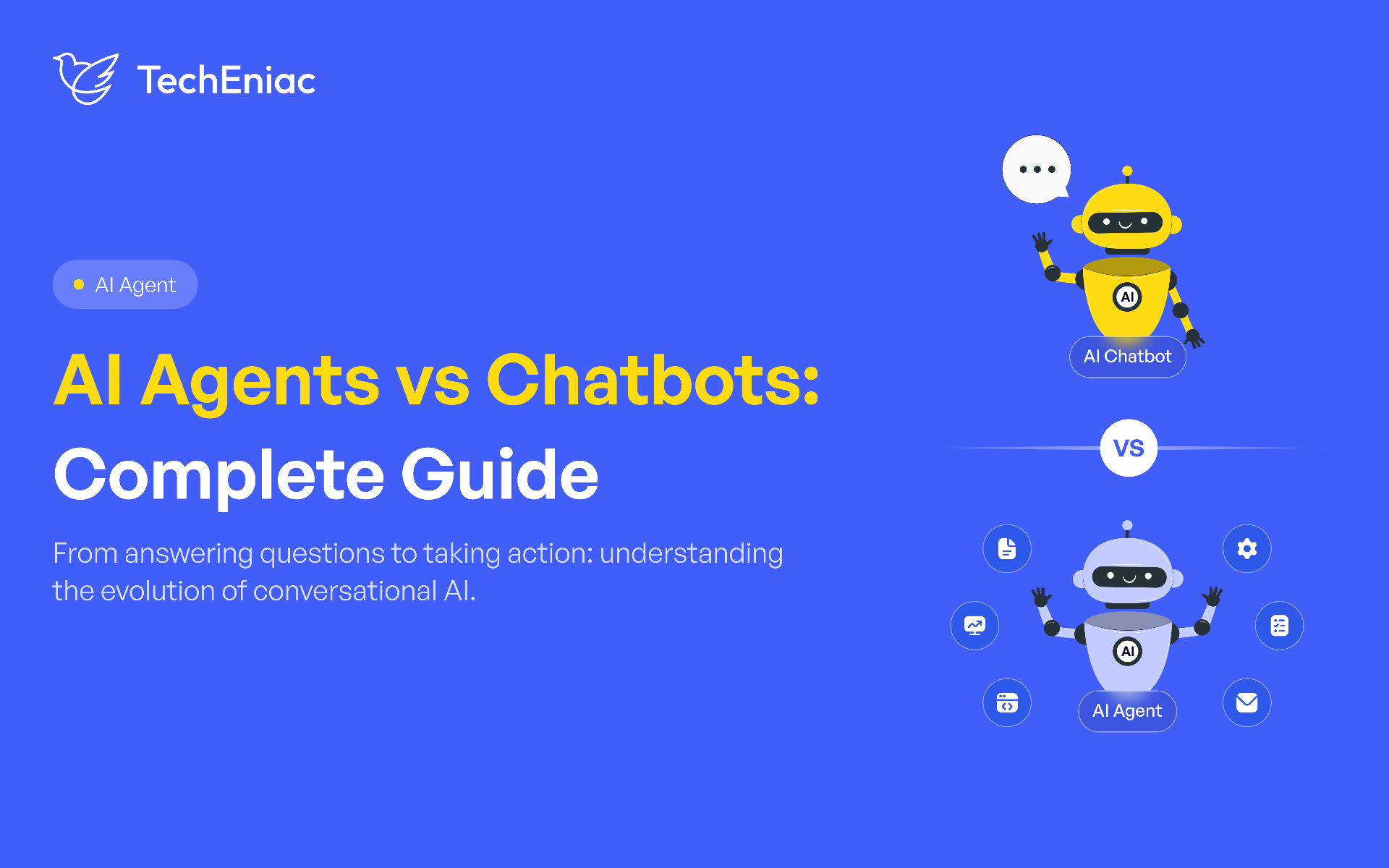
That's the real question behind "AI agents vs chatbots," and it's not a matter of one being more advanced than the other. It's a matter of what your business actually needs the system to do. Chatbots are built to communicate. AI agents are built to accomplish goals and take action. This article breaks down what separates them, where each one genuinely fits, and how to decide which one if your product needs.
What Is a Chatbot?
A chatbot is a communicative interface: a user sends a message; the system generates a response. Early chatbots were algorithmic matching keywords to recorded answers. Most modern chatbots are LLM-powered, meaning they use a large language model to understand intent and generate natural responses, often grounded in a company's own data through retrieval (so the chatbot answers from your actual documentation, not general internet knowledge).
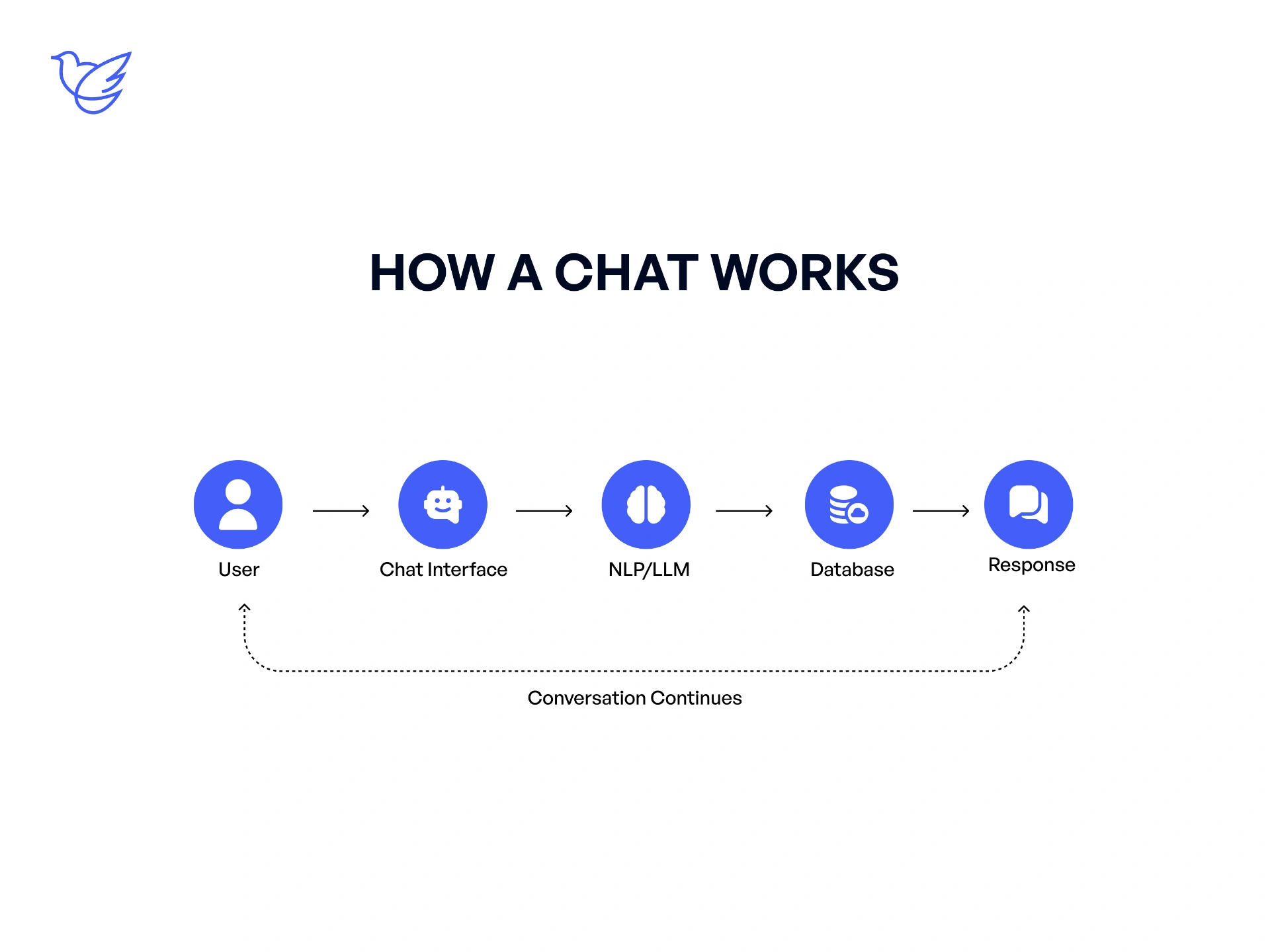
The user's message goes through natural language processing, so the system understands what's being asked, the model checks apposite knowledge or documentation, and it generates a response. The interaction typically ends there, the chatbot doesn't individually check other systems or carry out a result action.
Businesses building this kind of knowledge-grounded support experience often start with a retrieval-grounded chatbot rather than jumping straight to full automation.
What Is an AI Agent?
An AI agent is not simply a chatbot connected to a more powerful language model. It's a system built to pursue a goal: it reasons about what needs to happen, plans a sequence of steps, uses tools (APIs, databases, CRMs, internal software) to carry those steps out, evaluates whether the outcome matches the goal, and adjusts if it doesn't.
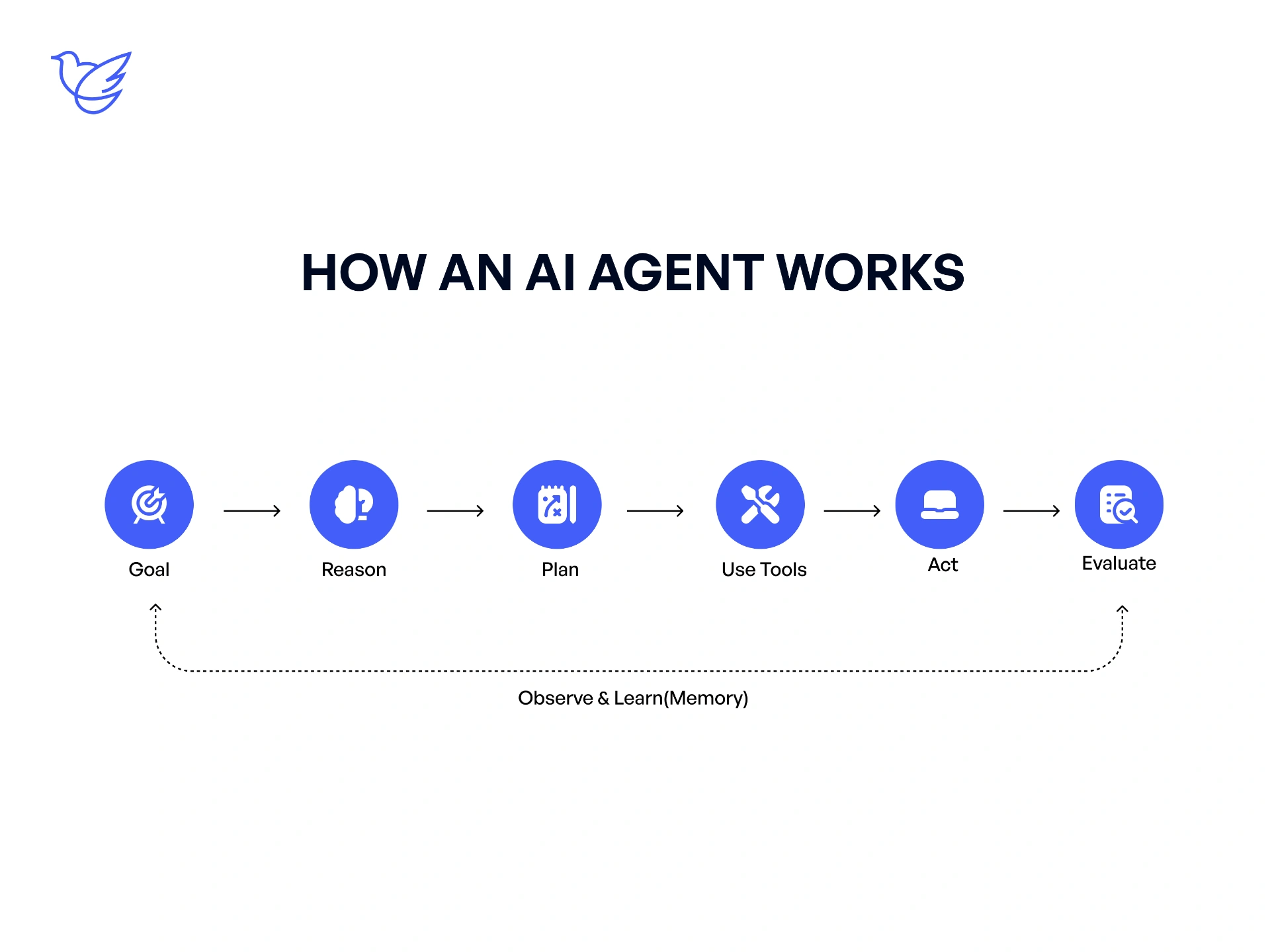
Given an objective "resolve this customer's shipping issue," the agent reasons about what information it needs, plans the steps (check order status, check carrier, determine the issue), uses the tools required to gather that information and take action, and evaluates whether the problem is actually resolved before closing the loop. If a step fails, it can replan rather than simply stopping.
Teams weighing this shift typically look into AI agent development once a workflow crosses the multi-step, tool-using threshold described above.
AI Agents vs Chatbots: The Short Answer
Aspect | Chatbot | AI Agent |
|---|---|---|
Primary purpose | Conversation | Task completion |
Interaction style | Reactive | Goal-oriented |
Autonomy | Lower | Higher |
Tool usage | Limited | Extensive |
Multi-step workflows | Limited | Strong |
Decision-making | Limited | More advanced |
Actions | Generates responses | Can execute actions |
Best suited for | Questions and conversations | Complex workflows and tasks |
Key Differences That Actually Matter
Purpose. A chatbot exists to hold a conversation. An agent exists to complete a task or reach a goal. Conversation, if it happens at all, is just the interface layer on top of that.
Autonomy. A chatbot waits for the next user's message before doing anything. An agent can execute several steps toward an objective without a person prompting each one individually.
Tool usage. Chatbots have limited or no access to external systems beyond retrieving information. Agents are built to interact directly with APIs, databases, CRMs, search systems, and other business software, which is what lets them actually change something, not just describe it.
Decision-making. A chatbot generates the most relevant response to a message. An agent selects between possible actions based on context and the current state of a task, which is a fundamentally different kind of reasoning.
Workflow complexity. Chatbots handle single-turn or simple multi-turn conversations well. Agents are built for workflows where step two genuinely depends on the outcome of step one.
Memory and context. A chatbot's memory is usually limited to the current conversation. An agent typically maintains state across an entire task, sometimes across a much longer span of time, which is part of what makes longer, multi-step work possible.
Action capability. This is the clearest dividing line. A chatbot can tell a user what their order status is. An agent can check the order, identify why it's delayed, and actually update the record or trigger the next step. That's the difference between describing a fix and performing one.
AI Agent vs Chatbot vs AI Assistant
Technology | Primary Role |
|---|---|
Chatbot | Communicate |
AI Assistant | Help |
AI Agent | Act |
These categories overlap in practice, and the industry doesn't use the terms with perfect consistency: a "virtual assistant" from one vendor might behave like a chatbot, while another company's "chatbot" might quietly include agentic capabilities. The labels matter less than understanding what a specific system can actually do.
AI Agents vs. Traditional Automation
It's worth separating agents from ordinary workflow automation, since the two get confused constantly. Traditional automation follows fixed logic: if X happens, perform Y. It's fast, cheap, and completely predictable, and for workflows that don't change, it's often the better choice. An AI agent instead starts from a goal, determines the appropriate steps given in the current situation, uses whatever tools are available, and adjusts as it goes. That flexibility is valuable exactly when the workflow varies too much for fixed rules to cover it, and unnecessary overhead when it doesn't.
Real-World Examples
Customer support. A chatbot answers "Where is my order?" with the tracking link. An agent checks the order, checks shipping status, identifies the actual issue, checks the relevant policy, opens a support ticket if needed, and communicates the resolution, not just the status.
Sales. A chatbot answers product questions from a website visitor. An agent researches a lead, qualifies it against defined criteria, checks the CRM for prior context, prepares personalized outreach, updates the CRM, and can move toward scheduling a meeting: a sequence, not a single reply.
Software development. A coding agent can inspect a codebase, identify a specific issue, modify the relevant code, run the test suite, analyze failures, iterate on the fix, and prepare the change for human review: meaningfully different from a chatbot that explains how to fix a bug in plain text.
E-commerce and healthcare administration follow the same pattern at a smaller scale: a chatbot answers a product or scheduling question, while an agent can search inventory and compare options, or handle administrative tasks like routing and documentation. In every regulated or sensitive context, healthcare especially, any agentic system needs real oversight and controls; agents accelerate a workflow, they don't replace professional judgment.
AI Agent Architecture
A production-grade agent generally follows this layered structure:
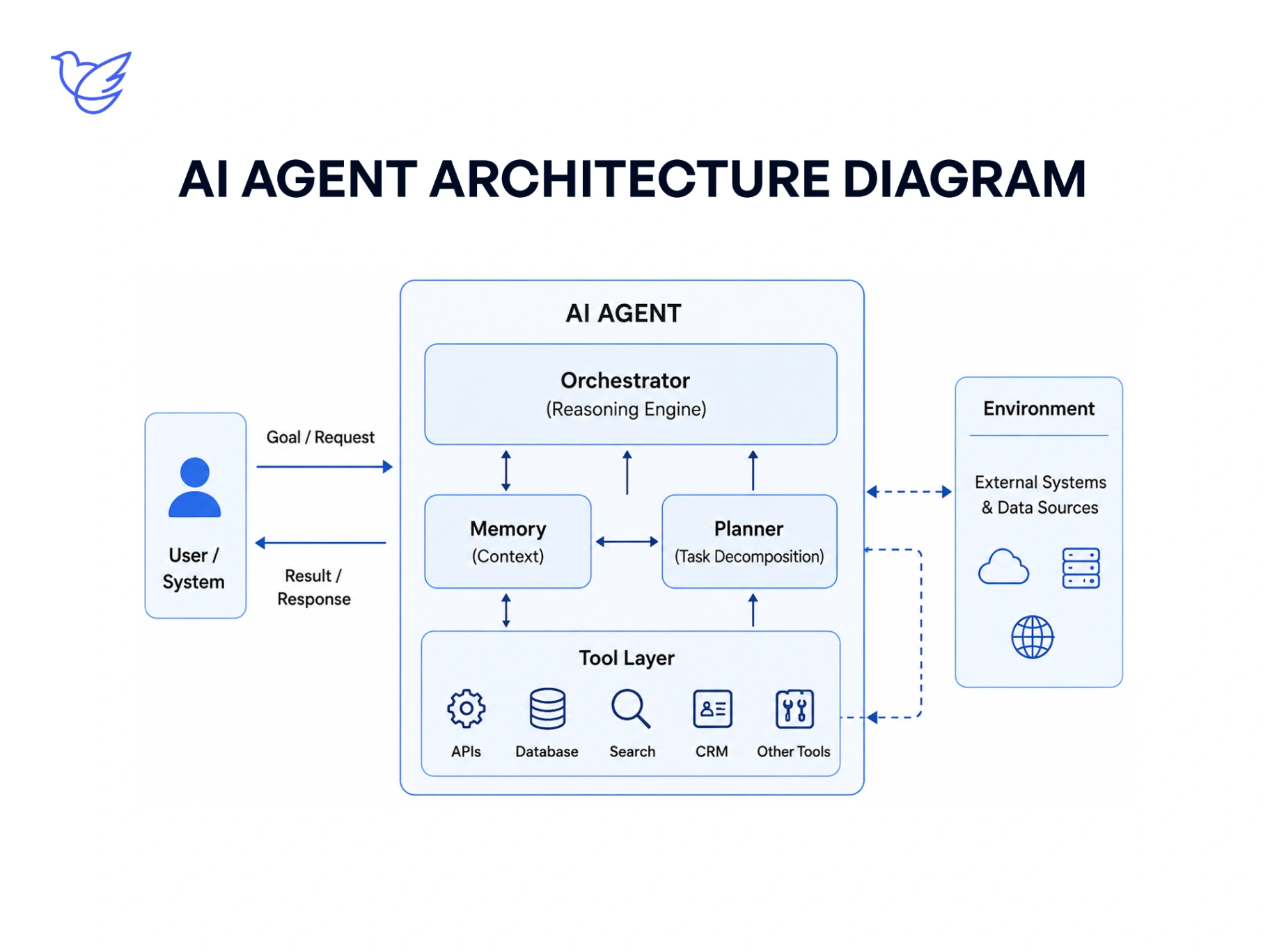
The orchestrator manages the overall flow. The reasoning and planning layer decides what needs to happen and in what order. Memory keeps track of state across the task so the agent isn't starting from zero at every step. Tool selection determines which system the agent needs to reach for a given step, and the action layer actually executes it. Evaluation checks whether the result matches the goal before the task is marked complete, and if it doesn't, the agent can replan rather than fail silently.
Types of AI Agents
Reactive agents respond to the current situation without planning ahead.
Goal-based agents work toward a defined objective, choosing actions that move closer to it.
Planning agents map out a sequence of steps in advance rather than deciding one step at a time.
Autonomous agents operate with minimal ongoing human input once a goal is set.
Multi-agent systems split a task across specialized agents that coordinate with each other, for example: Manager Agent → Research Agent → Analysis Agent → Writer Agent → Final Output.
Multi-agent systems add real coordination complexity, and they're worth it only when genuine specialization (different tools, different reasoning, different data access per agent) improves the outcome. Splitting a simple task across five agents for its own sake usually just adds failure points.
AI Agent Use Cases
Category | What the Agent Actually Does |
|---|---|
Customer support | Diagnoses an issue across systems and resolves or escalates it with context |
Sales automation | Qualifies leads and prepares outreach using CRM and research data |
CRM automation | Keeps records current based on actions taken elsewhere in a workflow |
Research & data analysis | Gathers and synthesizes information from multiple sources toward a specific question |
Document processing | Extracts, verifies, and routes information from unstructured documents |
Internal operations | Handles multi-step administrative tasks that currently require manual coordination |
Software development | Inspects, modifies, tests, and iterates on code changes |
SaaS operations | Monitors usage or billing systems and takes defined actions when thresholds are met |
When Should You Use a Chatbot?
Use a chatbot when the job is answering questions well: FAQs, product information, knowledge retrieval, basic support, lead capture, general website assistance. Don't build an AI agent when a well-grounded chatbot already solves the problem; the added complexity buys you nothing if every interaction ends with an answer, not an action.
If that's the case, focused chatbot development is usually the faster, cheaper path to a solid outcome.
When Should You Build an AI Agent?
Consider an agent when the workflow involves multiple steps, decisions that depend on real-time context, integration with external tools or business systems, and an outcome that requires something to actually change, not just be explained.
Do You Really Need an AI Agent?
The best architecture isn't the most sophisticated one. It's the one that solves the problem reliably and efficiently.
Choose a chatbot when: Question → Answer
Consider an AI assistant when: Question → Assistance
Consider an AI agent when: Goal → Reason → Plan → Tools → Action
How to Choose: A Decision Framework
Ask, in order:
Does the system primarily need to answer questions?
Does it need to perform actions?
Does it need to complete multiple steps?
Does it need external tools or APIs?
Does it need to make contextual decisions?
Does the right next step change depending on the situation?
If you're mostly answering "no" past the first question, a chatbot covers it. The more "yes" answers stack up, especially around tool access and multi-step decisions, the stronger the case for an agent.
The Future: From Answering to Assisting to Acting
The broader trajectory is fairly clear: AI systems are moving from answering questions, to assisting with tasks, to acting on them directly. Conversational interfaces are likely to become the front end for increasingly agentic workflows, running underneath a chat window that quietly triggers a multi-step process instead of just returning text. How fast that shift plays out varies by industry and use case, and it's worth treating specific timelines or market-size predictions with skepticism until they're backed by real data.
Conclusion
Chatbots are built primarily for conversation. AI agents are built to accomplish tasks. Neither is essentially superior. The right choice depends entirely on whether your workflow needs a precise answer or an accomplished action.
If you're unsure whether your product needs a chatbot, an AI assistant, or a full AI agent, that's a scoping question worth answering before any development starts. TechEniac works with SaaS founders and product teams to evaluate the actual workflow, the tools it needs to touch, and the right architecture for it: chatbot, agent, or a combination of both.