Quick Summary
AI Agents for Real Estate: Why This Technology Is Reshaping the Industry
Picture a buyer messaging a brokerage at eleven at night asking about a listing's flood history, financing options, and whether the seller might negotiate. No agent is awake to answer. By morning, three other buyers have already toured similar homes. This is the exact gap AI agents are built to close, and it explains why real estate has quietly become one of the fastest moving sectors in applied AI.
The scale of this shift is not subtle. The global AI in real estate market reached $301.58 billion in 2025 and is projected to climb to $404.9 billion in 2026, a growth rate of 34.3%, with the market expected to reach $1.3 trillion by 2030. Growth on this scale rarely comes from a single flashy feature. It comes from AI agents quietly taking over the repetitive, time-sensitive work that used to require a human to be online, available, and paying attention around the clock.
This guide breaks down exactly what these agents are, the technology and components behind them, and how a real estate business can build and benefit from one.
Types of AI Agents in Real Estate Industry
AI agents in real estate are not built on a single technology. They combine several distinct types of AI agents, each doing a different job.
Machine learning models. Power prediction-based tasks such as automated property valuation, rental yield forecasting, and identifying which leads are most likely to convert. These models learn from historical sales data, property characteristics, and market indicators, growing more accurate with every new data point.
Natural language processing. Allows an agent to understand a buyer's question, extract intent from a messy conversational message, and generate a clear, human-sounding response. This is what makes a chatbot feel like it understands a request, rather than just matching keywords.
Computer vision. Processes property images, floor plans, and video walkthroughs, extracting details like room count, condition, and layout. It increasingly powers virtual staging and automated listing photo enhancement as well.
Predictive analytics. Looks beyond a single property to forecast broader trends: price movement in a neighbourhood, seasonal demand shifts, and the likelihood of a specific listing selling within a target window.
Generative AI. Creates the actual content an agent produces listing descriptions, personalized email responses, market summary reports, and increasingly, video and virtual tour narration.
Individually, each of these is useful. Combined inside a single AI agent architecture, they become something closer to a digital team member one that can perceive a situation, reason about it, and act.
Scenarios Where AI Agents Can Be Used in Real Estate
AI agents show up across nearly every stage of a real estate business, not just customer-facing chat.
A buyer browsing listings at midnight gets an instant, accurate answer instead of waiting until business hours.
A property manager gets an early warning that an HVAC (Heating, Ventilation, and Air Conditioning) unit is likely to fail before a tenant ever files a complaint.
A leasing team's rent renewal notices, application screening, and lease documentation move through automatically instead of sitting in someone's inbox for a week.
An investor evaluating twelve properties gets a ranked comparison of projected returns in minutes instead of days of manual spreadsheet work.
A brokerage's marketing team gets listing descriptions and social content generated the moment a property is added to the system, instead of waiting for a copywriter's availability.
None of these scenarios require replacing a human. Each one removes a specific bottleneck where speed, availability, or repetitive volume was the actual constraint.
Why Use AI Agents in Real Estate: The Importance of Acting Now
The case for adopting AI agents in real estate is no longer theoretical, and the data reflects a level of urgency that is easy to underestimate. Nearly all real estate professionals 97% now show active interest in using AI, a dramatic shift from the widespread scepticism that defined the industry just a few years ago. Firms actively deploying AI for lead generation and follow-up are seeing the payoff directly, reporting increases in lead volume of up to 300% and conversion rate gains of around 40%.
The accuracy gains are just as significant. AI-powered valuation models now achieve error rates as low as 2.8%, compared with 10% to 15% only five years ago a level of precision that changes how confidently a business can price a property without waiting on a full manual appraisal. Morgan Stanley estimates AI could deliver roughly $34 billion in efficiency gains to the real estate industry over the next five years alone.
Investment intent backs this up. Deloitte's research found that 72% of real estate firms globally plan to increase their AI investment by 2026, and adoption is no longer confined to early experimenters. A 2025 survey found that 87% of brokerage leaders report that agents in their firms are already using AI tools in some form. The businesses treating this as optional are, in effect, competing against firms that have already automated their slowest, most repetitive processes.
Key Components of an AI Agent for Real Estate
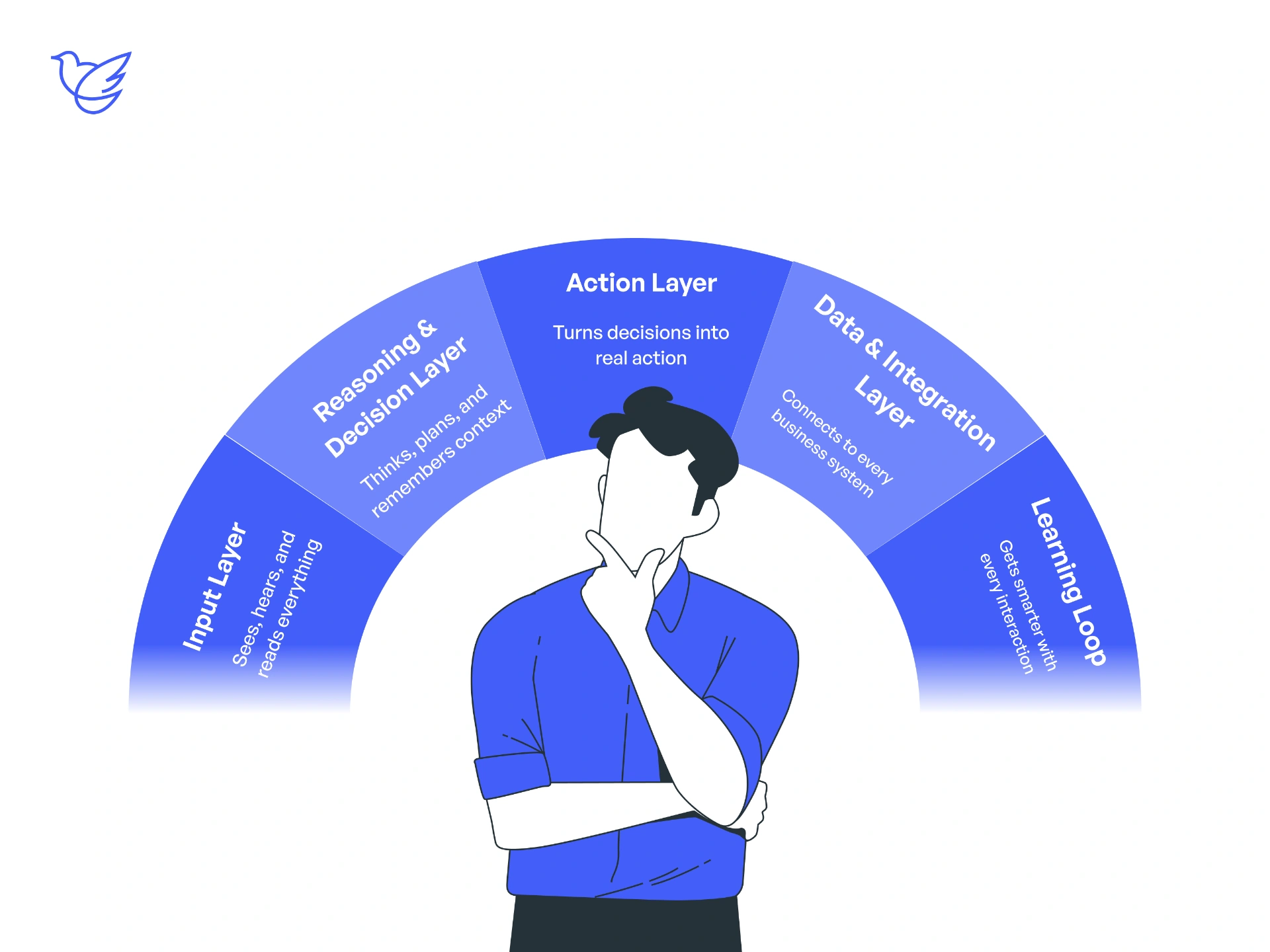
Every AI agent, regardless of how it is branded, is built from the same underlying architecture. Understanding these pieces makes it much easier to evaluate or commission one.
Input layer. This is how the agent perceives its environment. In real estate, that means voice queries from clients, text from emails and chat messages, and visual input such as property photos, floor plans, and virtual tour footage. The quality of an agent's output is only ever as good as what flows in through this layer.
Reasoning and decision layer, often called the brain. This is where the agent processes what it has perceived. It typically includes a profiling module that defines the agent's role and scope, a memory module that retains context from past interactions so a returning client does not have to repeat themselves, a knowledge module holding market data, legal requirements, and property details, and a planning module that decides the sequence of steps needed to complete a task, such as valuing a property or qualifying a lead.
Action layer. This is where reasoning turns into real work: sending a personalized follow-up message, updating a CRM record, generating a valuation report, scheduling a viewing, or drafting a lease renewal notice.
Data and integration layer. An agent is only useful if it can pull from and write back to the systems a real estate business runs on: MLS feeds, CRM platforms, property management software, and public records. Disconnected, siloed data is the single most common reason an otherwise well-built agent underperforms. Getting this integration layer right is often the hardest part of the build, which is where dedicated integrating with existing systems expertise matters most.
Learning loop. The strongest agents improve with use, refining lead scoring, valuation accuracy, and response quality based on outcomes and corrections rather than staying static from the day they launch.
How to Use AI Agents in Real Estate
Using an AI agent effectively is less about flipping a switch and more about matching the right agent type to the right task.
A conversational agent handles the first response to buyer and renter inquiries, day or night.
A valuation agent runs comparable sales analysis the moment a new listing is entered, giving an agent a defensible starting price in minutes.
A screening agent processes rental applications, cross-checking credit and rental history against a business's own criteria.
A marketing agent drafts listing copy, social captions, and email campaigns as soon as a property goes live.
A portfolio agent continuously tracks an investor's holdings, flagging properties that are underperforming their local market.
The common thread across all of these is that a human stays in the loop for judgment calls, negotiation, and relationship building, while the agent absorbs everything that is repetitive, time-sensitive, or simply too slow to do manually at the volume the business needs.
Steps to Build an AI Agent for Real Estate
Building a real estate AI agent that performs in production follows a consistent sequence.
Step 1: Define the Scope Precisely
Decide exactly what the agent needs to do whether that is a buyer-facing chatbot, an automated valuation tool, a leasing assistant, or a combination and set measurable success metrics such as lead conversion uplift or reduction in valuation error.
Step 2: Choose the Right Underlying Model
Select a large language model based on reasoning quality, latency needs, and cost, and decide whether a hybrid setup a smaller model for simple routing paired with a larger model for complex reasoning makes sense for the workload.
Step 3: Collect and Prepare Real Estate-Specific Data
Pull together MLS listings, CRM history, public property records, and client interaction logs, then clean and standardize this data so the model can use it reliably.
Step 4: Adapt the Model to the Domain
Fine-tune or ground the model using retrieval-augmented generation so it understands real estate terminology, local regulations, and the specific tone a brokerage wants to use with clients.
Step 5: Build the Agent Architecture
Construct the input, reasoning, and action modules as a connected system, with memory that persists across a client's interactions rather than starting fresh every conversation.
Step 6: Add Natural Language Understanding
Train the agent to correctly extract real estate-specific entities property type, budget, location, lease terms and to recognize what a client is asking for, not just the literal words used.
Step 7: Connect to Real Business Systems
Integrate the agent with the CRM, MLS feed, and property management software it needs to read from and write back to, since an agent that cannot act on its own conclusions is only half built.
Step 8: Test Rigorously Before Launch
Validate valuation accuracy against real sales data, check for bias in recommendations, and run a small pilot before rolling the agent out across an entire portfolio or client base.
Step 9: Monitor and Refine Continuously
Track real outcomes lead-to-close ratio, response accuracy, client satisfaction and use that feedback to keep improving the agent rather than treating launch day as the finish line.
Applications and Use Cases of AI Agents in Real Estate
The breadth of what AI agents already handle in real estate is genuinely wide.
Property valuation and dynamic pricing. Automated valuation models analyse recent sales, property features, and market shifts to produce real-time, defensible price estimates.
Customer service and virtual assistance. Conversational agents answer listing questions and schedule viewings around the clock, no longer limited by office hours.
Personalized property matching. Agents learn a client's budget, location preference, and must-have features to surface listings that fit, rather than showing every client the same generic search results.
Predictive maintenance for property managers. By analysing sensor and maintenance history data, agents flag likely equipment failures before they become expensive emergencies.
Tenant screening. Applications, credit reports, and rental history are processed automatically, flagging risk factors for a human to review rather than requiring manual cross-checking from scratch.
Lease management. Renewals, rent adjustments, and compliance monitoring run on autopilot, reducing the administrative load on property management teams.
Marketing and content generation. Listing descriptions, social captions, and even short video content are generated the moment a property is added to a system.
Fraud detection. Agents scan for anomalies such as duplicate ownership claims or suspicious buyer behaviour that a manual review process would likely miss.
Investment and portfolio analysis. Agents model rental yield, cash flow, and return scenarios across an entire portfolio, giving investors a continuously updated view instead of a quarterly spreadsheet.
Transaction and document automation. Contracts, disclosures, and compliance paperwork move through an automated review and generation pipeline, cutting the time a deal spends stuck in administrative limbo.
Key Benefits of AI Agents in Real Estate
The benefits of AI agents in real estate cluster around a few consistent themes that show up across nearly every deployment.
Around-the-clock availability. An agent never sleeps, meaning a client's question gets answered the moment they ask it, not the next business day.
Handling volume without degrading quality. A single AI agent can process hundreds of simultaneous inquiries with the same accuracy as the first one, something no human team can match at scale.
Sharper personalization. By learning from a client's actual behaviour and stated preferences, agents surface properties and recommendations that genuinely fit rather than generic top results.
Faster, more confident decisions. With valuation accuracy now reaching error rates as low as 2.8%, teams can move on pricing and investment decisions with far more confidence than manual estimates allowed just a few years ago.
Meaningful time savings on administrative work. Scheduling, document generation, and follow-up messaging move off a person's plate entirely, freeing agents and property managers to focus on negotiation and relationship building the parts of the job that require a human.
Stronger lead quality and conversion. Firms using AI for lead generation and follow-up report gains of up to 300% in lead volume and around 40% in conversion rates numbers strong enough to fund further AI investment on their own.
Better compliance and risk management. Automated fraud detection and document review reduce the chance of a costly error slipping through a manual process.
If your brokerage or proptech platform is exploring which of these use cases would deliver the fastest return, this is usually the right place to start scoping a pilot before committing to a full build. Talk to our AI agent development team about what a focused first deployment could look like for your specific workflow.
The Future of AI Agents in Real Estate
The next few years look less like incremental improvement and more like a structural shift in how real estate operates. Agentic AI systems agents capable of carrying out multi-step tasks with minimal human oversight are expected to reach mainstream use between 2026 and 2027, enabling largely automated transactions and property management rather than agents that simply answer questions.
The scale of this shift is reflected in where the market is heading. Continued growth toward a $1.3 trillion global market by 2030 signals that AI is moving from a competitive edge to standard infrastructure across the industry. Some industry projections go further still, suggesting that by 2028 to 2030, a significant majority of tasks traditionally handled by real estate agents in the range of 60% to 80% could be automated or AI-driven in some form.
This does not point toward agents disappearing from the industry. It points toward their role changing. The repetitive, administrative, and time-sensitive work scheduling, valuation, document review, initial client response is what agentic AI absorbs first. What remains negotiation, trust building, and judgment calls that depend on reading a room or a relationship is exactly the part of the job that continues to require a human, just with far less noise competing for their attention.
How TechEniac Helps Build AI Agents for Real Estate
Most real estate businesses do not struggle with recognizing the opportunity in AI agents. The real bottleneck is technical: integrating an agent cleanly with an existing MLS feed, CRM, and property management stack, while making sure the model's outputs are accurate enough to trust.
At TechEniac, our engineering teams work directly with product and business leaders through AI agent development, building agents that go beyond a simple chatbot demo into systems that reliably connect to real data sources, learn from real outcomes, and hold up under production traffic. For real estate platforms and proptech founders building a broader product around this capability, our AI SaaS product development work focuses on architecting the full platform, not just the agent sitting on top of it, so the system scales cleanly as your user base and data volume grow.
Key Takeaways
AI agents in real estate combine machine learning, natural language processing, computer vision, and generative AI into a single system that can perceive a situation, reason about it, and act.
Adoption is no longer experimental. Investment intent, lead conversion gains, and valuation accuracy improvements are already well documented across the industry.
Every AI agent shares the same core architecture: an input layer, a reasoning layer, an action layer, and a data integration layer connecting it to real business systems.
Building a reliable agent depends far more on clean data and solid system integration than on the underlying model itself.
The clearest benefits show up in availability, lead conversion, valuation accuracy, and time saved on administrative work.
Agentic AI is expected to reach mainstream use in real estate by 2026 to 2027, absorbing the repetitive parts of the job while leaving negotiation and relationship building to people.
AI agents are not replacing real estate professionals. They are replacing the version of the job that involved manually doing what an agent can now do faster and around the clock.