
Healthcare Software Development
Your clinical teams work across disconnected systems. Your administrative teams spend hours moving information between platforms. Your patients expect digital experiences that healthcare systems often struggle to provide.
This isn't simply a technology problem. It's a workflow problem.
Healthcare software should fit the way clinicians, administrators, patients, and healthcare organizations work.
TechEniac builds secure, HIPAA compliant healthcare software for hospitals, clinics, and health tech companies across the United States from EHR systems and patient-facing platforms to healthcare integrations and AI agents supporting clinical and administrative workflows.
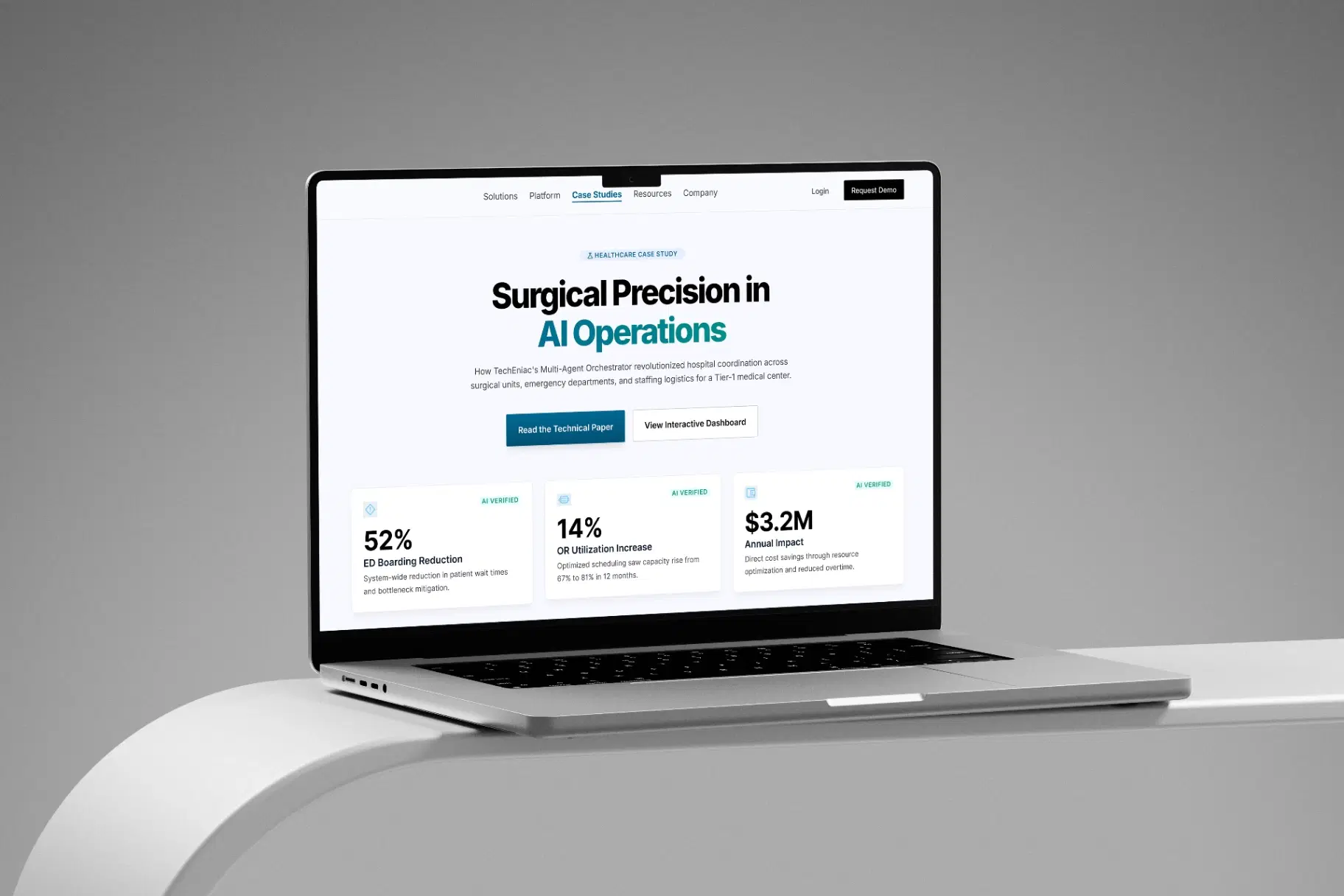
We've built healthcare AI agents across four hospitals and more than 800 beds that delivered measurable operational outcomes.
The goal isn't to add more technology. It's to make healthcare workflows work better.
0%
Reduction in emergency department boarding
0%
Increase in operating room utilization
0%
Reduction in discharge delays
What's Holding Healthcare Teams Back?
Five patterns show up again and again across hospitals, clinics, and health tech companies we work with.
Disconnected Systems Create Fragmented Workflows
EHRs, laboratory systems, pharmacy platforms, billing systems, scheduling tools, and patient platforms often need to exchange information. When they don't communicate reliably, staff compensate manually - information gets re-entered, teams switch between applications, and administrative work increases across the whole organization.
Manual Administrative Work Consumes Clinical Capacity
Data processing, information routing, notifications, documentation support, appointment communication, and administrative follow-ups all create workload that doesn't require clinical judgment. The more fragmented the workflow, the more time teams spend moving information instead of acting on it.
Legacy Healthcare Platforms Become Harder to Scale
Architecture that worked at an earlier stage struggles as users, integrations, data, and functionality increase - new integrations become difficult, performance grows inconsistent, and maintenance gets expensive. Replacing the entire platform isn't always the right answer.
Healthcare AI Has Less Room for Error
An incorrect response in a general business application may be inconvenient; an incorrect statement inside a patient's clinical workflow can create serious risk. Healthcare AI needs reliable data, appropriate grounding, defined workflows, evaluation, and clear boundaries around where humans stay responsible.
Security and Compliance Cannot Be Added at Launch
HIPAA requirements, access controls, audit logging, encryption, data handling, vendor considerations, and ongoing risk analysis all need to influence the system from the beginning - security can't be a final-stage checklist.
What Happens When Healthcare Software Handles the Routine?
Instead of staff manually moving information between systems, what if healthcare software could automatically route data to the right workflow?
Instead of teams repeatedly searching through disconnected information, what if AI could retrieve relevant organizational or patient information and provide grounded answers?
Instead of healthcare organizations replacing legacy platforms completely, what if existing systems could be modernized and connected through a stronger architecture?
The opportunity is not to automate everything. It's to automate the right things.
Clinical Operations Impact
Reduce emergency department boarding
Improve operating room utilization
Reduce discharge delays
Support clinical documentation workflows
Make relevant information accessible within existing workflows
Administrative Impact
Reduce repetitive manual processes
Automate information routing and notifications
Improve patient communication
Reduce fragmented data entry
Give administrative teams more time for higher-value work
Technology Impact
Connect EHRs, laboratories, pharmacies, billing platforms, and other systems
Modernize legacy healthcare applications
Improve application performance and scalability
Build secure healthcare SaaS platforms
Introduce AI where it creates measurable value
Purpose-Built Software for Healthcare
From EHR systems to healthcare AI agents, we build software around how your clinical and administrative teams actually work.
We build custom healthcare software around specific clinical, administrative, and operational workflows, with HIPAA compliance and patient data security built into the development process. From workflow automation and provider portals to patient management systems and specialty-specific applications, we design software around how your team works.
We develop and customize electronic health record and electronic medical record solutions for healthcare organizations with specialized workflow requirements - supporting patient records, clinical documentation, and other healthcare workflows, so relevant clinical information stays accessible within the workflow instead of forcing providers across disconnected systems.
We develop healthcare applications for patients, providers, administrators, and other stakeholders - supporting appointment management, patient communication, telehealth workflows, health records, provider access, remote services, and administrative processes, built around the underlying workflow, integrations, security requirements, and expected user volume.
We integrate EHRs, laboratory systems, pharmacy platforms, billing systems, and other healthcare applications using interoperability standards such as HL7 and FHIR, creating reliable data flows and reducing manual data entry, fragmented information, and disconnected workflows.
We develop healthcare AI for clinical documentation, information retrieval, workflow automation, patient communication, operational forecasting, and decision support - using approaches such as RAG to keep AI systems grounded in verified organizational or patient data.
We build AI-powered chatbots and virtual assistants for patient FAQs, appointment-related communication, information retrieval, administrative support, and internal knowledge access - designed around appropriate data access, grounding, and security for sensitive or organization-specific information.
We build automation that connects healthcare applications and streamlines repetitive workflows - data processing, notifications, information routing, documentation support, and administrative tasks - reducing operational friction without forcing teams to redesign the workflows they already depend on.
We take healthcare products from architecture through production, helping founders validate focused MVPs before investing in larger platforms - building software that can operate securely, integrate with healthcare systems, and scale as adoption grows.
We help healthcare organizations modernize legacy systems, improve application architecture, address technical debt, optimize performance, and prepare platforms for increased usage - because sometimes the smarter solution is to modernize what already works rather than replace it.
What You Can Actually Build
Four use cases we build repeatedly for hospitals, clinics, and health tech companies.
Core Use Cases
Situation
Clinical teams spend time moving information between systems and completing repetitive administrative steps.
Solution
Build automation that routes information, triggers workflows, supports documentation, and connects existing systems.
Outcome
Less manual work, fewer disconnected steps, and more time for clinical activities.
Situation
Healthcare information exists across organizational systems and documents, making relevant information difficult to retrieve quickly.
Solution
Build grounded AI retrieval using verified organizational information and RAG-based workflows where appropriate.
Outcome
Faster access to relevant information without relying on unsupported AI-generated answers.
Situation
Patients and staff repeatedly exchange information about appointments, FAQs, administrative requirements, and routine communication.
Solution
AI-powered patient communication and virtual assistants handle appropriate repetitive interactions while escalating situations that require human involvement.
Outcome
Faster communication and reduced administrative workload.
Situation
EHR, laboratory, pharmacy, billing, and other systems operate independently.
Solution
Connect systems using APIs and healthcare interoperability standards such as HL7 and FHIR.
Outcome
More reliable data flows, less manual entry, and fewer disconnected workflows.
From Healthcare Idea to Production
Discovery and Workflow Assessment
We start with the healthcare problem rather than the requested technology - understanding users, clinical or administrative workflow, existing systems, data sources, and compliance requirements, so we know what should actually be built.
Architecture and Technical Strategy
We define system architecture, integrations, data flows, security model, AI requirements, technology stack, and interoperability requirements - deciding what should be custom built, what should integrate with an existing system, and where simpler technology may be more appropriate than AI.
Product Development
Our engineering team builds the product in defined development cycles, with working software available for review rather than waiting until the end of the project. AI capabilities are developed and evaluated as part of the product, not added as an afterthought.
Testing and Validation
Healthcare software requires more than standard functional testing - we evaluate AI accuracy and hallucination behavior, edge cases, security, access controls, integration reliability, performance, and workflow behavior.
Production Deployment and Scaling
Once the platform is ready, we support production deployment and the infrastructure required to operate it reliably - continuing to support performance optimization, new integrations, technical debt reduction, and platform scaling as usage grows.
What Healthcare Software Should Actually Improve
The right healthcare software should be measured by what changes after implementation, not simply by how many features were shipped.
Clinical Efficiency
Software can reduce operational bottlenecks and give clinical teams faster access to relevant information - our healthcare deployments demonstrated a 52% reduction in emergency department boarding.
Resource Utilization
Better software helps organizations make better use of expensive clinical resources - our healthcare AI deployments demonstrated an 81% increase in operating room utilization.
Faster Patient Flow
Operational bottlenecks delay discharge and create downstream capacity problems - our deployments demonstrated a 71% reduction in discharge delays.
Administrative Efficiency
Automation reduces repetitive information processing, routing, notifications, and documentation support. The objective isn't just fewer manual steps - it's more capacity for higher-value work.
Scalability
Healthcare platforms need to support increasing patient volumes, users, integrations, and data without proportional increases in operational complexity - architecture decisions made early determine how well the system scales later.
Production-Grade Technology for Healthcare
Healthcare software needs more than a functional interface - it needs an architecture capable of handling sensitive information, interoperability requirements, AI workloads, integrations, security controls, and production scale.
AI Layer
LLMs and specialized AI models selected according to the specific healthcare workflow and risk profile.
RAG & Knowledge Layer
Grounds AI responses in verified organizational or patient information where appropriate - hallucinations aren't acceptable in a clinical workflow.
AI Orchestration
Stateful workflows for multi-step healthcare processes, with defined escalation points back to a human.
Data Layer
Secure handling of healthcare information and structured data sources.
Integration Layer
APIs and interoperability standards such as HL7 and FHIR for connecting EHRs, laboratories, pharmacies, and billing platforms.
Application Layer
Patient, provider, administrator, and operational applications designed around specific workflows.
Infrastructure
Secure cloud or on-premises deployment environments with monitoring, logging, and access controls.
Monitoring
Application, infrastructure, and AI monitoring to catch performance, reliability, and model-related issues early.
Why This Architecture Matters
Works with existing healthcare systems instead of operating as a disconnected demonstration.
Protects sensitive information at every layer, not just at the perimeter.
Maintains reliable data flows between EHRs, labs, pharmacy, and billing systems.
Supports real clinical and administrative workflows, not idealized ones.
Provides appropriate AI grounding and allows human oversight where required, while still scaling as usage grows.
Security Built for Healthcare from Day One
Security cannot be treated as a final-stage requirement or pre-launch checklist - it needs to influence the architecture, data flows, access controls, integrations, and workflows from the beginning.
Data Encryption
Connections carrying patient information use TLS 1.2 or higher, while databases, backups, caches, and AI embedding stores are encrypted using industry-standard approaches.
Role-Based Access Control
Access is scoped to a user's role and responsibilities - everyone gets the minimum access required for the work they need to perform.
Audit Logging
Access to protected health information is logged to create a reviewable trail of who accessed information, when, and what action was taken.
Business Associate Agreements
Vendors that handle patient data, including cloud infrastructure and AI providers, are evaluated for appropriate BAA requirements.
Continuous Risk Analysis
Healthcare security isn't a one-time pre-launch exercise - risk analysis stays part of the development and operational process.
Why Healthcare Organizations Choose TechEniac
We Measure Outcomes, Not Just Features
A software project shouldn't be judged by how many screens were delivered - we focus on the operational or clinical problem the software is expected to improve.
We're Engineers First
Our recommendations are grounded in what can actually be built, integrated, secured, maintained, and scaled in production.
We Understand the Stakes of Healthcare AI
An incorrect AI response in a healthcare workflow carries different consequences than one in a low-risk business application - our architecture and evaluation approach reflects that difference.
We Build for Long-Term Scale
We consider future patient volume, system integrations, data requirements, and interoperability when making architecture decisions.
We Work Directly with Your Team
TechEniac works directly with founders and clinical leaders from the initial architecture discussion through production, rather than separating strategy from engineering execution.
We Don't Add AI Where It Doesn't Belong
AI is powerful, but it isn't always the right solution - when simpler, more deterministic software is more reliable for a healthcare workflow, that's the approach we recommend.
Who We Build Healthcare Software For
Hospitals and Health Systems
Modernize clinical and operational workflows, integrate fragmented systems, and improve healthcare operations.
Clinics and Specialty Practices
Build workflow-specific software around the needs of providers, administrators, and patients.
HealthTech Startups
Turn healthcare product ideas into secure, scalable software built for real-world adoption.
Healthcare SaaS Companies
Modernize and scale existing platforms while improving architecture, integrations, performance, and security.
Healthcare Organizations
Connect fragmented systems and data while reducing manual processes and operational friction.
Healthcare Founders
Build AI-powered healthcare products with the architecture, security, integrations, and engineering foundation required for production.
Frequently Asked Questions
Everything you need to know before getting started.