
AI for Financial Services
Your insurance team reads PDFs. Your lending team verifies pay stubs manually. Your fraud detection happens after money leaves your account. Your underwriters spend 14 days on a decision that competitors make in 3 days.
This isn't a staffing problem. It's a workflow problem.
AI changes this - not the chatbot kind that answers questions, but AI agents that actually process claims end-to-end, verify documents automatically, detect fraud in real-time, and score loan applications faster than a customer can refresh their browser.
We've built systems that achieve 98% first-pass acceptance on claims (vs 68% manual), process underwriting in 3 days (vs 14), and catch fraud patterns in real-time instead of after payout. Not theoretical. Live in production. Handling thousands of transactions monthly.
The ROI pays for itself in 4-6 months. The competitive advantage lasts forever.
0%
First-pass claims acceptance (vs 68% manual)
0 days
Underwriting turnaround (vs 14 days)
0%
Fraud loss reduction
What's Killing FinTech Profitability & Competitiveness
Insurance and lending teams are bleeding time and revenue to workflows built for a slower, smaller era.
Claims Processing Takes 30-45 Minutes - And 68% Get Denied
Claims staff extract data from PDFs, check coverage, and validate medical necessity by hand. 68% need rework - a missed exclusion, an unverified policy - doubling the time spent while revenue sits in queue and policyholders wait.
Fraud Detection Happens After You've Already Paid
Claims get paid, then discovered fraudulent. Fraud detection tools are reactive - they find patterns in historical data instead of catching suspicious claims in real time, so the loss is already absorbed by the time it's found.
Manual Document Extraction Is Error-Prone
Claims arrive as PDFs, scans, handwritten forms, and images. One misread number triggers a denial; one missed field means rework. The more volume you process, the more errors compound - and staff burn out on repetitive work.
Compliance Overhead Keeps Growing
GDPR, SOC 2, industry audits, regulatory reporting - every process change needs compliance review. Compliance stays reactive, checking boxes on audits instead of enabling the next system to ship.
What Happens When AI Handles the Routine
Instead of your team spending 30-45 minutes reading PDFs and checking boxes, what if an AI system could extract information, validate coverage, flag risk, and route appropriately - all in under 2 minutes?
Instead of underwriters spending 8-12 hours reviewing applications, what if an AI system could verify documents, score applicants, flag fraud signals, and recommend approval in 3 days?
First-pass claims acceptance
68%
0%Claims processing time
30 min
0 minUnderwriting turnaround
14 days
0 daysFraud detection timing
After payout
Real-time$1.2M–1.8M
in annual value for a mid-sized fintech processing 10,000+ claims monthly or 500+ loan originations - reduced labor, faster revenue, fewer losses.
Purpose-Built AI for Financial Services
Most AI vendors build chatbots that generate text. We build systems that take real action inside your claims and lending workflows.
AI reads claim documents (PDFs, images, handwritten forms), extracts information, validates against policy rules, checks for fraud indicators, and routes to humans only for complex or suspicious cases. 98% first-pass acceptance. Under 2 minutes per routine claim. Every decision logged and auditable.
Extracts relevant information from any document format - claim PDFs, tax returns, pay stubs, bank statements, identity documents. No manual data entry. Handles poor image quality, handwriting, and multiple languages, then validates extracted data before it enters your systems.
Flags suspicious claims before they're processed - duplicate submissions, procedures that don't match diagnoses, provider billing outside their specialty, fake documents in lending applications. Catches organized fraud rings, not just outliers. Reduces fraud loss by 60-70%.
Verifies employment, validates tax returns, checks credit history, flags inconsistencies, detects forged documents. Turnaround drops from 14 days to 3. Approval rate stays the same; processing speed increases 5x - so your customers get answers while competitors are still reviewing documents.
Predicts which claims will be denied before submission, which applicants are high-risk, and which claims are likely fraudulent - so you can prevent rework, adjust pricing, and investigate proactively instead of after the fact.
Related services:
What You Can Actually Build
Eight production-shaped use cases across claims and lending - each one something we've built and shipped, not a theoretical roadmap slide.
Insurance & Claims
Situation
Processing 500 claims daily. 68% need rework. Claims staff spending 30-45 min per claim.
Solution
AI agent reads any claim document, extracts data, validates against policy rules, flags fraud indicators, and routes complex cases to humans.
Outcome
98% first-pass acceptance (−67% denials). Claims process in <2 min (−95% time). 80% fully automatic.
Situation
Fraud detected after the claim is paid. An organized fraud ring is exploiting known patterns.
Solution
AI flags suspicious claims in real time - duplicate submissions, procedures outside provider specialty, diagnosis-to-procedure mismatches.
Outcome
60-70% reduction in fraud loss. Catches organized rings, not just outliers.
Situation
Claims arrive in multiple formats - PDFs, scanned images, handwritten forms. Manual extraction is error-prone.
Solution
AI extracts data from any format, handles poor image quality, and validates extracted information.
Outcome
Zero manual data entry. Fewer errors. Processing speed 5x faster.
Situation
68% of claims need rework after submission, delaying revenue 2-3 weeks.
Solution
AI predicts which claims will be denied before submission and flags issues for correction.
Outcome
First-pass acceptance improves from 68% to 98%. Rework eliminated; revenue recognized faster.
Lending & Underwriting
Situation
Underwriting takes 14 days while competitors close in 3. Customers are shopping around.
Solution
AI reviews the application, verifies employment, validates documents, checks credit, and flags inconsistencies.
Outcome
Underwriting 14 days → 3 days. Same approval rate, 5x faster - closing more deals before customers refinance elsewhere.
Situation
Income, employment, and asset verification are all manual - each adding 2-3 days.
Solution
AI verifies documents automatically, validating tax returns, pay stubs, bank statements, and employment records.
Outcome
Document verification drops from 3-5 days to under 1. Manual follow-ups eliminated.
Situation
Fabricated tax returns and falsified pay stubs get approved before discovery, causing fraud loss after funding.
Solution
AI detects forged documents before approval, analyzing authenticity and flagging claimed-vs-reported income inconsistencies.
Outcome
Document fraud caught before loan approval. Post-funding fraud losses eliminated.
Situation
Default risk prediction is unreliable - high-risk loans get approved and loss rates run higher than expected.
Solution
AI scores applications against historical data, detects high-default-risk patterns, and recommends pricing adjustments.
Outcome
Better risk assessment, fewer defaults, and pricing that offsets risk - improving portfolio quality.
From AI Idea to Production
AI Opportunity Audit
We walk through your workflows - not to sell you AI, but to find where it actually creates measurable value. You'll know honestly what to build, or that you shouldn't build anything yet.
Validate the Business Case
Before code is written, we model the outcomes: processing time saved, revenue impact, ROI. If the system doesn't pay for itself, we tell you. If it only works under specific conditions, we flag that risk.
Architecture & Prototype
We design the system, test it against your real (de-identified) data, and show you working prototypes - so you discover mid-prototype if data quality or workflow complexity changes the plan, not after the full build.
Production Build
Your engineering team builds the production system with monitoring, audit trails, and governance from day one. Direct access to engineers, integrations with your core systems, every decision logged and auditable.
Go Live & Knowledge Transfer
The system goes live for your claims team, underwriters, and fraud analysts. We transition full knowledge - how it works, how to retrain it, how to handle edge cases. In 16 weeks, you own it.
How AI Moves FinTech Metrics That Matter
Cost Reduction
Claims automation cuts processing staff from 12 FTE to 4 - $400-600K in annual labor savings. Underwriting automation reduces manual review hours by 80%, another $200-300K for a mid-sized lender. Total: $600-900K annually.
Revenue Acceleration
Faster claims payment means faster revenue recognition and better cash flow - accelerating payment by 10 days on $10M in monthly claims improves working capital by $3.3M. Faster underwriting closes more loans before customers shop around: +8-10% revenue per loan.
Accuracy & Quality
First-pass acceptance rising from 68% to 98% means fewer denials, less rework, faster revenue recognition. For an insurer with $50M in annual claims and a 3% error rate, cutting that to 1% prevents $1M+ in rework and denied claims.
Fraud Prevention
Real-time detection catches 60-70% more fraudulent claims before payout - $900K-1.05M in annual savings for an insurer with $50M in claims and 3% fraud loss. In lending, forgery detection prevents fraud before funding.
Scalability
Process 2x, 3x, or 10x more claims and loans without proportional hiring. Seasonal spikes clear without overtime, backlogs disappear, and customer service improves because everyone waits less.
Production-Grade AI for Financial Services
Most AI vendors build chatbots that generate text. We build systems that take real actions in your systems - processing claims, approving loans, detecting fraud, verifying documents. That requires production-grade infrastructure.
LLM Layer
Claude (Anthropic), OpenAI (GPT-4), Google Gemini - chosen based on your needs. Claude for reasoning-heavy tasks like claims validation; specialized models for domain-specific work.
Orchestration & Agentic Systems
LangGraph for stateful agent orchestration. Agents maintain context across multiple steps, adapt when situations change, and escalate to humans at decision points where risk is high.
Document Intelligence
Specialized models for document extraction, OCR for scanned documents, and layout analysis for complex forms - handling poor image quality, multiple document types, and multiple languages.
Fraud Detection
Pattern-detection algorithms trained on historical fraud data, scoring claims and applications in real time and flagging suspicious patterns immediately.
Knowledge Layer (RAG)
Your policies, underwriting guidelines, and compliance requirements ground every decision. Hallucinations aren't acceptable in fintech, so every response is validated against your actual rules.
Infrastructure
AWS or on-premises - deployed in your environment, not ours. Your data never leaves your systems. Monitoring, logging, and audit trails are built in from day one.
Integration
APIs into your core systems - claims platform, underwriting system, CRM, databases. Real-time integrations, batch processing options, and webhook support.
Why This Architecture Matters
Stateful orchestration handles multi-step workflows, not just single prompts.
Your data stays on your infrastructure - compliance requirement met.
Monitoring and audit trails are built in for regulatory compliance and internal audits.
Agents integrate with your systems - never a disconnected black box.
You can see exactly what the AI is doing at every step.
AI Built With Security and Compliance at the Core
Data Privacy & Residency
Your fintech data - claims, loan applications, customer information - stays on your infrastructure. AI models run in your environment. API calls to external LLMs are anonymized; no sensitive data reaches third-party servers.
Audit Trails & Explainability
Every AI decision is logged: what data was considered, which agent made the call, what reasoning was used. If the system recommends denying a claim or approving a high-risk loan, you see exactly why - and a human reviews before anything is final.
Human-in-the-Loop at High-Risk Decisions
The system doesn't automatically approve loans or deny claims - it recommends, humans decide. That's not a limitation, it's the point: AI handles the routine, humans focus on exceptions and risk.
Compliance Ready
SOC 2 compliance built in. GDPR-aligned data handling. Audit logging and regulatory reporting. We've built AI for regulated industries before - compliance is designed in from day one, not bolted on after.
Why FinTech Companies Choose TechEniac
Business-First Approach
We start with ‘what's the measurable outcome you need?’ If AI doesn't move that metric, we tell you - we've turned down projects that weren't AI-right because honesty builds more trust than a signed contract.
Production Over Prototypes
We've deployed live claims systems handling 10,000+ transactions monthly and underwriting systems processing 500+ loan applications monthly. That's proof we can handle production complexity - and fix it when it breaks at 2 AM on a Sunday.
You Own the System When We Leave
Most AI vendors create dependency. We do the opposite - your team shadows every engineering decision, and we hand off documentation, architecture decisions, and retraining processes. In 16 weeks, you own it, not locked into renewal.
Regulatory & Compliance Intelligence
We've navigated SOC 2, GDPR, AML/KYC, and fraud-detection compliance across 20+ fintech deployments. Your risk team won't need to slow us down - we've already solved it.
Case Studies
FinTech / InsurTech- Insurance Claims Processing
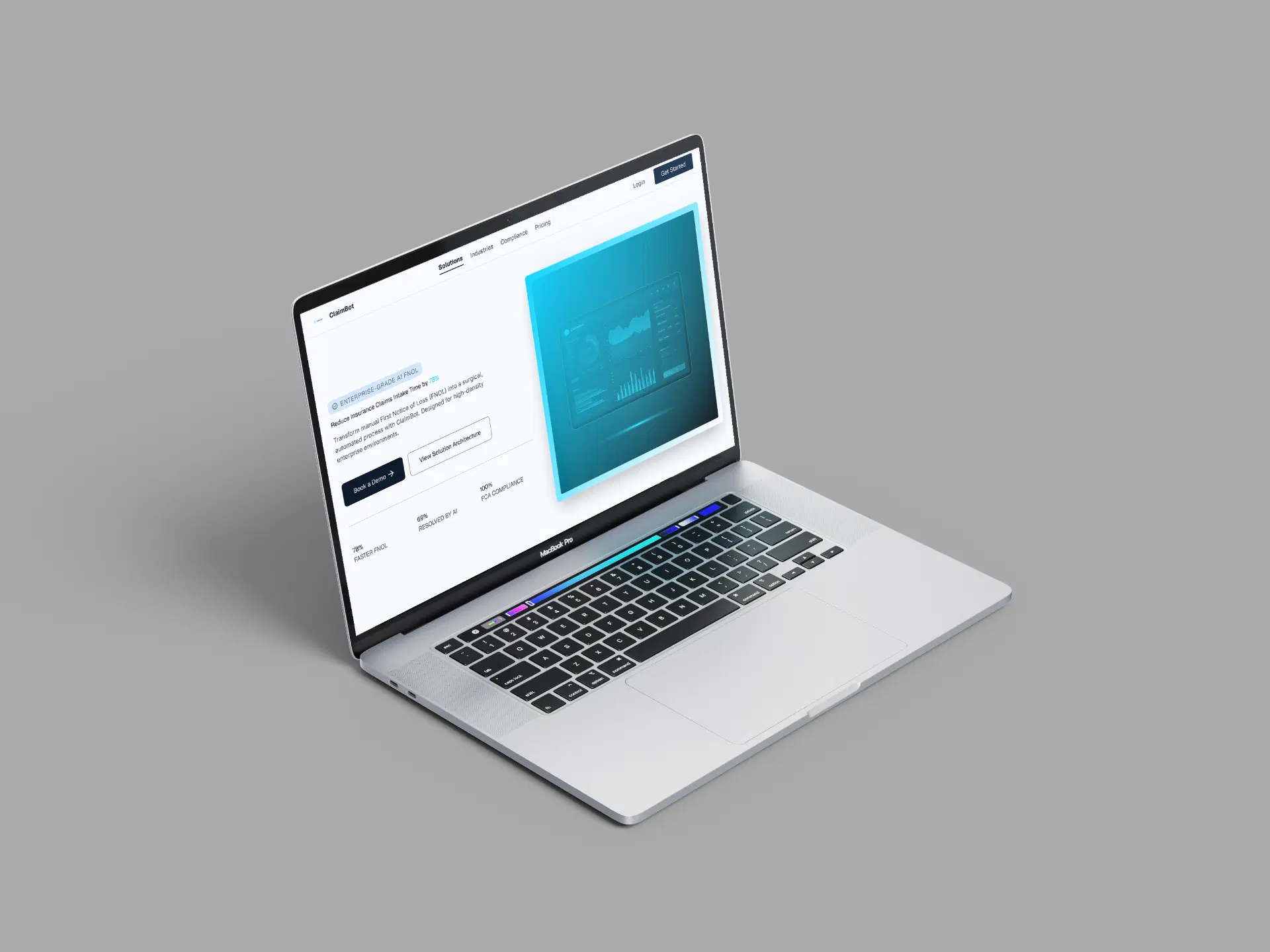
Making Insurance Claims Faster Smarter and Always On With ClaimBot
ClaimBot An AI-powered insurance claims chatbot that automates FNOL intake across web and voice channels. ClaimBot reduced claims processing time by 78%, integrated with Guidewire and Duck Creek, and generated FCA-compliant audit records for every interaction.
FinTech
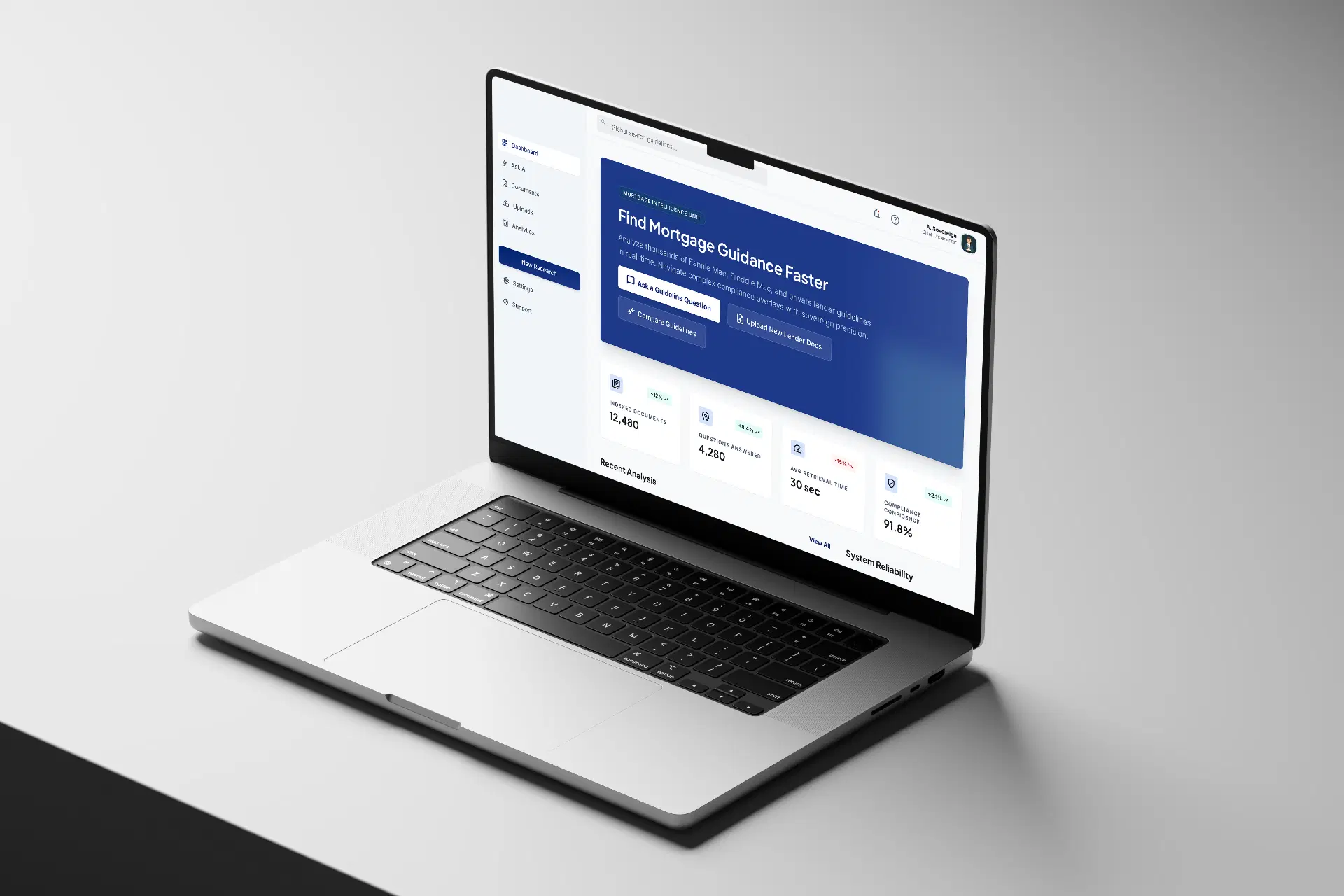
Turning 20-Minute Mortgage Guideline Searches Into Instant, Cited Answers
RAG-powered platform for mortgage underwriting. Processes 500+ page PDFs, scanned images, and video modules. Grounded answers with page citations on serverless AWS Lambda.
Frequently Asked Questions
Everything you need to know before getting started.