Quick Summary
A support bot that answers one question and forgets you exist the moment the chat window closes is an AI agent. A system that notices a customer is about to churn, pulls their usage history, drafts a retention offer, and books a call with the account manager without anyone asking it to do any of that, that is agentic AI. Both terms get thrown around as if they describe the same thing, and that mix up is starting to cost product teams real budget, because the two require different architecture, different oversight, and different expectations from day one. Get the label wrong at the start of a project and you either overbuild a simple task or underbuild one that genuinely needed several steps and a plan.
Key Takeaways
An AI agent completes one defined task. Agentic AI plans and carries out several connected steps toward a goal.
AI agents are faster to build, cheaper to run, and easier to audit. Agentic AI handles genuinely complex, multi-step work but needs stronger oversight.
Common AI agent types include simple reflex, model based, goal based, utility based, and learning agents.
Agentic AI systems range from single agent setups to fully autonomous, multi agent systems with human checkpoints in between.
Most successful projects start with one reliable AI agent before expanding into a full agentic workflow.
What Is an AI Agent?
An AI agent is a software system built to complete a specific task using a defined set of tools, rules, or a language model. It receives an input, decides on an action within its scope, and produces an output. Most AI agents today handle one job well: answering a support question, summarizing a document, or pulling data from an API when asked. They are reactive by design, which means they wait for a prompt before doing anything.
Chances are your product already has one of these buried in it somewhere, quietly doing its job under a different name.
What Is Agentic AI?
Agentic AI describes a system, usually built on generative AI foundation models, that plans and carries out multiple connected steps toward a goal with little to no human prompting at each stage. Instead of answering one question, it breaks a larger objective into smaller tasks, decides the order to tackle them in, calls on outside tools or other agents along the way, and adjusts its approach when something does not go as expected.
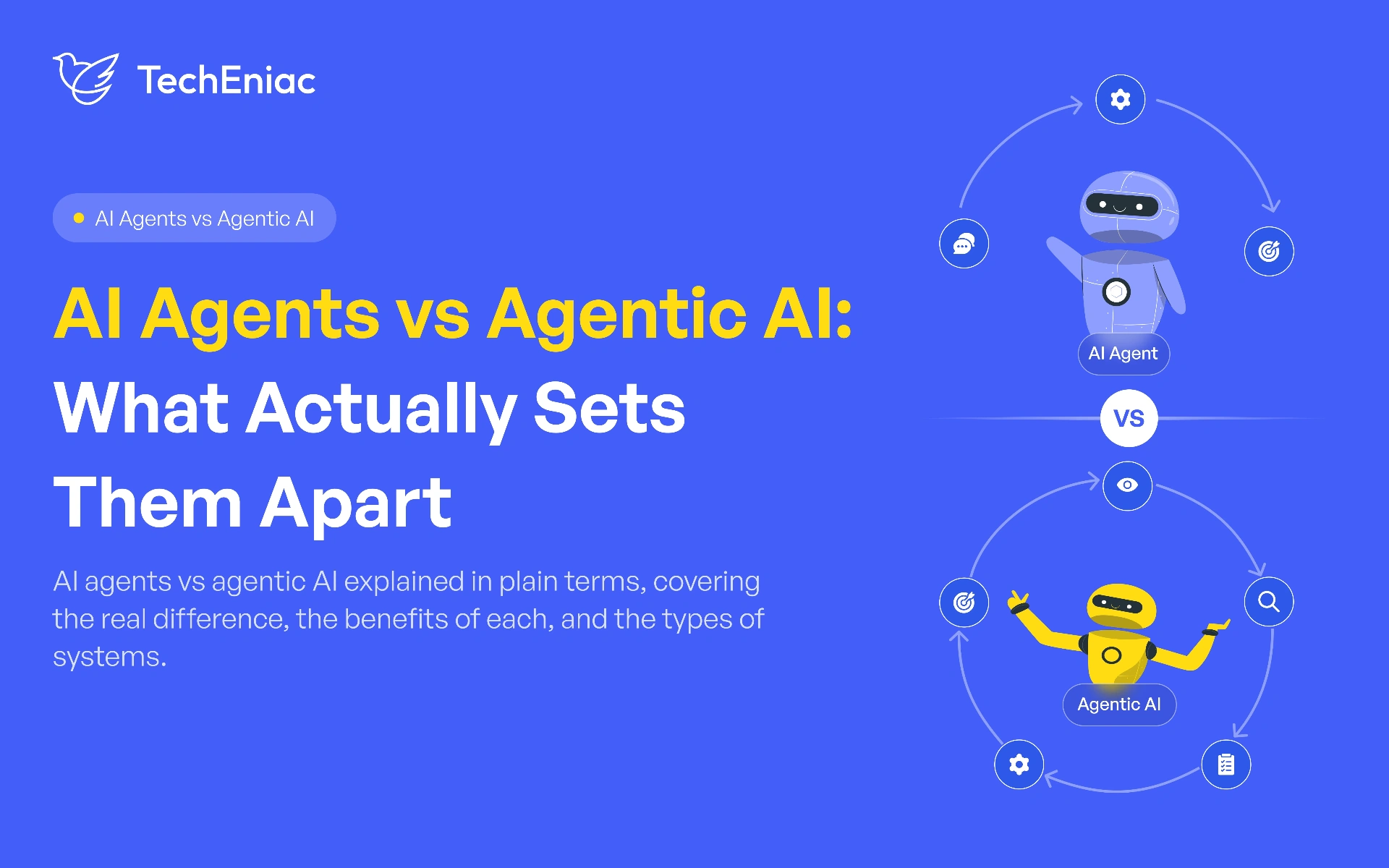
An AI agent waits to be asked. Agentic AI decides what needs doing next. That gap between responding and pursuing is the one most blog posts on this topic never actually explains.
AI Agents vs Agentic AI: The Difference Explained
The confusion mostly comes down to scope. An AI agent is a component. Agentic AI is a system made up of several of those components working together with memory, planning, and a degree of independence layered on top.
Aspect | AI Agent | Agentic AI |
|---|---|---|
Primary function | Completes one defined task | Plans and executes a multi part goal |
Human involvement | Prompted for each action | Set a goal, then largely left to run |
Decision making | Follows rules or a single model call | Reasons, plans, and adapts across steps |
Memory | Often stateless or short lived | Persistent context across the workflow |
Typical use | FAQ bot, data lookup, single API call | Research and reporting, order fulfilment, multi-step operations |
Failure mode | Gives a wrong or incomplete answer | Can compound errors across several steps if ungoverned |
Companies exploring AI agent development services for the first time usually start with one well scoped task, then expand into agentic behaviour once the first agent is proven reliable in production. That order matters more than most teams expect, because an agentic system built on top of a shaky single agent inherits every one of its weaknesses.
Benefits of AI Agents
A well-built AI agent earns quickly because it is narrow, testable, and cheap to run compared with a full agentic system.
Faster time to value: A single purpose agent, like one that classifies incoming support tickets, can be built, tested, and shipped in weeks rather than months.
Lower operating cost: Because the agent handles one task, it typically needs fewer tool calls and less compute per interaction, which keeps inference costs predictable.
Easier to audit: With one job and one decision path, it is straightforward to trace exactly why an agent produced a given output, which matters in regulated industries like healthcare and finance.
Simple to bolt onto existing systems: Most AI agents can sit alongside legacy software through an API without requiring a rebuild of the underlying product.
Reduced risk exposure: A narrow scope limits what can go wrong, since the agent cannot take actions outside its defined boundaries.
Benefits of Agentic AI
Agentic AI trades some of that simplicity for the ability to handle work that used to require a human coordinating several steps by hand.
Handles genuinely complex workflows: Tasks that span multiple systems, like reconciling an invoice, checking inventory, and issuing a refund, can run end to end without a person routing each step.
Adapts when conditions change: If a tool call fails or new information changes the plan, an agentic system can revise its approach rather than stopping and waiting for instructions.
Frees up skilled staff for judgment calls: Routine coordination work moves to the system, leaving people to focus on decisions that genuinely need human accountability.
Scales without linear headcount growth: One agentic workflow can manage a growing volume of cases because the bottleneck shifts from people to compute.
Creates new product possibilities: Features like autonomous research assistants or self-managing customer accounts were not practical before agentic systems existed, since no single model call could carry a task that far.
McKinsey's research on gen AI adoption found that despite nearly eight in ten companies already using generative AI somewhere in the business, most had not seen material bottom line impact from it, which is part of why agentic AI is being positioned as the next step toward turning that adoption into measurable results. It is worth noting this comes from McKinsey's own client engagements and industry surveys rather than independent audited data, so it should be read as directional rather than exact.
Types of AI Agents
Most AI agents in production today fall into a handful of recognizable categories, each suited to a different kind of task.
Simple reflex agents: These act on the current input alone, using fixed rules with no memory of past interactions, like a chatbot that answers from a script.
Model based agents: These keep a working model of their environment, allowing them to handle situations where the full picture is not visible in a single input.
Goal based agents: These evaluate several possible actions against a defined objective and choose the one most likely to reach it, rather than reacting on instinct alone.
Utility based agents: These go a step further than goal-based agents by weighing trade-offs, picking the action that produces the best overall outcome when several options could technically work.
Learning agents: These improve their performance over time by incorporating feedback from past outcomes, which is common in recommendation engines and fraud detection tools.
Gartner's own forecasting shows how fast this shift is moving: the firm expects up to 40 percent of enterprise applications to include task specific AI agents by 2026, up from under 5 percent the year before. Most of that growth is happening at the single agent level described above, long before companies attempt anything fully agentic.
Types of Agentic AI
Agentic AI systems are usually classified by how much independence they are given and how many moving parts they coordinate.
Single agent systems: One agent handles an entire workflow on its own, planning and executing every step without help from other agents.
Systems with several cooperating agents: Multiple specialized agents divide a task among themselves, such as one that drafts content, another that fact checks it, and a third that formats the output before it reaches a person.
Orchestrator and worker systems: A lead agent breaks a goal into subtasks and assigns them to worker agents, then assembles the results, which is common in research and reporting tools.
Human in the loop systems: The system plans and executes most of a workflow but pauses for approval at defined checkpoints, giving teams control without removing the automation benefit.
Fully autonomous systems: These operate with minimal checkpoints and are typically reserved for lower risk, high volume tasks where the cost of an occasional error is small.
Choosing Between AI Agents and Agentic AI
Most teams do not actually choose between an AI agent and agentic AI. They default to whichever one is easier to explain in a planning meeting, then spend the next two quarters untangling the mismatch once the workflow turns out to need more than a single response. Gartner's own CIO survey put a number on how common that stall is: only 17 percent of organizations had deployed AI agents as of early 2026, even though more than 60 percent expected to within two years. That gap is not really a technology problem. It is a decision that keeps getting postponed because nobody wants to commit to the wrong one.
There is no universal right answer here, and anyone who tells you otherwise is probably selling something. A single AI agent is often the smarter starting point for a business that needs one problem solved reliably, like triaging support tickets or pulling data from a spreadsheet on request. Agentic AI earns its complexity when the work genuinely spans multiple steps and multiple systems, and when the cost of a person coordinating that manually has become the actual bottleneck.
Start Narrow, Then Expand
We are a small team, and one thing we have learned building both kinds of systems is that jumping straight to a fully autonomous, multi-step agentic workflow before proving out a single reliable agent almost always costs more time than it saves. Most of the successful projects we have been part of started narrow, earned trust with one task, and only then expanded scope.
Businesses exploring what a chat-based entry point into either of these systems could look like often begin with AI powered chatbot development, since a chatbot is frequently the first visible layer sitting on top of either a single agent or a fuller agentic workflow underneath. And for teams building the underlying models and content generation capabilities that either approach depends on, it is worth understanding how generative AI development differs from simply wiring up an existing API, since the quality of the foundation model work underneath directly shapes how reliable the agent or agentic layer built on top of it will be.