Most founders spend $50,000 building an AI product, then discover the AI isn't accurate enough to ship. This guide is the playbook to avoid that straight from the 15 production AI SaaS products we've shipped at TechEniac.
Why Building an AI SaaS Product Is Different from Traditional SaaS
Traditional SaaS products execute deterministic logic the same input always produces the same output. An invoice generator calculates tax the same way every time. A project management tool moves a card from one column to another using predefined rules. The software does exactly what the code tells it to do, nothing more.
AI SaaS products are fundamentally different. They make probabilistic decisions, generate novel outputs, process unstructured data, and behave differently based on context. A healthcare AI that answers patient questions must reason across medications, lab results, and medical history simultaneously producing a unique response for every query. This distinction changes everything about how you design, build, test, and scale the product.
At TechEniac, we have built 15 AI SaaS products for startup founders across healthcare, fintech, martech, edtech, and enterprise automation through our AI SaaS product development practice. This guide shares the step-by-step process we follow the same methodology that produced SolidHealth AI (95% medical accuracy), Linkfluencer (10,000+ creators), and PatientFlow AI ($3.2M annual revenue impact for a 4-hospital system).
Step 1: Building your product starts with answering these three questions
Validation for AI products requires three questions that traditional SaaS validation doesn't:
Does AI actually solve this problem? If a database query or simple rule handles it, adding AI creates cost with no upside. We've turned away founders whose idea was really a well-designed filter, not an AI.
What accuracy level does the market require? Content tools can tolerate 80%. Medical AI needs 95%+. Financial compliance AI needs 90%+ to avoid regulatory liability. Your required accuracy decides your architecture before you write a line of code.
Can you access the training data? RAG needs a document corpus. Fine-tuning needs thousands of labelled examples. No data means no product no amount of clever prompting changes that.
If you can answer all three confidently, you have a real product. If you can't, spend another week sharpening the idea before writing code.
Step 2: This one decision shapes everything that comes after
Most founders underestimate how much the AI-architecture decision constrains everything downstream. Choose for your accuracy requirement and data availability not because a competitor used a particular approach.
Lowest cost. Fastest to ship. Good for content generation and summarization where the stakes are low.
Moderate cost. Grounds the model in your documents at query time. The default for question-answering over knowledge bases.
Highest cost. Multiple specialized agents coordinating on a task. Use it for complex reasoning or compliance-sensitive workflows.
Moderate to high cost. Trains the model on your patterns. Best for custom vocabulary, output format, or tone.
Our honest take: 80% of products perform well with RAG alone. Fine-tuning sounds sophisticated but it's usually unnecessary and it makes iteration much slower. Start with RAG; fine-tune only after you've proven RAG isn't enough for your accuracy bar.
Step 3: Pick a boring, proven tech stack
After 15 production products, TechEniac has converged on a stack that's intentionally unglamorous:
Frontend: React + Next.js + TypeScript
APIs: Node.js + Express
AI services: Python + FastAPI
AI orchestration: LangChain for retrieval, LangGraph for multi-agent workflows
Vector storage: Qdrant or Pinecone
Data stores: PostgreSQL + MongoDB + Redis
Infrastructure: AWS or GCP
Every piece of this stack is hiring-friendly, well-documented, and boring. That's the point.
Step 4: Build the MVP in weeks ruthlessly scoped
The failure mode isn't technical. It's scope. Founders who try to ship everything in V1 run out of budget before launch. SolidHealth AI's V1 was only the KNOAH assistant with FHIR integration no medication correlation engine, no multi-provider LLM switching. Those came in V2 and V3, after the core product proved its value with real patients.
Your MVP must include: user auth, the core AI feature, basic usage analytics, billing (if you're charging from day one), and a feedback mechanism so users can flag bad outputs.
Your MVP must not include: admin dashboards, multi-language support, advanced reporting, or a mobile app. Every one of those is a V2 decision disguised as a V1 requirement.
For a deeper look at how scope trades off against budget, see our SaaS development cost guide.
Step 5: Accuracy testing is where AI development gets hard
Traditional products need functional testing. AI products need four additional layers on top:
Accuracy testing 50–200 test cases, each measured against human-verified gold standards specific to your domain. No gold standard, no trustworthy accuracy number.
Hallucination testing Adversarial prompts designed to trigger confabulation. Verify every cited source actually exists. Hallucinated citations are the single most common reason enterprise AI pilots fail review.
Safety testing Prompt-injection resistance, PII handling, content-policy compliance, and (for healthcare) emergency escalation paths.
Load testing AI quality degrades under concurrent load. Test at 2–3× your expected peak, with realistic prompt sizes.
Skip any of these and you'll hear about it from your first ten enterprise customers.
Step 6: The real work starts after launch
AI products improve dramatically in months 3–6 post-launch because real users reveal patterns no test suite can predict. SolidHealth AI went from 91% to 95% medical accuracy in the first three months entirely through iterative improvement driven by logged production data.
Build the observability loop into V1. By the time you wish you had it, you've already lost the data that would have told you what's wrong.
Frequently Asked Questions
Can a non-technical founder build an AI SaaS product?
Yes. Most TechEniac clients are non-technical. You bring domain expertise and product vision; a good technical partner handles execution and explains decisions in business terms, not jargon. The best founders we work with ask "why" a lot and trust us with the "how."
How long does it take to build an AI SaaS product?
3–6 months for a standard MVP. 6–12 months for complex products with multi-agent AI or regulated compliance. TalentSync AI shipped a 5-agent platform in 6 months. CourseGen AI shipped with SCORM export in 5 months. The honest gating factor is usually data readiness, not engineering speed.
Should I use GPT-4o, Claude, or Gemini for my AI product?
GPT-4o for complex reasoning and content generation. Claude for structured output and compliance-sensitive tasks. Gemini for multimodal work and cost efficiency. TechEniac evaluates all three during discovery based on your specific requirements and designs the system so you can switch between them without rewriting the product.
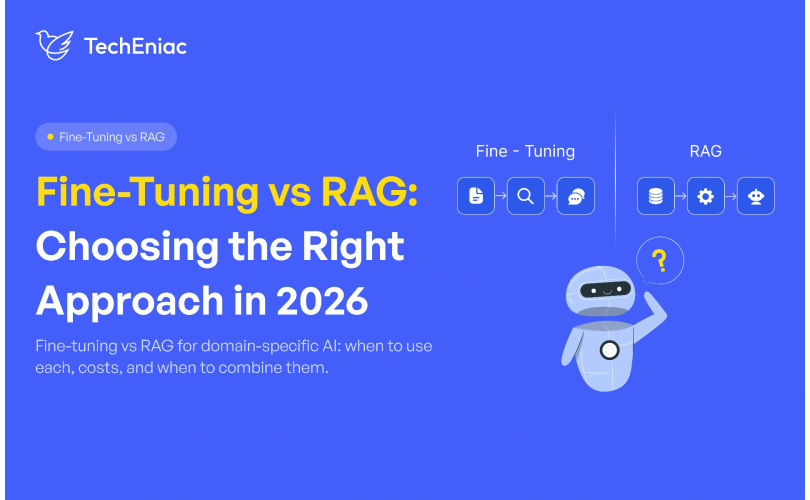
What is the difference between RAG and fine-tuning?
RAG retrieves your data at query time and grounds the AI in facts. Fine-tuning changes the model's behaviour by training it on your data. RAG is better for question-answering over specific documents. Fine-tuning is better for custom vocabulary or output format. Again start with RAG.