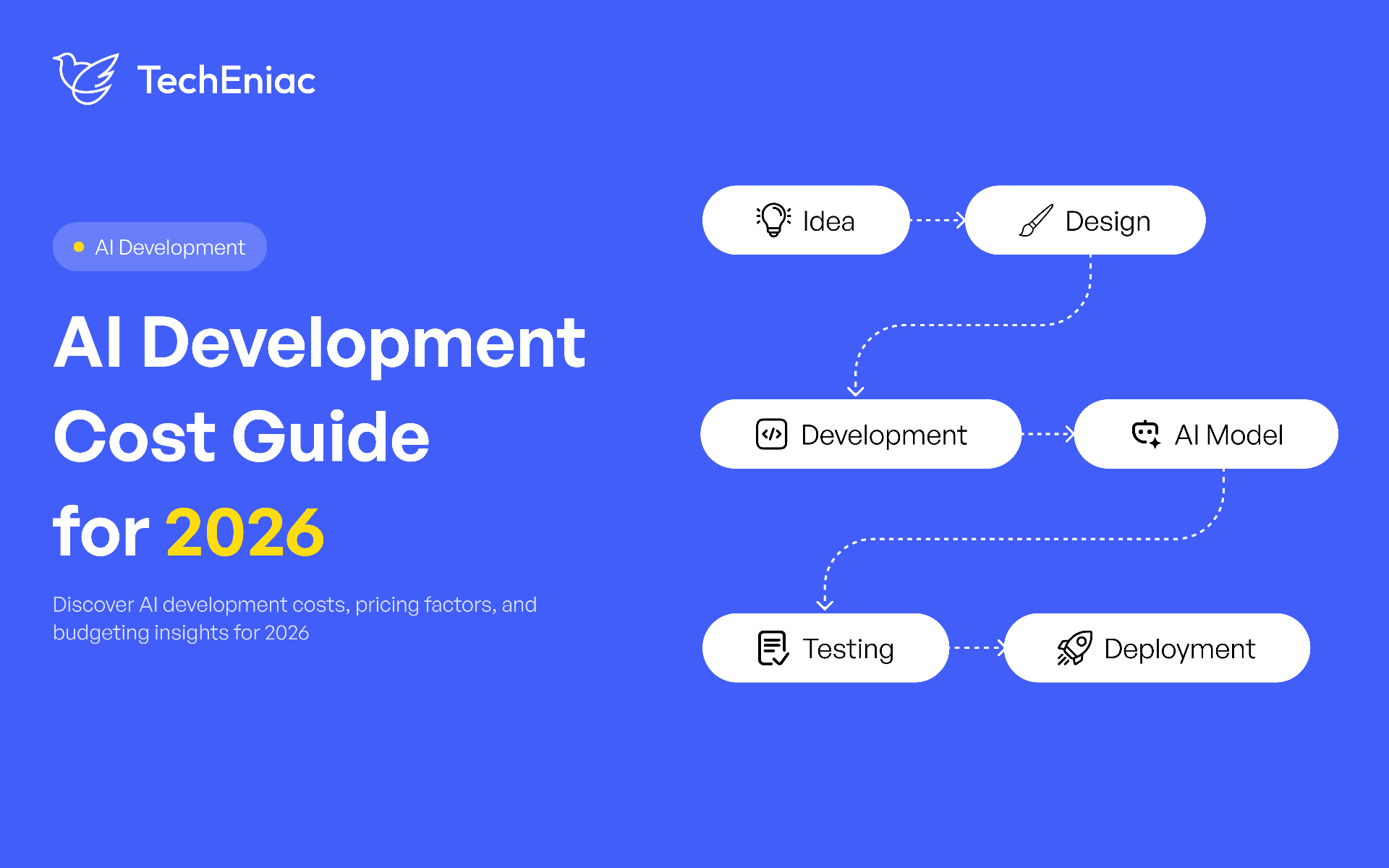
The honest answer to "how much does AI development cost?" is somewhere between $15,000 and $500,000+ depending on what you're building. That range is so wide it's almost useless which is why most founders leave AI pricing articles more confused than when they arrived.
This guide is different because the numbers come from products we've actually shipped not vendor surveys or market estimates. After building AI products across healthcare, fintech, edtech, martech, insurance, and enterprise automation, we can help you with what each type of AI system costs to build, what drives the cost up, what keeps it down, and where the hidden expenses live that most budget guides conveniently skip.
AI Development Cost by Project Type
Every AI project falls into one of five tiers. The tier determines your budget, your timeline, and the engineering complexity involved.
Tier 1: Single AI Feature ($15,000–$30,000)
You have an existing product and want to add one AI capability a chatbot, a content generator, a search upgrade, a classification engine, or a recommendation system.
This is prompt engineering + basic RAG integration + API connection to your existing backend. The LLM does the heavy lifting. The engineering work is designing the prompts, connecting the data, and building the interface.
Timeline: 4–8 weeks.
What you get: One working AI feature integrated into your existing product.
What you don't get: Multi-model routing, compliance validation, or production-grade safety guardrails. Those come at Tier 2.
Tier 2: AI-Powered MVP ($30,000–$60,000)
You're building a new AI product from scratch where AI is the core value proposition, not a bolt-on feature. This includes the AI pipeline, backend API, frontend interface, database, authentication, and basic deployment infrastructure.
This is the tier where most startup founders land. The AI SaaS MVP delivers a production-ready product that real users can sign up for, use, and pay for not a demo that impresses in a pitch meeting.
Timeline: 8–12 weeks.
What you get: A complete, deployable AI product with one core feature.
Real examples: CourseGen AI (AI course creation $30–50K range), WorkflowAI (AI decision nodes $30–50K range).
Tier 3: Production AI Product ($60,000–$120,000)
A full-featured AI product with multi-model routing, safety guardrails, compliance architecture, provider failover, cost optimization, and production monitoring. This is the tier where AI products become enterprise-ready.
The jump from Tier 2 to Tier 3 isn't about adding features it's about adding production discipline. Output validation. Model routing that sends simple queries to cheap models and complex queries to frontier models. Automatic failover when a provider degrades. Compliance documentation for regulated industries. Continuous accuracy monitoring.
Timeline: 12–24 weeks.
What you get: A production-grade AI product ready for enterprise sales.
Real examples: ContentForge AI (brand content platform 40+ brands, 97% compliance), ClaimBot (insurance claims FCA compliant, voice + chat), WealthPilot AI (FCA-regulated wealth advisory).
Tier 4: Complex Multi-Agent Platform ($80,000–$150,000+)
Multiple specialized AI agents collaborating on complex tasks through orchestrated workflows with human-in-the-loop oversight, compliance verification at every decision point, and the accuracy levels that regulated industries demand.
This is the tier for healthcare, fintech, and insurance products where single-model accuracy (75–85%) isn't sufficient and multi-agent verification pushes accuracy above 90%.
Timeline: 16–28 weeks.
What you get: A multi-agent AI system with production-grade orchestration.
Real examples: SolidHealth AI (5 agents, 95% medical accuracy, HIPAA compliant 11 months), PatientFlow AI (4 agents, $3.2M revenue impact, hospital operations 8 months).
Tier 5: Enterprise AI Platform ($150,000–$300,000+)
Large-scale AI infrastructure serving multiple departments, business units, or customer segments with enterprise governance, SSO, dedicated tenancy, advanced analytics, and API platforms for third-party integration.
Most startups never need this tier in V1. This is Series B territory when the product has proven market fit and needs enterprise-grade infrastructure to scale.
Timeline: 24–40+ weeks.
The Cost Breakdown - Where Your Money Actually Goes
Understanding where the budget is allocated helps you make smarter scoping decisions and identify where costs can be reduced without sacrificing quality.
Phase | % of Budget | What It Covers |
|---|---|---|
Discovery & Architecture | 10–15% | Requirements mapping, LLM evaluation, architecture design, cost modelling |
Data Preparation | 15–25% | Document ingestion, data cleaning, chunking strategy, embedding pipeline, knowledge base setup |
AI Pipeline Development | 25–35% | Prompt architecture, model integration, RAG pipeline, agent orchestration, output validation |
Application Development | 20–25% | Backend APIs, frontend UI, authentication, billing, database architecture |
Testing & Deployment | 10–15% | Accuracy evaluation, integration testing, CI/CD setup, production deployment, monitoring |
The most underestimated phase is data preparation. It accounts for 15–25% of direct cost but consumes 40–50% of total project time. If your data is fragmented, unstructured, or poorly labelled, expect this phase to expand significantly before any model work begins.
The most important phase is discovery. Spending an extra $5K–$10K on architecture evaluation, LLM benchmarking, and requirements validation consistently saves $30K–$100K downstream by preventing mid-project architectural pivots. We evaluate candidate LLMs against 50–100 representative queries from your domain before committing to a model the evaluation data drives the architecture, not vendor marketing.
The Costs Nobody Tells You About
The build cost is the number you see in proposals. The operating costs are the numbers that surprise you at Month 3.
LLM inference costs. Every query to GPT-4o, Claude, or Gemini costs money. At 100,000 queries/month, inference alone costs $500–$4,000/month depending on which model handles how many queries. Model routing (sending simple queries to cheap models) reduces this by 30–40%. One of our healthcare products saved 40% on inference costs through dynamic routing between Gemini and Llama without sacrificing accuracy on complex queries.
Vector database hosting. If your product uses RAG, the vector database runs continuously. Pinecone, Qdrant, or pgvector hosting costs $50–$500/month depending on data volume and query throughput.
Cloud infrastructure. AWS hosting for a typical AI SaaS product runs $200–$2,000/month covering compute (ECS Fargate), database (RDS), storage (S3), CDN (CloudFront), and monitoring (CloudWatch + Datadog).
Maintenance and retraining. AI products degrade over time as real-world data drifts from training patterns. Budget 10–15 hours/month for prompt refinement, knowledge base updates, retrieval accuracy monitoring, and model upgrades. This is ongoing and indefinite it never stops.
Compliance costs. HIPAA compliance adds $5,000–$30,000 in Year 1 for architecture, documentation, and audit preparation. FCA compliance for financial products adds similar. SOC 2 Type II certification costs $15,000–$50,000 for first-time certification. These are table stakes for enterprise sales in regulated industries.
What Drives AI Development Costs Up (and How to Keep Them Down)
Costs go up when:
Data is unstructured, fragmented, or poorly labelled (doubles data prep time).
Accuracy requirements exceed 90% (multi-agent verification adds $30–50K).
Multiple compliance frameworks apply (HIPAA + GDPR + SOC 2).
Real-time processing is required (streaming infrastructure adds complexity).
Multi-language support needed (cultural adaptation, not just translation).
Integration with legacy systems (SOAP APIs, custom protocols, inconsistent data formats).
Costs stay down when:
Data is clean, structured, and accessible (fastest projects have clean data from Day 1).
RAG is sufficient (80% of use cases no fine-tuning needed).
Single compliance framework applies.
Async processing acceptable (batch instead of real-time).
One language in V1 (add languages after product-market fit).
Modern API integrations (REST, webhooks, standard auth).
The Three-Year Total Cost of Ownership
The build cost is Year 1. But AI products have ongoing costs that most budget guides understate.
Year | Typical Costs (Tier 2–3 Product) |
|---|---|
Year 1 | Build: $30K–$120K + Infrastructure: $5K–$25K + Inference: $6K–$48K = $41K–$193K |
Year 2 | Maintenance: $15K–$30K + Infrastructure: $5K–$25K + Inference: $6K–$48K + Feature iteration: $20K–$50K = $46K–$153K |
Year 3 | Maintenance: $15K–$30K + Infrastructure: $5K–$25K + Inference: $6K–$48K + Scaling: $15K–$40K = $41K–$143K |
Three-year TCO for a mid-complexity AI product: $128K–$489K.
The recurring costs (inference, infrastructure, maintenance) typically equal or exceed the original build cost by Year 3. Budget for this from Day 1 not as a surprise at Month 18.
In-House vs Outsourced: The Cost Comparison
The build-vs-buy decision significantly impacts your total AI development cost.
In-house team (US-based): A minimum viable AI team 1 AI/ML engineer, 1 full-stack developer, 1 DevOps engineer costs $450K–$650K/year in fully-loaded US salaries. Average AI engineer salary in 2026 reached $206,000 in the US. You're paying 12 months of salary to deliver a product that an outsourced team delivers in 3–6 months.
Outsourced to a specialised AI development company: A Tier 2–3 AI product costs $30K–$120K with an 8–24 week timeline. The same product built in-house costs $225K–$325K (6 months of team salary) 2–3× more expensive and 2–3× slower.
The hybrid approach that works for most founders: Outsource V1 to a specialised AI development company, learn from the codebase, and bring maintenance in-house after launch. You get production-quality architecture from Day 1 and the knowledge transfer to maintain it yourself. Full IP ownership should be non-negotiable if the development partner retains any claim on the code, walk away.
How TechEniac's AI Development Costs Compare
Our pricing is transparent because vague pricing generates sales calls, not trust.
Project Type | TechEniac Cost | Timeline | Example Product |
|---|---|---|---|
Single AI Feature | $15K–$30K | 4–8 weeks | RAG chatbot, content generator, search upgrade |
AI SaaS MVP | $30K–$60K | 8–12 weeks | CourseGen AI, WorkflowAI |
Production AI Product | $60K–$120K | 12–24 weeks | ContentForge AI, ClaimBot, WealthPilot AI |
Multi-Agent Platform | $80K–$150K+ | 16–28 weeks | SolidHealth AI, PatientFlow AI |
These costs reflect AI SaaS product development from architecture through production deployment including LLM evaluation, prompt architecture, RAG pipeline, safety guardrails, cost optimization, and monitoring. They don't include ongoing inference and infrastructure costs, which are budgeted separately.
Frequently Asked Questions
How much does AI development cost in 2026?
AI development costs range from $15,000 for a single AI feature added to an existing product to $150,000+ for a complex multi-agent platform with compliance requirements. The most common range for startup founders is $30,000–$60,000 for an AI-powered MVP and $60,000–$120,000 for a production-ready AI product. Ongoing costs (inference, hosting, maintenance) add $3,000–$10,000/month at scale.
What are the main cost drivers in AI development?
Five factors drive cost more than any others data preparation quality (clean data = lower cost), accuracy requirements (above 90% requires multi-agent verification), compliance frameworks (HIPAA, FCA, SOC 2 add $5K–$50K), integration complexity (legacy systems cost more than modern APIs), and inference volume (more queries = higher monthly operating cost).
How can I reduce AI development costs?
Start with RAG before fine-tuning RAG handles 80% of use cases without the $5K–$20K fine-tuning investment. Implement model routing from Day 1 route simple queries to cheap models ($0.59/1M tokens) and complex queries to frontier models ($2.50–$3.00/1M). Build one feature in V1 and skip the admin dashboard, analytics, and multi-language until V2. Use pre-trained models via API before considering custom training this reduces initial cost by 60–80%.
What are the hidden costs of AI development?
LLM inference ($500–$4,000/month at scale), vector database hosting ($50–$500/month), cloud infrastructure ($200–$2,000/month), ongoing maintenance and accuracy monitoring (10–15 hours/month indefinitely), compliance certifications ($5K–$50K for HIPAA or SOC 2), and model retraining as real-world data drifts from training patterns. The three-year total cost of ownership typically exceeds the original build cost by 2–3×.
Should I build AI in-house or outsource?
For most founders, outsource V1 and bring maintenance in-house after launch. A US-based in-house AI team costs $450K–$650K/year. The same product built by a specialized AI development company costs $30K–$120K in 3–6 months 2–3× cheaper and 2–3× faster. Outsourcing V1 gives you production-quality architecture and the knowledge transfer to maintain it independently.