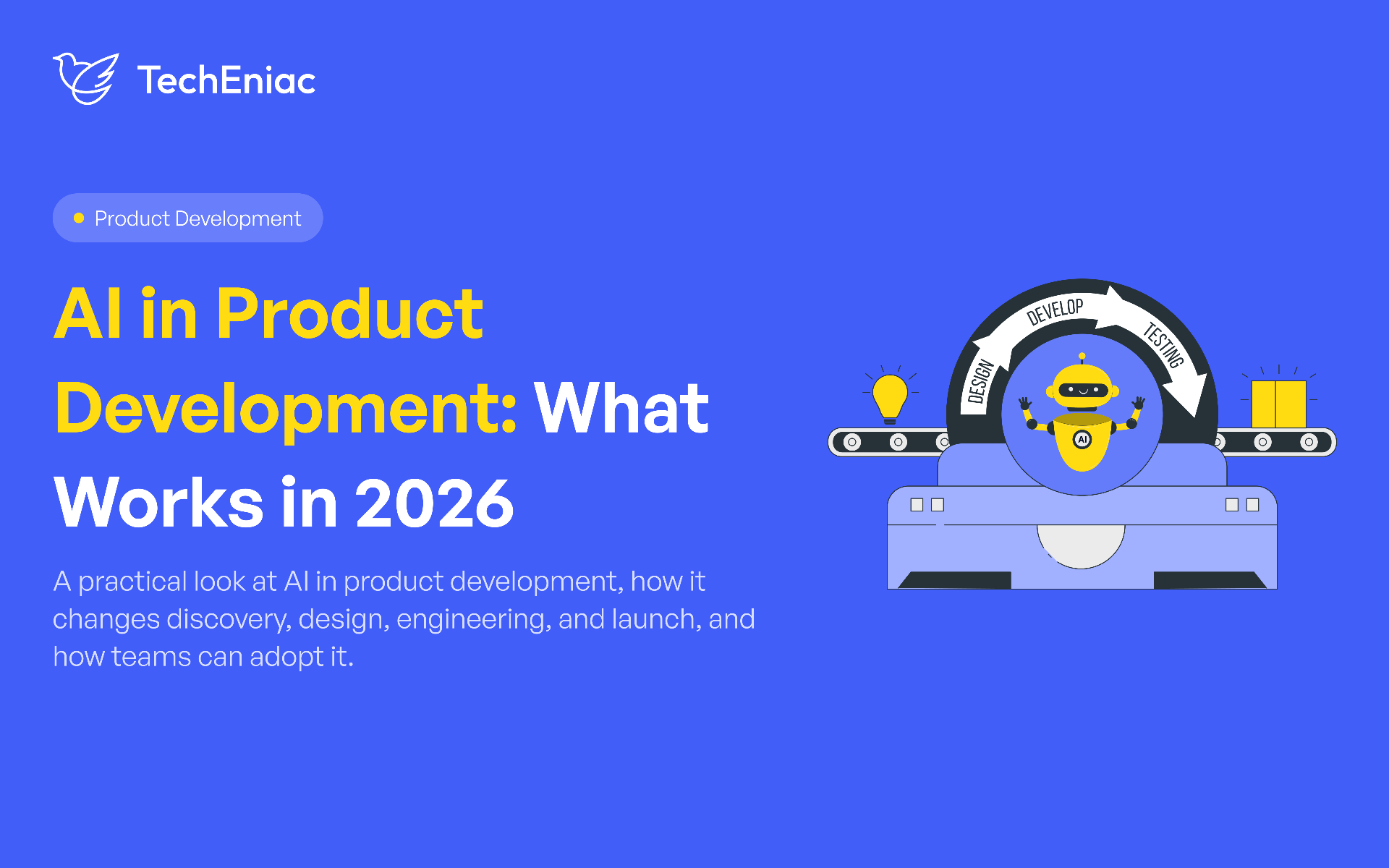
AI in product development speeds up the slowest parts of building a product, research synthesis, prototyping, coding support, testing, and post launch analysis, without replacing the judgment calls only a person can make. Teams that apply it well get back the time they used to lose to manual synthesis and spend it on decisions that need a human. That distinction, speed without giving up judgment, is what separates a useful AI workflow from a gimmick bolted onto the roadmap.
Key Takeaways
AI in product development speeds up research synthesis, prototyping, coding support, testing, and post launch analysis, but it does not replace product judgment.
The strongest results come from teams that apply AI to one real workflow at a time instead of scattering it across the roadmap.
Revenue gains from AI are increasingly showing up in product and service development, right behind marketing and sales, according to McKinsey's most recent global survey.
AI product engineering works best when it sits inside existing tools and rituals rather than living as a separate experiment nobody maintains.
Teams that measure speed, quality, and product outcomes together avoid the trap of moving faster while shipping worse products.
Most teams start experimenting with AI product development somewhere in the middle of their process, usually coding, because that is where the tools got good first. But the lifecycle runs much wider than that, and understanding where AI adds value versus where it just adds noise makes the difference between a useful workflow and an expensive distraction.
What Is AI in Product Development?
AI in product development means using machine learning, generative models, and natural language processing to support the work product teams already do, researching users, designing experiences, building features, testing quality, and learning from what happens after launch. It touches research synthesis, concept generation, UX writing, code assistance, test creation, and usage analysis.
The technology itself is not one thing. Generative AI drafts requirements, prototype copy, and code. Machine learning spots patterns in usage data and predicts which features will stick. Natural language processing clusters feedback from reviews, tickets, and interview transcripts into themes a human can act on. Each of these plays a different role depending on where in the lifecycle a team applies it.
None of this replaces the fundamentals. A team still needs a real problem, evidence from actual users, a workable technical approach, and a launch plan that holds up under pressure. AI earns its place when it removes repetitive work, surfaces a pattern faster than a person could find it manually, or gives a team more options to compare before they commit to one.
AI Use Cases in Product Development
Before going deeper into how each stage changes, here's a quick scan of where AI earns its place across the product lifecycle.
Research: Clusters hundreds of support tickets, reviews, and interview transcripts into themes by pain point and severity, so a team can shortlist what's worth investigating without reading every source manually.
Design: Generates concept directions, flow variations, and interface copy, and maps a flow into its full set of states, empty, error, edge case, and loading, before engineering ever touches it.
Development: Suggests code, catches obvious bugs, and generates a first pass of tests, reducing repetitive engineering work on small, reviewable changes.
Testing: Drafts test cases, flags likely edge cases based on how similar features have broken before and summarizes a pull request for a reviewer who wasn't in the room.
Analytics: Turns adoption numbers, funnel drop off, crash reports, and sentiment into a digestible summary, replacing the manual dashboard stitching that used to eat a Monday morning.
Launch: Surfaces early signals after a release, so a team can catch a problem worth investigating before it shows up as a support ticket backlog.
Each of these earns its place only when a person still checks the output against a real source. The sections below go into how that plays out stage by stage.
How Artificial Intelligence in Product Development Changes Every Stage
The value of artificial intelligence in product development shows up differently at each stage of the lifecycle. Some stages benefit from faster synthesis, others from faster iteration, and a few benefit simply from someone finally reading all the data instead of a sample of it.
Discovery and Research
Research used to mean picking a handful of representative tickets and hoping they told the whole story. AI changes that math. A product manager can now ask a model to cluster hundreds of support conversations, interview transcripts, and app reviews by pain point, severity, and affected user segment, then hand the team a shortlist worth investigating further.
The output still needs a human check. AI finds patterns, but only a person can confirm whether a pattern reflects a real, high value problem or just a loud minority. Keeping source quotes and confidence notes attached to every AI generated insight protects the team from acting on something that sounds convincing but isn't representative.
Prototyping and Design
Designers can use AI to generate several concept directions, flow variations, and pieces of interface copy before committing to one. This works best when the prompt includes real context: the user, the scenario, the platform, and the constraints. Without that context, AI tends to produce generic screens that look finished but solve nothing.
AI also helps translate a flow into a full list of states before engineering ever touches it: empty states, error states, edge cases, loading states. Catching these early, instead of discovering them mid sprint, is one of the more underrated wins of using AI for product design.
Engineering and Build
This is where most teams already have some AI in their workflow, usually through coding assistants and test generators. Used on small, reviewable changes, these tools genuinely reduce repetitive engineering work. Used on sweeping, end to end feature requests, they tend to generate more code to review than anyone saved time on.
Teams that treat AI as an amplifier of their existing engineering discipline get the most out of it. Teams with unclear requirements or weak review processes usually just end up with more output to sort through, not more finished work.
Testing and Quality Assurance
AI can draft a first pass of test cases, flag likely edge cases based on how similar features have broken before and summarize a pull request for a reviewer who wasn't in the room when the decision was made. QA still owns the judgment call on what matters to test and what risk is acceptable to ship with.
Launch and Post Launch Learning
Once a feature ships, AI can turn a flood of noisy signals, adoption numbers, funnel drop off, crash reports, support tickets, and sentiment, into a digestible weekly summary. That saves a team from spending Monday morning manually stitching dashboards together before they can even start deciding what to fix.
The team still decides what the data means. AI can flag that funnel drop off increased after a release. Whether that calls for a rollback, a copy change, or a deeper investigation is a decision only the people who own the product should make.
AI Product Engineering: Where the Real Leverage Sits
AI product engineering is the discipline of building the connective tissue between all of these individual use cases, so that a research insight actually flows into a design hypothesis, which flows into acceptance criteria, which flows into a test case, without getting lost in translation between teams. That connective work is harder than any single AI feature, and it's where most of the durable value ends up sitting.
At TechEniac, this is the part of the work we spend the most time on with founders. Anyone can wire up a chatbot. The harder problem is building the AI SaaS Product Development Service foundation where the AI layer is part of the architecture from day one, not bolted onto a product that wasn't designed to support it.
For teams that already have a working product and want to add AI capability without a rebuild, AI Integration & Automation Service is usually the more realistic starting point than a ground up rewrite. It lets AI sit quietly inside workflows people already use, handling document processing, intelligent search, or customer interactions, while the core product stays stable.
If your team wants to explore this without committing to a full build yet, this is a genuinely good moment to bring in outside technical judgment before you write a single line of code.
AI Powered Product Development vs Traditional Product Development
Framing these side by side makes it easier to see where AI genuinely changes the work and where the fundamentals haven't moved at all.
Aspect | Traditional Product Development | AI Powered Product Development |
|---|---|---|
Research synthesis | Manual review of a sample of feedback | AI clusters full data sets, humans validate patterns |
Prototyping speed | Days per concept direction | Hours per concept, more variants explored |
Coding support | Manual implementation, manual test writing | AI assisted coding and first pass test generation |
Post launch analysis | Weekly manual dashboard review | AI summarized signals, human decides what to act on |
Decision ownership | Fully human | Still fully human, better-informed inputs |
Biggest risk | Slow feedback loops, missed patterns | Overtrusting AI output without source grounding |
The table makes one thing clear: the roles haven't changed. What changed is how much evidence a person can review before making the same kinds of decisions they always made.
Benefits and Real Challenges Product Teams Should Plan
McKinsey's 2026 State of AI survey found that revenue gains from AI are most reported in marketing and sales, followed closely by product and service development and software engineering, which is a meaningful signal that this isn't hype confined to customer facing tools. The same survey also found that eighty percent of respondents report AI has improved their individual productivity, while broader EBIT impact has stayed roughly flat year over year. That gap between individual speed and organizational results is exactly why the benefits below need to be paired honestly with the challenges.
Faster time to market: AI reduces the hours spent on synthesis, drafting, prototyping, and documentation, which shortens the gap between an idea and a testable version of it.
Better informed decisions: Teams can review far more customer and usage evidence than manual synthesis ever allowed, without adding headcount.
Stronger workflow connection: AI can link product, design, and engineering artifacts so less context gets lost at each handoff.
Sharper quality coverage: AI assisted test generation and edge case detection catch gaps that often surface too late in traditional workflows.
Data quality risk: Weak or fragmented source data produces AI recommendations that look confident and are wrong.
Over trust risk: Models can invent user needs or overstate certainty when nobody checks the output against a real source.
Governance gaps: sensitive research, customer data, and pricing information need clear rules about what enters a model and who reviews the output.
Teams that measure success purely by hours saved tend to miss the second half of this list. Speed that comes with more rework or weaker traceability back to real evidence isn't progress. It's a name for the same problem you had before, moving faster.
Building an AI Product Development Process That Actually Works
A durable AI product development process starts small on purpose. The DORA team's 2025 report on AI assisted software development, drawn from nearly five thousand technology professionals, found that AI adoption among developers has surged to ninety percent, but the report's central finding is that AI acts as an amplifier: it makes strong teams stronger and struggling teams' problems more visible, faster. The same logic applies to product teams more broadly, not just engineering.
Here's the process broken into four steps, followed by what each one looks like in practice.
Step | What to Do | Why It Matters |
|---|---|---|
Start with a real problem | Pick one painful, specific workflow with an owner and a measurable baseline | A vague goal like "use AI somewhere" rarely survives contact with a real quarter |
Fit AI into existing tools | Build the workflow inside your project tracker, design tool, or CI pipeline, not around them | Workflows living outside daily tools tend to become demos nobody maintains |
Get data and access ready | Confirm what data a model can see, whether prompts are retained, and where stricter review is needed | Useful AI output depends on clean, current, permission aware source data |
Measure speed and outcomes together | Track cycle time and synthesis time alongside defect rate, rework, and activation or retention | A workflow that's faster but increases rework isn't ready to scale |
Start With a Real Problem, not a Tool
Pick a painful, specific workflow with an owner and a measurable baseline, slow feedback synthesis, scattered research, or repeated QA planning are good starting points. A vague goal like "use AI somewhere in the roadmap" almost never survives contact with a real quarter.
Fit AI Into Tools Your Team Already Uses
AI workflows that live outside the tools your team already opens every day, your project tracker, your design tool, your CI pipeline, tend to become demos nobody maintains past the first month. Define where inputs come from, who reviews the output, and where the approved result lives before you scale anything.
Get Your Data and Access Controls Ready
Useful AI output depends on clean, current, permission aware source data. Before relying on any AI recommendation for a product decision, confirm what data the model can see, whether prompts are retained anywhere, and which workflows are sensitive enough to need a stricter review step.
Measure Speed, Quality, and Outcomes Together
Track cycle time and synthesis time alongside defect rate, rework, and actual product outcomes like activation and retention. If a workflow makes the team faster but increases rework, it isn't ready to scale yet, no matter how good the demo looked.
If your team is past the pilot stage and ready to build a properly engineered AI product rather than a proof of concept, SaaS Product Engineering & Scaling Service is where that architecture work actually happens, covering reliability, performance, and the kind of scaling decisions that get expensive to fix later if they're rushed early.
Where TechEniac Fits into This Shift
We're not a large agency, and we don't pretend to be one. What TechEniac brings to AI product development is a small team that has actually shipped production AI systems, including RAG pipelines handling five hundred plus page documents and multi agent platforms running inside real hospital operations, not just pilots that never left a slide deck.
If you're a founder weighing where AI genuinely fits your product versus where it would just be decoration, an AI Consulting Services conversation upfront tends to save far more time than jumping straight into development and discovering the gaps six weeks in. You can see how this has played out for other teams in our case studies, including a mortgage guideline assistant and a hospital operations platform built the same way we'd approach your product.