Building the full product first is the single most common way founders burn their runway on something nobody wanted. CB Insights' March 2026 analysis of 431 VC backed startups that shut down since 2023 found that poor product market fit was behind 43% of failures with an identifiable cause, and that these companies had raised a combined $17.5 billion before closing. Running out of cash is how most of these stories end, and poor product market fit is the leading cause behind it. The AI SaaS MVP vs full product decision isn't really about budget. It's about how much of your idea you're willing to validate before you build it in full.
Key Takeaways
An MVP tests one core value proposition with real users. A full product serves that validated value proposition at scale.
Validating the idea with an MVP first protects your runway and keeps your options open.
The MVP to full product cost difference comes from infrastructure, compliance, and team structure, not just more features.
Phased SaaS development, MVP first and then the full build, protects budget and avoids a rebuild when the architecture is planned from day one.
Investors past pre seed look for retention and usage data, so an MVP with real users carries more weight than a polished demo.
What Separates an MVP from a Full Product
You probably have a feeling about whether to start with an MVP or a full product. The sections below check that feeling against real costs, timelines, and trade-offs, starting with what separates the two.
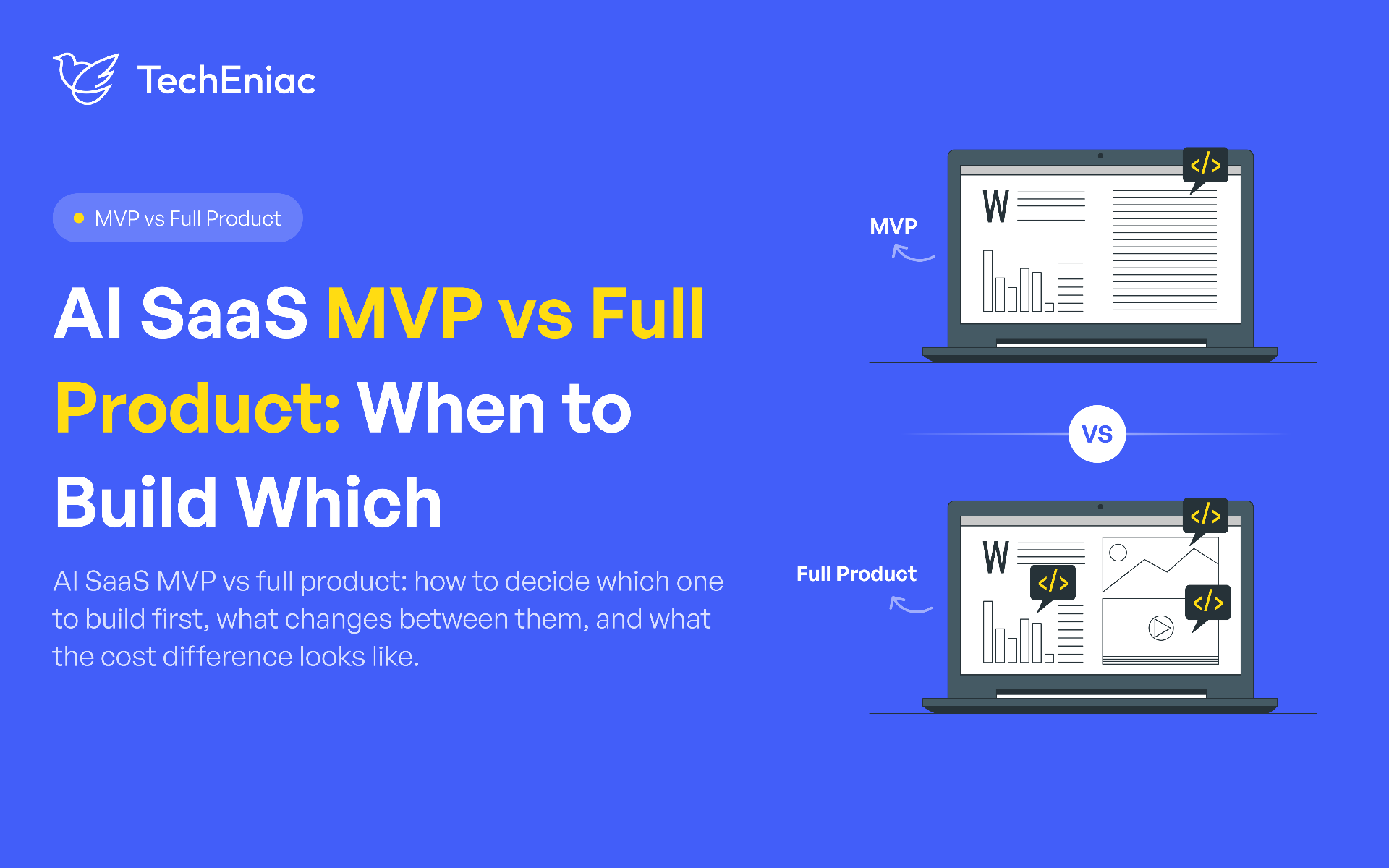
An MVP tests whether people want your product, and a full product serves the people who do. The order you build them in decides how safely your budget is spent.
What Is an MVP?
An MVP is the smallest version of a product that tests whether your core value proposition is real. It does one thing well enough that real users can tell you whether the rest is worth building.
What Is a Full Product?
A full product is that validated idea built out with the infrastructure, feature depth, and reliability to serve a growing user base at scale.
Which Question Does Each One Answer?
An MVP answers "does anyone want this?" A full product answers, "how do we serve this well to a lot of people?" Answering them in that order keeps a large budget from riding on an untested assumption.
Why AI Products Need an MVP First
An MVP matters even more for AI products than for traditional software, because an AI feature that impresses in a demo can behave very differently once real users get hold of it. Real people type messy questions, upload odd file formats, and ask for things nobody planned for. This is where AI SaaS MVP Development earns its place. It puts the feature in front of those users within weeks, so you learn what works while changing direction is still inexpensive.
When an MVP Is the Right Call
An MVP is almost always the right starting point, and four signals make that clear:
You want proof from real users: Enthusiasm from friends and advisors feels like validation, but real proof comes from strangers using the product. An MVP puts a focused, testable version in front of them in 8 to 12 weeks.
Your runway is measured in months: A lean MVP keeps budget in reserve to iterate on what users tell you, something a full build rarely leaves room for.
You're still learning which feature drives value: Founders often assume they know which feature matters most. An MVP built around that assumption and tested with real usage confirms it or corrects it cheaply.
You plan to raise a pre seed or seed round on traction: A working MVP with real early users is a far stronger fundraising asset than a polished deck describing a vision.
When a Full Product Is the Right Call
The signals flip once a few specific conditions are true.
The core value proposition is already validated. Real users are engaging with the MVP, and the data shows people actually want what you built, not just that they tried it once, which is where AI SaaS Product Development picks up, architecting the full build properly from that validated starting point.
The MVP has outgrown its foundation: Pages slow down under real traffic, the data model needs to handle many customer accounts at once, or the architecture needs reshaping before the next feature can land. These are the usual signs. The usual fix is to strengthen the base while the product stays live. That is the work behind SaaS Product Engineering & Scaling, and it avoids a ground up rebuild.
The product is entering a regulated industry: Healthcare, finance, and similar sectors expect compliance once real customers are involved, including HIPAA safeguards, SOC 2 aligned practices, and audit logging. An MVP is usually scoped around the core workflow, so a full product is where these get built in properly.
Why AI Specifically Changes This Calculation
AI SaaS products carry a validation risk traditional software doesn't. A traditional feature either works or it doesn't, and that's usually visible quickly. An AI feature can pass every test a team runs internally and still behave unpredictably once real users bring inputs nobody anticipated, an unusual phrasing, an edge case document format, a workflow the team never considered when writing the system prompt.
This is exactly why an MVP matters more, not less, for an AI product. It's the cheapest place to discover that an AI feature needs a different approach entirely, a different retrieval strategy, a different model, or in some cases no AI at all. Finding that out after a full product has been built around the wrong approach costs far more than finding it out during an 8-to-12-week MVP built specifically to surface that answer.
MVP vs Full Product: Cost, Timeline, and Team Differences
Factor | AI SaaS MVP | Full Product |
|---|---|---|
Primary goal | Validate the core value proposition | Scale a validated product to more users |
Typical timeline | 8 to 12 weeks | 4 to 9 months |
Typical cost | $15,000 to $70,000 | $100,000 to $500,000+ |
Team size | Small, focused team | Full cross-functional team |
Infrastructure | Lean, single-tenant or lightly multi-tenant | Multi-tenant, built for scale and compliance |
Feature scope | One core workflow, done well | Full feature depth across the product |
Success measure | Real user validation | Retention, usage growth, revenue |
The table makes the pattern clear: an MVP is built to answer a question cheaply; a full product is built to serve an answer that's already confirmed.
MVP to Full Product Cost Difference: What Actually Changes
The jump from MVP to full product costs more than "extra features," and understanding why prevents budget surprises later.
Multi-tenant infrastructure replaces a lighter setup: An MVP can often get away with simpler infrastructure. A full product generally needs proper multi-tenant architecture, role-based access, and the ability to onboard many organizations without a redesign.
Compliance and security work moves from optional to required: An MVP validating an idea in a regulated space can sometimes defer full compliance infrastructure. A full product serving real paying customers in that space usually can't.
The team grows from a focused build team to a full product team: An MVP typically runs on a small, dedicated team. A full product usually needs dedicated roles across frontend, backend, AI, DevOps, and ongoing support, not just development capacity.
Ongoing AI and infrastructure costs scale with real usage: Token spend, hosting, and monitoring costs that were minor during MVP testing become a real, ongoing line item once usage grows past a handful of early users.
Common Mistakes When Choosing Between MVP and Full Build
A few patterns show up repeatedly in founders who choose wrong.
Building the full product to look more fundable: A polished full build without real users is generally a weaker fundraising asset than a scrappy MVP with genuine traction, not a stronger one.
Treating the MVP as throwaway code: An MVP built with zero regard for what comes next often needs a full rebuild the moment it validates, turning a cost-saving first phase into a second, redundant expense.
Skipping validation because the team is confident: Confidence isn't evidence. The value of an MVP is that it produces evidence a pitch deck can't.
Waiting too long to move to a full build: Once validation is real, delaying the full build risks losing momentum, competitors catching up, or an MVP's limited infrastructure becoming the actual bottleneck to growth.
How TechEniac Approaches This Decision
We don't default to pitching whichever build is bigger. The first real conversation is about where your product sits, validated or not, funded for which stage, and what happens if the MVP succeeds.
For founders who haven't validated yet, AI SaaS MVP Development is built specifically around getting a focused, testable version in front of real users in 8 to 12 weeks, on an architecture that can extend rather than get thrown away. For founders past that stage with a validated idea ready to scale, AI SaaS Product Development is where the full build gets architected properly from the start. If you've already got a live product hitting real growth limits, SaaS Product Engineering & Scaling is the work that gets it past those limits without a ground-up rebuild. And if you're still not sure which stage you're at, an AI Consulting Services conversation is built exactly to settle that before any budget gets committed either direction.