Quick Summary
The question most businesses ask is which engagement model is better a dedicated team or staff augmentation. That's the wrong question. Neither model is objectively superior, and the businesses that get this decision wrong almost always do so because they picked based on cost or popularity rather than matching the model to their project's actual maturity and how much control they need to retain. This guide compares dedicated teams and staff augmentation directly, places extended team into the picture as a related third option, and walks through real scenarios so the decision becomes obvious rather than theoretical. It closes with a practical framework, a FAQ, and key takeaways.
What Is a Dedicated Team
The clearest way to understand these two models is to compare them directly rather than define them one at a time, since the difference between them comes down to a single underlying question: who owns delivery.
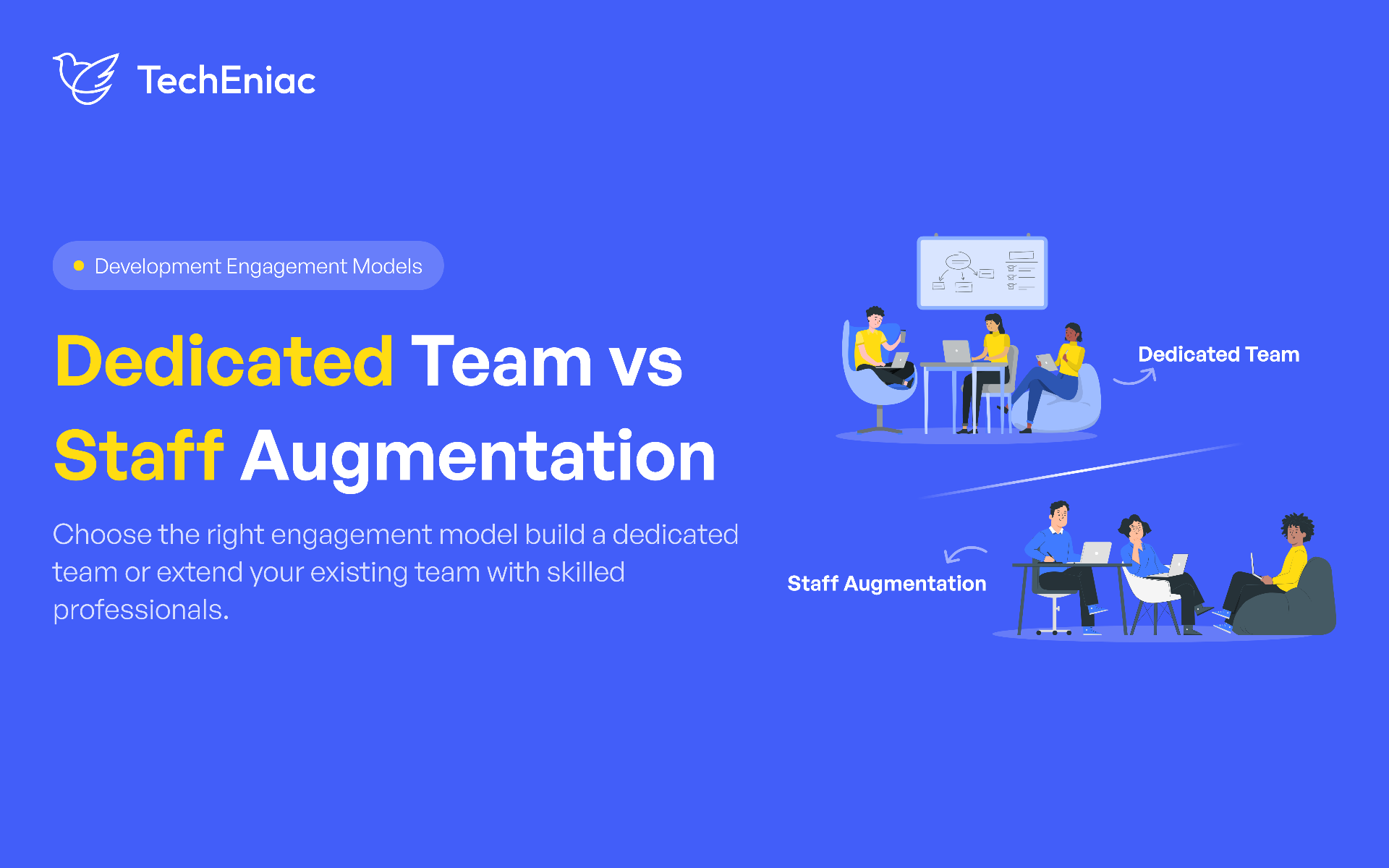
A dedicated team is a complete, self-contained unit developers, a project lead, often QA and design assembled by an external provider and assigned entirely to one client's project. The provider recruits, manages, and retains this team, but the client sets the product direction and priorities. Ownership of delivery sits with the dedicated team itself. If a feature ships late or a bug slips through, that responsibility sits with the team and the provider managing it, not with individual contributors the client must chase down separately.
What Is Staff Augmentation
Staff augmentation works differently. Instead of handing over ownership of an outcome, a business brings in individual specialists a backend developer, a DevOps engineer, a data scientist who plug directly into its own existing team and follow its own management and workflows. The client retains full ownership of delivery. Staff augmentation fills a skill or capacity gap. It does not take delivery off the client's plate.
Choose a dedicated team when you want an outcome delivered and are comfortable handing over execution. Choose staff augmentation when your management structure is already in place and you simply need more hands or a specific skill inside it.
Where Extended Team Fits into This Comparison
A third model, extended team, sits between a dedicated team and staff augmentation. It blends a client's in-house staff with an outsourced group working under the client's own leadership, sharing tools, sprints, and culture as one combined unit. In practice, it is less a standalone starting choice and more where staff augmentation naturally evolves once a temporary gap turns into a sustained, deeper engagement. The table below compares all three models directly.
Factor | Dedicated Team | Staff Augmentation | Extended Team |
|---|---|---|---|
Who owns delivery | Provider owns delivery outcomes | Client owns delivery outcomes | Client owns delivery, shared execution |
Day-to-day control | Provider manages the team | Client fully manages the specialist | Client leadership manages, larger headcount |
Best for project length | Six months or longer | Under three months | Three to twelve months |
Cost structure | Fixed or near fixed | Hourly or per engagement | Combined headcount retainer |
Management overhead | Lowest for the client | Highest for the client | Moderate, shared |
How it starts | Deliberate choice from day one | Deliberate choice for a defined gap | Usually evolves from staff augmentation |
Ideal use case | Full product ownership needed | Narrow, well-defined skill gap | Sustained capacity under client leadership |
Team composition | Fully external, provider assembled | Individual specialists only | Blended internal and external |
Benefits of a Dedicated Team
The real case for a dedicated team is not simply that it is convenient. It comes down to predictable ownership a business gets a single, accountable unit responsible for outcomes end to end, rather than a set of individual contributors who each need daily direction.
Cost predictability. A dedicated team typically operates on a fixed or near-fixed structure, unlike hourly augmented resources where the budget expands every time scope shifts mid-project.
A single point of accountability. One team lead is answerable for delivery, so a client is not left coordinating and chasing several individual specialists separately when something falls behind.
Freed up internal leadership bandwidth. When a dedicated team owns execution, internal product leaders spend their time on product direction and strategy instead of day-to-day people management of external contributors.
Compounding domain expertise. A dedicated team that stays on a product for a year builds a real understanding of its edge cases, its customers, and its technical debt depth a rotating set of augmented specialists rarely develops, since continuity is the whole point of the model.
Benefits of Staff Augmentation
Where a dedicated team's advantage is ownership, staff augmentation's advantage is precision. A business is not buying a team it is buying an exact skill for an exact window of time, and nothing more than that.
No bench cost for short-term needs. Staff augmentation lets a business pay for expertise only while a specific gap exists, rather than committing to a team retained for a full project lifecycle.
No new team culture to manage. The client's own team and processes remain fully in charge, with the augmented specialist simply plugging into what already exists.
Real flexibility as needs shift. Swapping a frontend specialist for a security engineer partway through a project is a conversation with a staffing partner, not a renegotiation of an entire outsourced team's scope.
This model is also why the global market for it has grown as fast as it has. According to Verified Market Research, the global IT staff augmentation market was valued at roughly $299.3 billion in 2024 and is projected to reach $857.2 billion by 2032, a compound annual growth rate of 13.2%, reflecting just how many businesses are choosing precision, flexible staffing over rigid, full-time hiring to solve narrow technical gaps.
Dedicated Team vs Staff Augmentation vs Extended Team: Control, Cost, and Timeline Compared
Every factor covered so far narrows down to four things that decide this choice. Get these four right, and the rest of the decision tends to fall into place on its own.
Control shifts depending on who is directing the workday. Staff augmentation keeps that control entirely with the client, since the specialist operates inside the client's own structure. A dedicated team hands more of that control to the provider in exchange for full ownership of the outcome. Extended team splits the difference client leadership stays in charge while execution is shared across the combined group.
Cost behaves differently depending on how the engagement is structured. A dedicated team runs on a fixed or near-fixed basis tied to the team's composition, which holds steady even as scope shifts. Staff augmentation ties cost to hours or a specific engagement cheaper for a narrow ask but prone to creeping upward if that scope expands. Extended team typically settles into a combined headcount retainer, priced between the two.
Timeline is often the clearest signal of all. A gap under three months almost always points to staff augmentation. A product maturing over three to twelve months, needing sustained combined capacity, points to extended team. Anything six months or longer, with requirements still likely to shift, points to a dedicated team.
Management load falls hardest on whichever side retains the most control. A dedicated team asks the least of internal leadership, since the provider runs the team directly. Staff augmentation asks the most, since every specialist needs to be integrated and directed by the client's own managers. Extended team lands in between real involvement, but shared rather than solo.
Real Scenarios: Which Model Fits Which Situation
Abstract comparisons are useful, but decisions get made against real situations, so consider three concrete ones.
A pre-seed startup with no technical co-founder is trying to build an MVP from a blank page. There is no internal team to augment, no existing process to plug a specialist into, and full ownership of delivery is exactly what the founder needs since they lack the technical background to manage day-to-day execution themselves. This is a clear dedicated team situation.
A scaling SaaS company with a healthy internal engineering team suddenly needs a specialist to lead a single, well-defined infrastructure migration over the next six weeks. The internal team already owns the product and its processes; they simply lack one specific skill for a short window. This is a clear staff augmentation situation, bringing in narrow expertise without disrupting an already functioning internal structure.
An established company with an existing web product wants to add a mobile app alongside it a meaningful expansion that will run for the better part of a year, led by the company's own product leadership but requiring substantially more engineering capacity than the internal team currently has. This sits squarely in extended team territory: a sustained combined effort under internal leadership rather than either a narrow skill fill or a fully outsourced deliverable.
Common Mistakes Businesses Make When Choosing a Model
A few patterns show up repeatedly among businesses that choose the wrong engagement model, and most competitor content on this topic skips straight past them.
Choosing staff augmentation for undefined, evolving scope. Staff augmentation assumes the client already knows what needs to be built and simply needs more hands to build it. When requirements are still shifting significantly, a dedicated team's built-in ownership and adaptability serves the project far better than adding individual specialists into a management structure that hasn't yet stabilized.
Hiring a full dedicated team for a short, well-defined task. A task that will realistically wrap up in two months rarely justifies a dedicated team, since the project absorbs onboarding and ramp-up costs it never gets enough runway to recoup. A single augmented specialist would solve the same problem at a fraction of the overhead.
Underestimating the communication overhead of staff augmentation. The model's flexibility only pays off if the client's internal team has the bandwidth to integrate and direct that resource daily, especially across a meaningfully different time zone. Businesses that assume an augmented specialist will simply run independently often find delivery slows rather than accelerates.
How to Choose the Right Model for Your Business
Rather than repeating the comparison above, a short set of questions tends to cut through the decision quickly.
How long will this need realistically last? Under three months points toward staff augmentation, over six months with evolving scope points toward a dedicated team, and something in between usually points toward extended team.
How much day-to-day control do you want to keep? If your internal team should stay firmly in charge of execution, staff augmentation or extended team fits better than a dedicated team, which shifts more of that control to the provider.
Do you have the internal management bandwidth to direct outside specialists daily? If the honest answer is no, a dedicated team's built-in management removes that burden entirely.
Is the scope of the work still genuinely undefined? If yes, a dedicated team's adaptability handles shifting requirements far better than staff augmentation, which works best against a reasonably fixed scope.
How Techeniac Helps You Build the Right Team
Most businesses do not actually struggle to understand these models in the abstract. They struggle to map their own specific project honestly against them, and that honesty is often easier with an outside perspective.
At Techeniac, our teams work directly with founders and product leaders through our dedicated AI SaaS product development service, owning a product's architecture and delivery from the first sprint through launch, which fits naturally for teams that need full ownership rather than a set of individual contributors to manage. For businesses that already have a working product and simply need additional engineering capacity to scale it, our SaaS scaling and engineering support is built around exactly that kind of augmentation, adding the right specialized capacity into an existing team and process rather than replacing it.
Key Takeaways
The right engagement model depends on project maturity and how much control you want to retain, not on which model is cheaper or more popular.
A dedicated team owns delivery end to end and fits best for long, evolving projects where full ownership matters more than granular control.
Staff augmentation fills a narrow, well-defined skill gap inside your existing team and processes, and fits best for short, clearly scoped needs.
Extended team is usually a natural evolution of staff augmentation into a sustained, combined effort, not a separate starting decision.
The most common mistake is mismatching model to project definition choosing augmentation for undefined, evolving scope, or a full dedicated team for a task that will wrap up in weeks.
Project duration, desired control level, and internal management bandwidth are the three questions that resolve this decision fastest.