Quick Summary
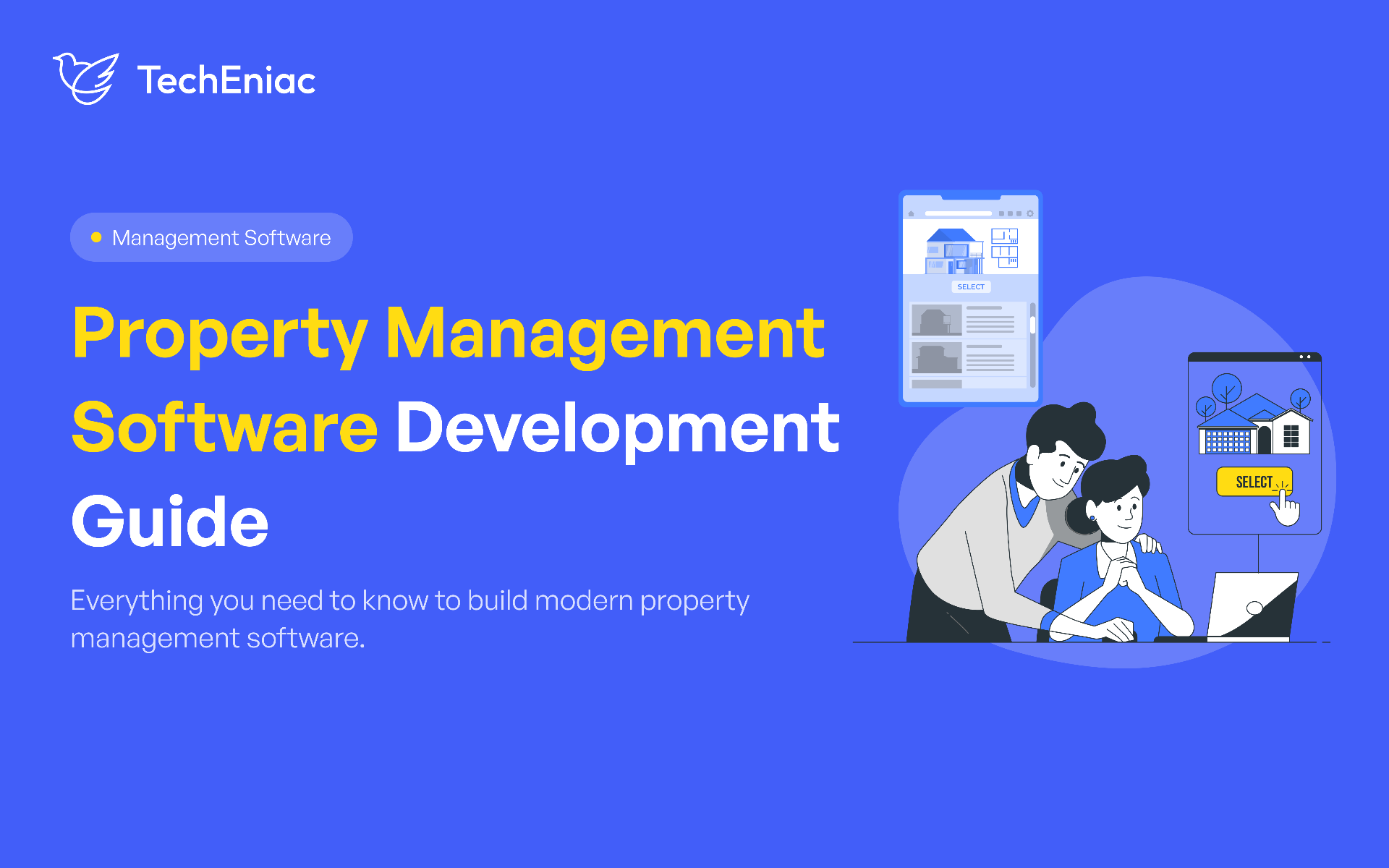
Property management software development involves designing and building a digital platform to manage properties, tenants, leases, rent collection, maintenance, accounting, documents, reporting, and other real estate operations from one system.
How to Develop Property Management Software: The Right Approach
Here's what most teams get wrong before they write a single line of code: they treat this as a coding problem. It isn't. Property management software development is a systems integration problem wrapped around a very specific operational reality, rent has to be collected, leases have to be tracked, and maintenance requests have to reach the right technician, and none of it can go down for even a day without real financial consequences for a property owner.
The teams that get this right start from a different place. They treat the software as a unified operating layer, not a collection of disconnected features bolted together. Before any development begins, three questions need honest answers. Who are the actual users, owners, managers, tenants, and what does each one need to see and do. What already exists today, spreadsheets, a legacy system, years of tenant data, that must migrate cleanly rather than get left behind. And should this be a custom build, a configured off the shelf platform, or a hybrid of the two, a decision worth settling in a AI Consulting Services conversation before any development budget gets committed.
This single framing decision is the one that matters most. Get it right before writing a line of code, and the PMS scales cleanly as the portfolio grows. Get it wrong, and the same system needs a full rebuild eighteen months after launch, usually right when the business can least afford the disruption.
Types of Property Management Software
Not every PMS solves the same problem, and the type of property being managed changes almost everything downstream, which features matter most, what integrations are non-negotiable, and how the system needs to handle compliance.
Residential PMS: Built around individual leases, tenant screening, rent collection, and maintenance requests for apartments, single family rentals, and multi-unit residential portfolios. This is the most common starting point and the category most off the shelf platforms are built for first.
Commercial PMS: Manages office, retail, and industrial leases, which tend to run longer, involve more complex terms, common area maintenance charges, and require deeper financial reporting than a typical residential lease.
Hospitality and Vacation Rental PMS: Centres on short term bookings, dynamic pricing, channel management across platforms like Airbnb and Booking.com, and housekeeping or turnover scheduling, a fundamentally different operational rhythm than long term residential leasing.
Industrial PMS: Covers warehouses, distribution centres, and industrial facilities, where lease terms, equipment tracking, and safety compliance requirements look closer to commercial PMS but with heavier emphasis on facility and equipment management.
HOA and Community Association PMS: Built for homeowner's associations and community management, handling dues collection, community communication, amenity booking, and governance documentation rather than individual tenant leases.
Beyond property type, PMS platforms also split by deployment model. Cloud based PMS runs on a vendor's infrastructure, updates automatically, and is typically faster to get running. Custom built PMS gives full control over architecture, data ownership, and feature scope, and makes more sense once a business's workflows or growth plans outgrow what a generic cloud platform supports well. Most growing property management businesses start with a cloud-based tool and move to a custom build once scale or workflow complexity makes the trade-offs worth it, the same build versus buy logic covered later in this guide.
Requirements of Property Management Software
Every well-built PMS is grounded in a clear set of functional and technical requirements. Skipping this step is the single most common reason a project runs over budget.
Functional Requirements
Functional requirements define what the software must do for its users.
Centralized property, tenant, and lease data accessible from a single dashboard
Automated rent collection, invoicing, and late payment tracking
Maintenance request submission, technician assignment, and resolution tracking
Document storage for leases, receipts, and compliance records, with full audit trails
Role based access so owners, managers, and tenants each see only what they need
Non-Functional Requirements
Non-functional requirements define how well the system needs to perform under real conditions.
High availability, since a PMS going down during a payment cycle has direct financial impact
Data security strong enough to handle financial records and personally identifiable tenant information
Scalability to support a growing number of properties and users without a system redesign
Fast response times on dashboards and reporting, even across large, multi-property portfolios
Compliance with regional data protection and real estate regulations
Documenting both sets of requirements before development starts is what allows a team to correctly scope features, choose the right tech stack, and estimate cost with real confidence instead of guesswork.
How to Build Property Management Software: 7-Step Development Process
Step 1: Discovery and requirement gathering. Define the business model, target users, and required modules before any design work starts, the same discovery discipline behind how we approach every product build.
Step 2: Architecture and platform selection. Decide between mobile and web, microservices and monolith, and cloud versus on premise, based on the requirements gathered in step one.
Step 3: Design and prototyping. Build wireframes and prototypes for each user persona, owner, manager, tenant, and gather feedback before committing to full development.
Step 4: Frontend and backend development. Build out the finance, maintenance, tenant, and lease modules alongside the APIs that connect them to external systems.
Step 5: Testing and quality assurance. Run functional, security, performance, and compliance testing, with rigor around any automated valuation or financial calculation logic.
Step 6: Deployment and go live. Roll out in stages, a pilot group, then broader deployment, rather than a single hard cutover, and train the actual end users on the new system.
Step 7: Support, maintenance, and continuous improvement. Monitor real usage, fix issues quickly, and iterate based on user feedback rather than treating launch as the finish line.
Best Tech Stack for Property Management Software Development
Choosing a tech stack for property management software should start with the product, not the technology. The stack exists to serve what the business needs, not the other way around, and this is the exact philosophy Techeniac applies when architecting SaaS platforms for founders.
Before any framework gets picked, three questions need answers.
Does the feature genuinely need AI, or would rules based logic solve it more reliably and cheaply? Not every maintenance prediction or tenant screening step needs a model behind it.
What accuracy and reliability level does this specific feature require? A rent reminder tolerates more error than a compliance report.
What belongs in a first version, and what can be added once the platform has real usage data?
With those answered, a typical modern PMS stack looks like this.
Frontend: React or Next.js for a fast, component driven interface that works cleanly across web and mobile
Backend: Node.js for a scalable, event driven API layer, paired with GraphQL where multiple clients, web, mobile, and partner integrations, need flexible data access
Database: A relational database for financial and lease records where data integrity is non-negotiable, often paired with a document store for unstructured data like maintenance photos or inspection reports
Cloud infrastructure: A cloud native setup on AWS with container orchestration for auto scaling and high uptime as a portfolio grows from a handful of properties to thousands of units
AI and automation layer: Large language models such as OpenAI or Claude for tenant facing chat and document summarization, paired with a retrieval pipeline using a vector database so responses stay grounded in the property's own lease and policy documents rather than generating unverified answers
The mistake most teams make is picking a stack because it sounds modern, agentic AI everywhere, the newest framework, rather than because it solves a validated problem for the specific PMS being built. A tech stack chosen this way, product first, technology second, is what keeps a PMS maintainable five years after launch rather than needing a rebuild.
Core Features to Include When Developing a PMS
Property management software features generally fall into a few functional categories, and a well-designed system covers all of them rather than over investing in one at the expense of the rest.
Rent and Financial Management
This is the financial backbone of any PMS, and it should include automated rent collection through digital payment gateways, expense tracking with general ledger and accounting software integration, and financial reporting alongside revenue forecasting.
Tenant and Lease Management
This category governs how a business manages the full tenant lifecycle. It should include tenant onboarding, screening, and communication tools, lease creation with renewal tracking and expiration alerts, and a self-service tenant portal for payments and requests.
Maintenance and Work Order Management
Maintenance is where operational efficiency is won or lost, and the software should support maintenance request submission with technician assignment, preventive maintenance scheduling, and resolution tracking with vendor coordination.
Document and Compliance Management
Given the regulatory weight property data carries, this category requires centralized, searchable storage for leases, receipts, and disclosures, a full audit trail for every document action, and regional regulatory compliance tracking built directly into the workflow.
Reporting, Analytics, and Dashboards
Data only creates value when it is visible and actionable. This means portfolio wide performance metrics covering occupancy, rental yield, and vacancy rates, dedicated budgeting and forecasting tools, and real time visibility for both owners and managers.
Mobile and Portal Access
Property management happens as much in the field as at a desk, which makes responsive web and mobile access essential, alongside real time communication between managers, tenants, and technicians.
Integration and External Interfaces
Finally, a PMS is only as useful as the ecosystem it connects to. This requires reliable integration and automation work connecting accounting software, CRM platforms, IoT sensors, marketing channels, and payment gateways.
From Basic to Advanced PMS: The Real Evolution Path
Understanding where a PMS sits on this evolution path is one of the most useful diagnostic tools available before starting a build, since it reveals exactly what problem the software needs to solve.
Phase 1: Spreadsheets and manual processes. Property managers track everything through Excel, phone calls, and paper leases. There is no centralized data, which means high error rates and no real scalability.
Phase 2: Basic PMS for core automation. The business adopts a system for rent collection, basic maintenance logging, and lease tracking, but modules often run in isolated silos with limited cross visibility.
Phase 3: Integrated cloud-based PMS. Data moves to the cloud, modules connect to each other, and mobile access becomes possible, giving managers a genuinely centralized system for the first time.
Phase 4: Data driven analytics layer. Dashboards and analytics get layered on top, covering vacancy trends, rental yield, and forecasting, letting managers make decisions based on real portfolio data rather than instinct.
Phase 5: AI powered smart PMS. The system integrates machine learning for behavioural analytics, chatbots, dynamic pricing, tenant screening, and predictive maintenance, often alongside IoT sensors for real time building monitoring and digital twin modelling, the kind of ground up architecture work covered under AI SaaS Product Development.
Most real estate businesses are not actually behind because they lack AI. They are behind because they have not fully completed phases 2 and 3, integration and centralization, which are the real foundation everything after them depends on.
Benefits of Property Management Software Development
The return on a well-built PMS shows up in measurable operational terms, not just convenience.
Reduced manual operations. Workflow automation and process automation can cut manual operational work by 30% to 40%.
Faster lease cycles. E signing and integrated CRM workflows can shorten lease cycles by 20% to 30%.
Lower maintenance costs. Predictive analytics and IoT integration can reduce maintenance costs by 15% to 25% by catching issues before they become expensive emergencies.
Higher net operating income. Dynamic pricing, delinquency risk scoring, and vacancy forecasting can lift net operating income by 10% to 15%.
Enterprise grade reliability. Cloud native, containerized architectures can support uptime above 99.9%, with dashboard response times under 200 milliseconds even across large portfolios.
These are not marketing numbers. They reflect what a genuinely integrated, automation first PMS changes at the operational level, not just what a feature list promises.
Challenges in Property Management Software Development
Building a PMS is rarely a smooth, linear process, and a few challenges show up consistently across projects.
Fragmented system architecture. Many legacy platforms lack modularity, making updates slow and risky. The fix is rebuilding around clean, modular APIs and microservices rather than patching a monolithic legacy system indefinitely.
Complex third-party integrations. A modern PMS needs to connect cleanly with IoT systems, accounting tools, payment gateways, and CRMs. This requires interoperable APIs and a dedicated integration layer designed from the start, not bolted on after launch.
Data security and compliance risk. Property, financial, and tenant data all carry strict governance requirements. Strong encryption, secure authentication, and role-based access control needs to be built in from day one, not retrofitted later.
Performance and scalability limits. As a portfolio grows, a poorly architected PMS slows down or experiences downtime. Cloud native architecture with load balancing is what keeps performance stable as usage scales.
Property Management Software Development Cost
Cost estimates vary based on scope, but industry data converges around a consistent range.
Simple or basic PMS: roughly $30,000 to $60,000, with a development timeline of 3 to 6 months. This typically covers core rent collection, basic maintenance tracking, and lease management without heavy customization.
Moderately complex or mid-tier PMS: roughly $60,000 to $120,000, with a timeline of 5 to 8 months. This tier usually adds CRM integration, advanced reporting, and multiple third-party connections.
Highly complex or enterprise grade PMS: $100,000 and up, often reaching $250,000, with a timeline of 8 to 12 months or longer. This tier includes AI powered features, IoT integration, multi region compliance, and support for large, multi-property portfolios.
These figures are directional. The only way to get an exact number for a specific project is a detailed scoping conversation with a development partner who can map the actual feature list against these cost drivers.
How Techeniac Helps Build Property Management Software
Most property management software projects do not fail because of a bad idea. They fail because of an under scoped architecture that cannot handle the second year of growth, a tech stack chosen for hype rather than fit, or integrations that were treated as an afterthought.
At Techeniac, our engineering teams approach PMS development the way we approach every SaaS product: the stack serves the product, not the other way around. Through AI SaaS product development, we help property management founders and businesses architect a system that is right sized for where they are today and built to scale without a rebuild. For platforms that have already launched and are now hitting real growth, our SaaS product engineering and scaling work focuses specifically on the integration, performance, and reliability work a growing portfolio demands.
Key Takeaways
Core features cluster around five areas: financial management, tenant and lease tracking, maintenance, document compliance, and reporting.
The right tech stack serves the product's needs, not the latest trend, which keeps a PMS maintainable for years.
Most businesses are behind on integration and centralization, not on AI.
PMS types split by property type (residential, commercial, hospitality, industrial, HOA) and deployment model (cloud based or custom).
Measurable ROI, less manual work, faster lease cycles, higher net operating income, makes PMS a financial decision, not just a convenience.
Cost ranges from 30,000 to 250,000 dollars or more, driven mainly by team location and integration count.
Custom versus off the shelf should hinge on workflow complexity and growth plans, not upfront cost alone.