Quick Summary
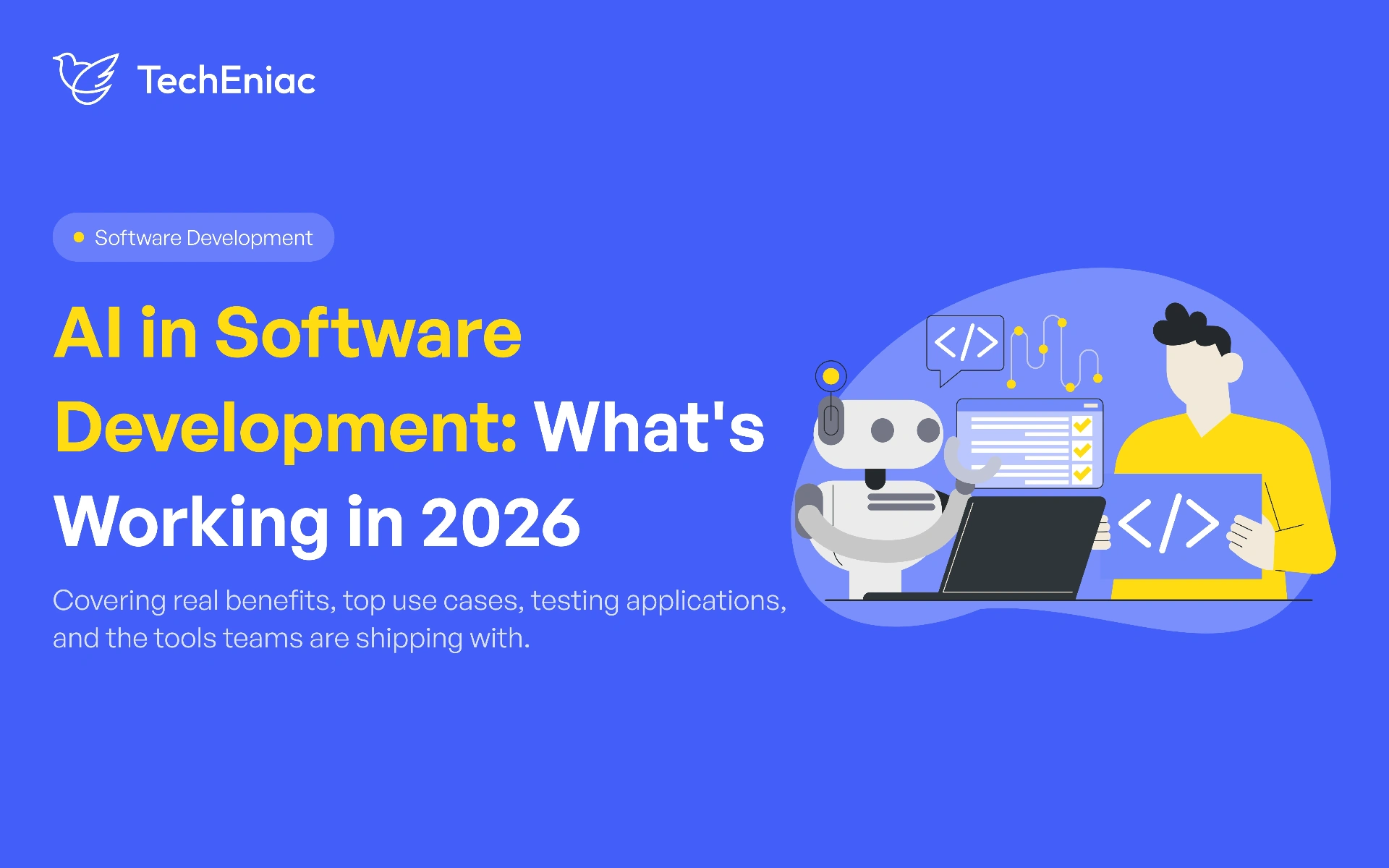
A senior engineer at a mid-sized SaaS company used to spend the first hour of every day writing the same boilerplate authentication logic across three different services. Now that hour is gone, absorbed by a tool that drafts the scaffolding while the engineer reviews and ships. Multiply that hour across a team of forty engineers, five days a week, and the math stops looking like a productivity anecdote and starts looking like a structural shift in how software gets built. AI in software development is not a future trend anymore. It is already sitting inside the editor of most professional developers, whether their organization has formally adopted it or not.
What Is AI in Software Development?
Artificial intelligence in software development refers to the use of machine learning models, most often large language models, to assist with writing, testing, reviewing, and maintaining code. This spans everything from inline code completion inside an editor to autonomous agents that can open a pull request on their own. The common thread is that a system trained on patterns across millions of codebases is now doing work that used to require a human typing every line by hand.
Key Takeaways
AI in software development has moved from experimental to standard practice, with adoption above 80 percent among professional developers in the most recent major surveys.
Controlled research shows real productivity gains, including a documented 55.8 percent speed increase on coding tasks in a Microsoft Research study.
Code generation, testing, review, debugging, and CI/CD automation are the five use cases delivering the clearest value today.
Trust in AI output has not kept pace with adoption, and delivery instability remains a real risk during scaling.
The strongest results come from teams that already have solid engineering practices, since AI tends to amplify existing strengths and weaknesses rather than fixing dysfunction on its own.
AI in the Software Development Lifecycle
AI now touches nearly every phase of the software development lifecycle, not just the coding stage most people associate it with.
Requirements and Planning: AI assists with parsing requirements documents, drafting user stories, and flagging ambiguous or conflicting requirements before a sprint even starts.
Design and Architecture: Large language models can propose architecture options, compare tradeoffs between approaches, and generate initial system diagrams a team can iterate on rather than starting from a blank page.
Development and Coding: This is where adoption is highest, inline completion, function generation, and increasingly full task completion through coding agents that read a repository and implement a change end to end.
Testing and Quality Assurance: AI generates unit and integration tests, identifies untested edge cases, and increasingly writes regression tests directly from a production incident report.
Deployment and DevOps: AI agents monitor CI/CD pipelines, detect the likely cause of a failed build, and either resolve it automatically or hand off with enough context for a fast human fix.
Maintenance and Documentation: Once software ships, AI helps keep documentation current, explains unfamiliar legacy code to new engineers, and assists with modernization work on older codebases that would otherwise sit untouched.
The sections below go deeper on the use cases and tools behind each of these phases, starting with how fast adoption has moved.
The Role of AI in Software Development in 2026: Overview and Evaluation
The Scale of the Shift
Adoption numbers in this space have moved fast enough that a survey from eighteen months ago already reads as outdated. Stack Overflow's most recent Developer Survey found that 84 percent of developers are now using or planning to use AI tools in their development process, up from 76% the year before, with 51% of professional developers reporting daily use. Google Cloud's DORA research team, which has tracked software delivery performance for over a decade, found an even higher figure among the technology professionals it surveyed: AI adoption reached 90%, with users spending a median of two hours a day working with AI tools.
The Paradigm Shift from Autocomplete to Autonomy
The first wave of AI coding tools worked like a faster autocomplete, suggesting the next line while a developer stayed firmly in control. What has changed since is the scope of what these systems attempt on their own. Coding agents can now read an entire repository, plan a multi file change, write the code, run the tests, and open a pull request with a description attached, checking in with a human only at defined points rather than after every keystroke.
A controlled study run by Microsoft Research put a number on the underlying capability gain: developers using GitHub Copilot to build an HTTP server completed the task 55.8 percent faster than developers working without it. That gap is large enough to explain why so much of the industry has moved past pilot programs and into standard workflow.
Benefits of AI in Software Development
The advantages tend to cluster around a few recurring themes across teams of very different sizes and maturity levels.
Faster feature delivery: Boilerplate, repetitive scaffolding, and routine implementation work get handled in a fraction of the time it would take a developer typing every line manually.
Lower cognitive load: Developers spend less mental energy on syntax and memory recall, freeing attention for architecture and logic decisions that need human judgment.
Broader test coverage: AI can generate test cases across edge conditions a developer might not think to check manually, catching issues earlier in the cycle.
Faster onboarding: New engineers ramp up more quickly when an AI assistant can explain unfamiliar parts of a codebase in plain language rather than requiring a senior developer's time for every question.
More consistent code quality: Automated review tools flag style violations, security issues, and anti-patterns before a human reviewer even opens the pull request.
Better documentation coverage: Generating and maintaining documentation, historically one of the most neglected parts of software work, becomes far less costly to keep current.
Comprehensive AI in Software Development Use Case Comparison
Development Stage | Specific AI Use Case | Core Tech Used |
|---|---|---|
Planning and design | Requirement analysis and architecture suggestions | Large language models, natural language processing |
Coding | Code generation and inline completion | Code focused LLMs, transformer-based models |
Testing | Automated test case generation and coverage analysis | Machine learning, generative AI |
Code review | Automated quality and security scanning | Static analysis combined with LLM reasoning |
Debugging | Root cause detection and fix suggestions | Machine learning, pattern recognition models |
DevOps and deployment | CI/CD pipeline automation and anomaly detection | AI agents, workflow automation |
Documentation | Auto generated code comments and technical docs | Generative AI, retrieval augmented generation |
Top Use Cases of AI Assisted Software Development
Code Generation and Completion
This remains the most widely used entry point into AI assisted software development, and for good reason. Tools trained on vast amounts of public and proprietary code can suggest entire functions, not just the next few characters, based on a comment or a function signature. The gap between a mediocre and a genuinely useful implementation usually comes down to how well the tool understands the surrounding codebase, which is why teams building custom AI coding assistants invest heavily in LLM Integration & Development Service rather than relying on a generic, unconfigured model.
AI for Software Testing
Testing has quietly become one of the strongest use cases for AI in engineering, because generating exhaustive test cases is exactly the kind of pattern matching work language models handle well. AI can analyse a function, infer likely edge cases, and generate unit tests a developer might never have gotten around to writing manually. Some teams are going further, using AI to analyse production incidents and automatically generate regression tests that prevent the same bug from resurfacing.
Automated Code Review
Static analysis tools have existed for years but pairing them with an LLM's reasoning ability produces reviews that catch more than syntax errors. These tools can flag a security vulnerability, explain why a particular pattern is risky, and suggest a safer alternative, all before a human reviewer spends time on it. This kind of review pipeline often needs to pull in project specific standards and prior decisions, which is where RAG Pipeline Development Service becomes relevant, grounding the review in a team's actual conventions rather than generic best practices.
Debugging and Bug Detection
Debugging has traditionally eaten a disproportionate share of engineering time, and AI is starting to change that math. Tools can now trace a stack trace back through a codebase, correlate it with recent changes, and suggest a likely root cause faster than a developer scanning logs manually. This does not remove the need for human judgment on complex, systemic bugs, but it meaningfully cuts the time spent on the more mechanical parts of the investigation.
DevOps and CI/CD Automation
Beyond writing and reviewing code, AI is increasingly involved in the pipeline that ships it. Autonomous agents can monitor build failures, identify the likely cause, and either fix the issue or flag it with enough context that a human can resolve it quickly. Teams building this kind of workflow into their pipeline typically start with focused AI Agent Development Service rather than trying to automate the entire DevOps stack in one move.
If your team is trying to figure out where to start across these five use cases, that decision is worth a focused conversation before committing engineering time. A short AI Consulting Service engagement can prevent months spent building the wrong thing first.
Best AI Development Tools Used by Software Teams Today
A handful of tools illustrate what mature AI assisted development looks like in production.
GitHub Copilot: The most widely deployed AI coding assistant, offering inline completion and increasingly autonomous coding agent capabilities integrated directly into major editors.
Cursor: An AI native code editor built around deep codebase understanding, popular with teams that want the AI woven into the entire editing experience rather than added as a plugin.
Claude Code: A command line and IDE based coding agent built to handle multi step engineering tasks, from refactoring across files to running tests and fixing failures.
Amazon Q Developer: AWS's AI assistant for software development, with strength in code migrations and modernizing legacy applications running on AWS infrastructure.
Sourcegraph Cody: A code intelligence tool focused on helping developers understand and navigate large, unfamiliar codebases using AI powered search and explanation.
Statistics on AI in Software Development
The numbers coming out of the most rigorous research programs paint a picture that is genuinely positive, though not uncomplicated. Google's 2025 DORA report found that AI adoption is now linked to higher software delivery throughput, a reversal from the previous year's findings, while also noting that AI tends to amplify a team's existing strengths and weaknesses rather than fixing dysfunction on its own. Stack Overflow's survey data adds a useful counterweight: even as usage climbed to 84%, developer trust in AI output declined, with more respondents reporting distrust of AI accuracy than trust in it. Read together, the data suggests adoption has outpaced confidence, which is a meaningfully different story than the one told by usage numbers alone.
2026 Trends in AI Software Development
A few patterns are shaping how engineering teams are approaching AI this year.
Agentic coding tools are moving from novelty to workflow: Tools capable of planning and executing multi step engineering tasks are increasingly trusted with real pull requests rather than isolated snippets.
Codebase context is becoming the real differentiator: As more tools reach similar baseline code generation quality, the tools that understand a team's specific codebase and conventions are pulling ahead.
Security and IP review are catching up to adoption: Organizations are investing more in scanning AI generated code for license conflicts and vulnerabilities, closing a gap that adoption speed created.
Engineering leaders are measuring outcomes, not just usage: The conversation is shifting from how many developers use AI tools to whether delivery throughput and quality improved as a result.
Areas of Application Across the Software Development Lifecycle
Beyond the five core use cases already covered, AI is showing up in requirements gathering and user story generation, legacy code modernization and migration, technical documentation upkeep, and infrastructure as code generation for cloud deployments. Very few stages of the software lifecycle remain untouched at this point.
Common Challenges of AI in Software Development
Adoption at this pace has not come without friction, and any honest account of this space needs to say so.
Trust and accuracy concerns: Developers increasingly report that debugging AI generated code takes longer than expected, particularly when a suggestion looks correct but contains a subtle logical error.
Delivery instability during scaling: Research from DORA has found that AI adoption correlates with higher software delivery instability, likely because code generation is outpacing the review and deployment capacity built to absorb it.
Security and intellectual property risk: AI generated code can unintentionally reproduce licensed snippets or introduce vulnerabilities that pass a quick glance but fail a deeper security review.
Inconsistent value across team maturity: Teams with strong existing engineering practices tend to see AI amplify their strengths, while teams with weaker foundations often see AI intensify existing problems instead of fixing them.
Best Practices for Adopting AI Development Tools Safely
Teams that get real value out of these tools tend to share a few habits. Code generated by AI still goes through the same review standards as human written code, without a lighter touch just because it came from a model. Sensitive systems, like authentication, payments, and anything touching regulated data, keep a human firmly in the loop rather than accepting autonomous changes outright. Teams also invest in the surrounding platform, clean internal documentation, well-structured repositories, and clear conventions, since research consistently shows AI performs best on top of strong existing engineering practices rather than compensating for weak ones.
How TechEniac Helps You Build Software With AI
We are a small team, and we would rather be upfront about that than pretend to be something larger. What it has meant in practice is staying closely involved in every engagement, including the AI native codebases we have shipped where AI capability is built into the development workflow itself rather than added as a feature afterward.
For engineering teams that want AI woven directly into their development process, whether that's code assistance, automated testing, or CI/CD automation, our Generative AI Development Service handles the model integration work end to end. For teams with an existing codebase who want to add AI capability, like intelligent code review or automated documentation, without a rebuild, our AI Integration & Automation Service focuses on exactly that.