Quick Summary
Agentic AI changes enterprise operations by letting software agents plan, decide, and finish multistep work across company systems, with people stepping in at set checkpoints. BCG reports that agent powered workflows can speed up business processes by 30% to 50%. The gains depend on redesigning a process around its outcome before any agent is deployed.
Key Takeaways
Agentic AI in operations: agents handle plans, decisions, and handoffs across systems, so work shifts from reacting to events toward resolving them early.
Outcome first redesign: BCG finds that 60% of companies have not captured material value from earlier AI waves, largely because the process itself stayed the same.
Governance from day one: Gartner expects over 40% of agentic AI projects to be canceled by the end of 2027 because of cost, unclear value, or weak risk controls.
Five step rollouts: define one outcome, redesign the process, build the foundation, pilot in shadow mode, then scale with controls.
What Agentic AI Means for Enterprise Operations
The sections below start with what agentic AI means in an operations setting. They then cover agentic AI use cases by industry, the reasons programs stall, and a five-step implementation roadmap. The final sections explain the controls that keep agents safe, the new ownership model, and the choice between building on existing systems or starting fresh.
Agentic AI describes software that takes a goal, breaks it into steps, uses company systems and tools to carry the steps out, and checks its own results. A traditional script follows a fixed path. A copilot suggests, and a person acts. An agent acts within limits that people set.
That difference is the line between AI agents and agentic AI: one completes a task; the other pursues a goal across many tasks and systems. Gartner expects the shift to arrive quickly, with 33% of enterprise software applications including agentic AI by 2028, up from less than 1% in 2024 (Gartner, June 2025). The same release projects that at least 15% of day-to-day work decisions will be made autonomously by 2028, up from 0% in 2024.
The table shows how the main automation approaches differ in practice.
Approach | Who acts | What happens when inputs change | Example |
|---|---|---|---|
Rule based automation | A fixed script | Stops at the exception | Copying invoice data into a form |
Copilot or chatbot | A person, with suggestions | The person adjusts | Drafting a reply to a support ticket |
AI agent | The agent, within set limits | The agent replans the next step | Resolving an IT ticket end to end |
Multiagent system | Several agents, one outcome | Agents coordinate across functions | An insurance claim from intake to payout |
Rule based tools remain a good fit for stable, predictable steps, and many workflow automation tools handle that layer well. Agents take over where steps vary; data arrives in mixed formats, or a decision depends on context.
Agentic AI Use Cases in Enterprise Operations by Industry
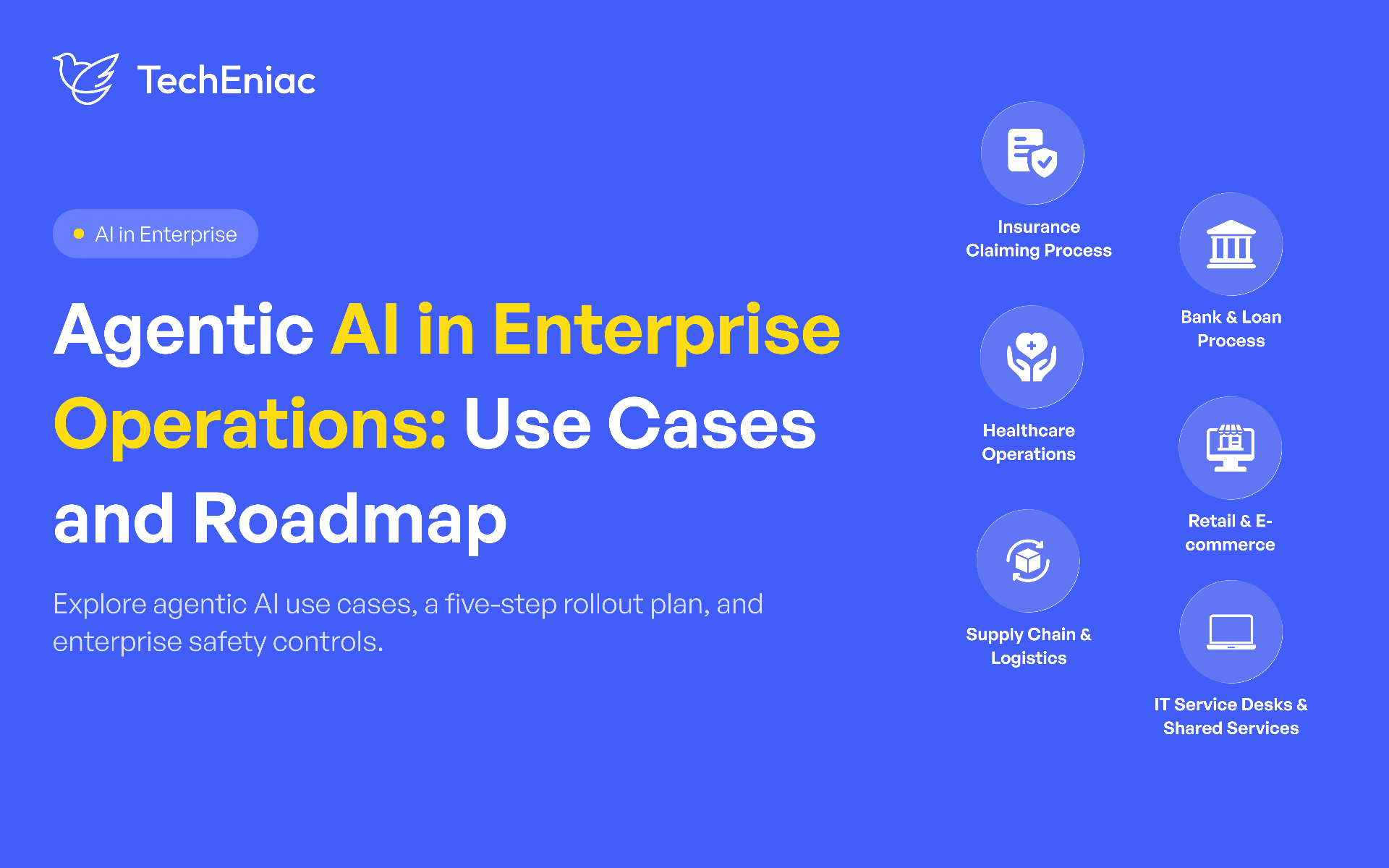
Agentic AI is already working in insurance, banking, healthcare, retail, supply chain and IT services. The pattern repeats in each one: an agent owns a complete piece of work, such as a claim or a loan file, and a person steps in at set checkpoints.
Agentic AI in Insurance Claims Processing
Claims suit agents well. An agent collects the required details, checks the documents, sorts the claim by type and risk, then pays it or passes it to an adjuster. BCG reports claim handling time cut by 40% in some cases, with net promoter scores up 15 points (BCG, October 2025).
TechEniac built a claims intake agent with a voice channel for a UK insurance broker that cut first notice of loss processing time by 78%, from 22 minutes to 4.8 minutes. The agent collects the required fields, validates them, and pushes a structured record into the broker's claims system.
Agentic AI in Banking and Loan Processing
A loan file passes through many hands, which suits an agent that reads, classifies, checks and corrects documents. BCG reports over 90% automation of end-to-end consumer loan processing at one global bank (BCG, June 2026). Finance teams use the same approach to flag unusual transactions and forecast cash, and a person approves any decision that moves money or changes a credit outcome.
Agentic AI in Healthcare Operations
Hospitals and clinics run on handoffs between the front desk, wards, and billing. Agents handle patient intake forms, appointment scheduling, bed and room assignment, and insurance paperwork. Clinical and capacity decisions stay with staff, and every agent action is logged. Because health data carries privacy rules, each agent gets access only to the records it needs.
Agentic AI in Retail and Ecommerce
Customer service, returns, and stock create a steady stream of small decisions. Agents answer order questions, process returns within set limits, move stock between locations and test campaign offers. A manager reviews any case outside those limits.
Agentic AI in Supply Chain and Logistics
Delays, shortages and supplier changes call for fast replanning. Agents watch orders and supplier updates, reroute shipments, and start procurement flows when stock runs low. Buyers approve large orders and new suppliers.
Agentic AI in IT Service Desks and Shared Services
IT service desks, HR, and finance back offices handle repeatable requests such as password resets, access requests, onboarding steps, and invoice questions. An agent resolves the whole request across the systems involved and hands up unusual ones to a specialist.
What these cases share is that the agent owns a complete piece of work with a clear finish line. Isolated tasks, such as summarizing one document, deliver smaller gains because the surrounding process still waits on people at each handoff.
Why Agentic AI Programs Stall in Enterprises
Earlier AI waves improved individual tasks, and the gains stopped there. BCG's June 2026 executive perspective reports that 60% of companies are not generating material value from those waves. The waves delivered productivity gains of roughly 10% to 20% through copilots and isolated bots. BCG also estimates that typical enterprises run under 3% of their work through agents, while AI native companies build operations around agents from the start.
Three patterns explain the gap between pilot and scale:
Process left unchanged: agents added on top of manual, fragmented workflows speed up the flaws along with the work.
Ownership split: separate owners for the budget, the business process, and the technology steer toward different targets.
Technology limits: fragmented data, security requirements, and compliance checks hold back each use case.
A simple test shows whether the process is ready. If its owner can describe the goal, the exceptions, and the decision maker for each exception on one page, an agent can run it. If the page cannot be written, the redesign comes first. Data and compliance needs also shape which AI solutions suit an enterprise in the first place.
Agentic AI Implementation Roadmap: Five Steps from Pilot to Production
Agentic operations can reach production in five steps. BCG recommends starting with one or two high-value domains rather than transforming everything at once. The table below outlines the process, with each step linked to a measurable outcome.
Step | What Gets Done | Number to Track |
|---|---|---|
1. Define the Outcome | Set one clear business goal and identify how success will be measured. | Time from request to resolution |
2. Redesign the Process | Map decisions, handoffs, and responsibilities, then define escalation rules. | Number of manual touchpoints per case |
3. Build the Foundation | Set up data access, integrations, orchestration, and guardrails. | Percentage of required data sources the agent can access |
4. Run a Shadow Pilot | Run the agent alongside the existing process and compare its results with human decisions. | Match rate with human results and percentage of cases escalated |
5. Scale with Governance | Establish managed identities, activity logs, and clear ownership for each agent. | Percentage of agents with a named owner and complete decision logs |
Step 1: Define the Business Outcome
The first step is a business goal with one number attached, such as lower processing cost, faster case resolution, or fewer manual touchpoints. BCG's loan processing example breaks a goal like faster case resolution into dependencies and pain points. Document verification and remediation suggestions then surface as natural jobs for agents. The number to track is time from request to resolution.
Step 2: Redesign the Process Around That Outcome
Redesign starts by mapping decisions, handoffs, and owners across the value stream, then setting escalation rules and confidence thresholds. A global technology company in BCG's research followed three moves: eliminate steps that add no value, simplify what remains, and then add agents. The program reached $4.5B in annual savings and automated about 1.0M activities. Agents came last, after the process was already leaning. The number to track is manual touchpoints per case.
Step 3: Build the Data and Integration Foundation
The foundation covers data access, system integration, agent orchestration, and guardrails. Legacy systems rarely need replacing at this stage. Connectors can wrap older workflows, so agents operate through existing screens and APIs, which is the core of AI integration and automation. Document heavy processes also need a retrieval layer, set up through RAG pipeline development that grounds answers in company data. The number to track is the share of required data sources the agent can reach.
Step 4: Run a Shadow Pilot Before Going Live
A shadow pilot runs the agent in parallel with the current process, so results can be compared without affecting live operations. BCG recommends shadow rollouts with a tested rollback plan before any wide release. Building the pilot agent is the work of AI agent development: defining each agent's single responsibility, its tools, and the point where it hands off to a person. The numbers to track are match rate against the human result and the share of cases escalated.
Step 5: Scale With Governance and Clear Ownership
Scaling adds many agents quickly, so control must scale with it. BCG calculates that a typical business with 100 to 150 core processes and 7,000 to 8,000 subprocesses could reach roughly 2,000 agentic solutions if a third of them become agentic. BCG advises giving each agent a managed identity and tracking drift, redundancy, and rogue agents. Once about 30% to 40% of end-to-end processes are agent focused, BCG suggests moving to an agentic delivery lifecycle by default. The number to track is the share of agents with a named owner and complete decision logs.
Agentic AI Governance and Risk Controls
Agentic AI delivers value where use cases are chosen with care and controls built early. Gartner expects over 40% of agentic AI projects to be canceled by the end of 2027, citing escalating costs, unclear business value, or inadequate risk controls (Gartner, June 2025).
The same release separates hype from reality. Gartner estimates that only about 130 of the thousands of agentic AI vendors are real and describes the relabeling of chatbots and rule-based tools as agent washing. For buyers, the practical test is whether a product plans, uses tools, and completes work across steps, or only answers questions.
BCG groups the controls into three phases: design, build, and operate.
Phase | Control | Example |
|---|---|---|
Design | A named owner, least-privilege access, and defined autonomy limits | A retail agent issues refunds up to a limit, while a manager reviews unusual refunds above $500 |
Build | A kill switch, strict input checks, and red-team testing | A procurement agent accepts only valid supplier IDs and capped amounts |
Operate | Human override, decision logs, version control, and rollback | A pricing agent that on-duty staff can stop overnight |
Human confirmation sits at the center of high-stakes work. TechEniac's hospital operations platform uses a multi agent design across four hospitals, where bed reassignment during a surge and surgical cancellation require a person to confirm before the agent acts. Every agent's action is logged for audit, and the platform reduced emergency department boarding time by 52%.
Security belongs on the same list. BCG notes that agents widen the attack surface, since a hijacked or misrouted agent can act inside company systems. Least privilege access and complete logs reduce that exposure.
How Agentic AI Changes the Enterprise Operating Model
Agentic operations move process steering from several partial owners to one accountable owner. BCG describes a single agentic process owner with end-to-end accountability for outcomes, decision rights built into the systems, and authority to coordinate across functions.
Change management shifts as well. Earlier AI programs focused on getting people to adopt a tool. In agentic operations, usage is built into the process, and people become supervisors who monitor and steer agent behavior. Roles, decision rights, and escalation paths need to be rewritten before scaling. Sponsorship from the top matters here, and the leadership principles for adopting AI cover how executives can set that tone.
Business models can change, too. When execution is near instant and capacity is elastic, offers can be tailored at low cost, priced on outcomes, and optimized continuously.
Build Agentic AI on Existing Systems or Start Fresh?
Enterprises with stable core systems usually add agents step by step, while those held back by legacy constraints may redesign from the ground up. BCG describes both paths as valid, and the right one depends on how much of the current stack can carry agents.
Use a brownfield approach when:
Core systems are stable and well documented.
Continuity and controlled risk matter more than speed of redesign.
Teams can add agents to one process at a time.
Use a greenfield approach when:
Legacy constraints make incremental change uneconomical.
The business can design autonomy first and move processes over in bulk.
Leadership is ready to commit to a full redesign.
Choice | Benefit | Trade off |
|---|---|---|
Brownfield, partial shift | Less disruption, higher speed, lower investment | Does not unlock the full value of end-to-end agents |
Greenfield, full shift | Full value from processes designed for autonomy | Larger change and higher upfront commitment |
BCG also advises picking one agentic platform and getting started, while designing interoperability across APIs, standards, and logging, since agents are expected to move across platforms over time.
The right path is the one that matches the starting point of the business, and both begin with a single process and a clear outcome.
How TechEniac Supports Agentic AI Programs
TechEniac's delivery record includes six multi-agent systems in production across healthcare, insurance, recruiting, and compliance, each built with human approval steps at high-stakes decisions. The team works from process discovery through architecture, building, and monitoring. Operations leaders who want a second opinion on process selection and pilot design can start with AI consulting services.