Quick Summary
For many early-stage SaaS products, shared tables with PostgreSQL Row-Level Security can provide a cost-effective starting point. The right design depends on security requirements, data residency, expected workload, and customer needs. Plan a migration path to dedicated resources if some customers later require stronger isolation.
Key Takeaways
Multi tenancy lets many customers share one application and database, which lowers the cost of serving each one.
Three data models cover almost every design: shared tables, schema per tenant, and database per tenant.
Tenant isolation works in layers: a tenant key on every row, database enforced policies, verified tenant context, and cross tenant tests.
A hybrid setup keeps most customers pooled and moves enterprise or regulated ones onto dedicated resources.
The tenant key is cheapest to add in the first version, so design for multi tenancy early.
What Is Multi Tenancy Architecture in SaaS?
These five points shape the first architecture decisions of a SaaS product. The sections below take them in the order you will meet them: the definition, the data models, isolation, cost, scaling, and timing.
Multi tenancy is a design where a single running copy of your application serves many customers, called tenants, and keeps each tenant's data invisible to the others. A tenant is usually a customer organization, such as a company, a team, or a workspace, and it can contain many users.
Picture two companies signing in to the same project management tool on a Monday morning. They hit the same servers and run the same code, yet each sees only its own projects, members, and files. That separation comes from deliberate design rather than from shared hosting, and building it well is the core job of a multi-tenant architecture.
The alternative is single tenancy, where each customer gets a separate copy of the application and database. Plenty of good products run that way. Most SaaS products lean multi-tenant for one practical reason: a single deployment, one database cluster, and one release process serve every customer, so each new account costs far less to add and support.
Multi-Tenant SaaS Design: Shared Tables vs Schema per Tenant vs Database per Tenant
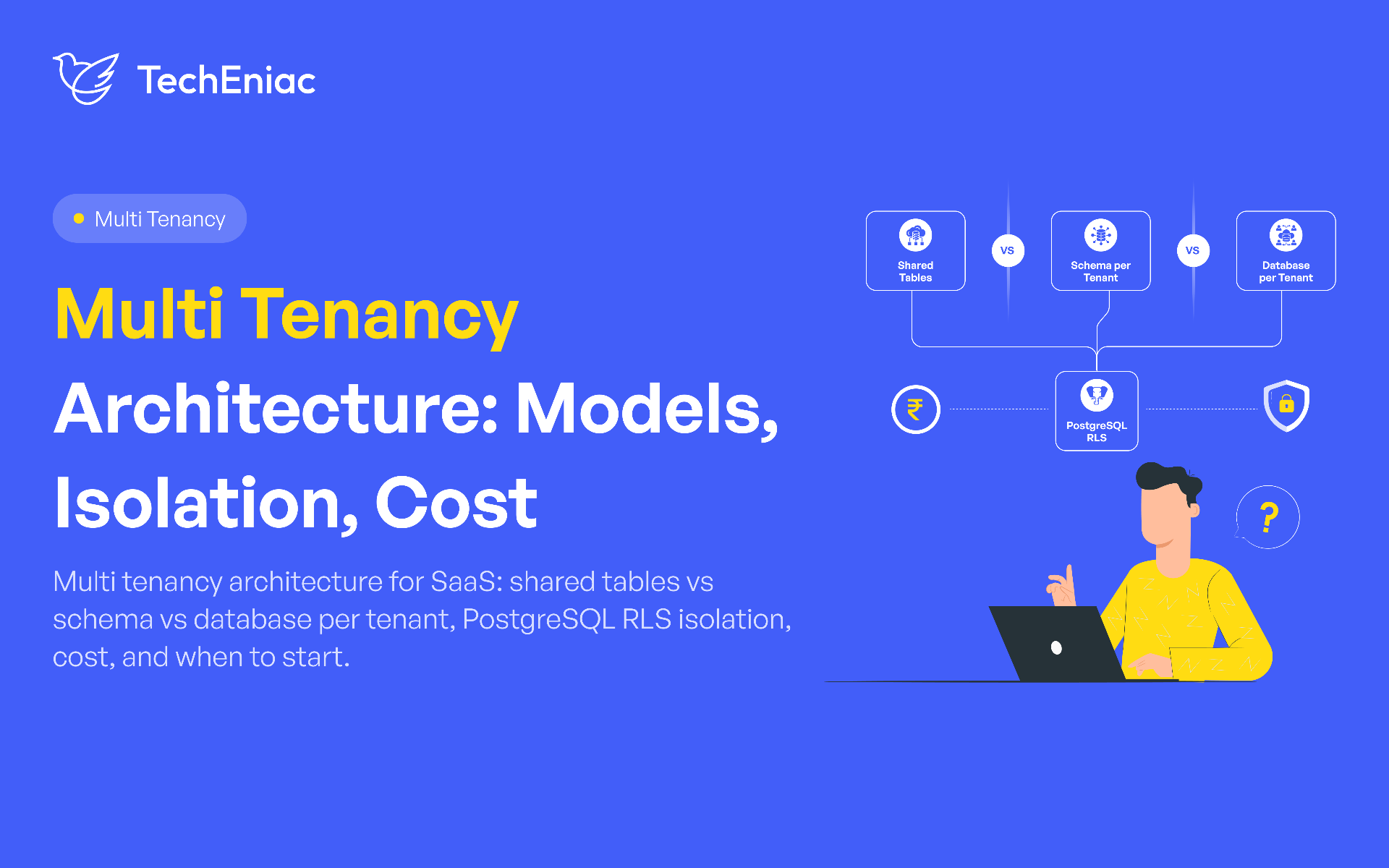
Every multi-tenant data design falls into one of three models, which AWS calls pool, bridge, and silo. The AWS guidance for multi tenant architectures maps them onto a database like this: the silo model gives each tenant a database instance, the bridge model gives each tenant a dedicated schema, and the pool model keeps tenants in shared tables protected by row level security. AWS frames the choice as a trade between isolation and cost. Silo offers the strongest isolation at the highest cost and complexity, and pool offers the lowest cost with the lightest built in isolation.
Model | How data is separated | Isolation | Cost per tenant | Best fit |
|---|---|---|---|---|
Shared tables (pool) | One set of tables with a tenant key on every row | Enforced by database policies and application code | Lowest | MVPs, small and mid-size customers, fast growth |
Schema per tenant (bridge) | One database with a separate schema for each tenant | Stronger when each tenant has its own role and grants; per-tenant schema changes possible | Medium | Customers who need cleaner exports and restore |
Database per tenant (silo) | A separate database for each tenant | Database-level separation, depending on deployment and access controls | Highest | Regulated industries, data residency demands, large enterprise accounts |
Many products mix models. The bulk of customers sit in shared tables, and the few who need more get a dedicated schema or database. That pattern is covered in the hybrid section further down.
SaaS Database Architecture: Best Practices for a Shared Tables Design
A shared tables design works when the tenant key is treated as a first-class column rather than an afterthought. These rules keep it dependable as the customer count grows:
Tenant key everywhere: Add a non-null tenant_id to every table that holds customer data, join tables included, and tie it to the tenants table with a foreign key.
Scoped uniqueness: Include the tenant key in unique constraints, so two customers can each have invoice number 1001 or a project called "Q4 Launch".
Tenant first indexes: Lead composite indexes with the tenant key, since nearly every query filters by tenant and row level policies add that filter automatically.
Migrations that know about tenants: In shared tables, one migration updates every customer at once. With schema or database per tenant, migrations roll through each tenant and record the version it is on.
Tenant scoped export and delete: Build the ability to export or remove a single tenant's rows early, because offboarding, data requests, and per customer recovery all depend on it.
The other two models bring their own strengths. Schema per tenant makes per customer export and restore simpler and allows a tenant specific schema change, while the schema count grows with the customer count and every migration runs once per schema. Database per tenant adds the option to place a customer's data in a specific region and restore one customer without touching the rest, in exchange for a larger fleet to patch, monitor, and connect to.
Tenant Isolation in Multi-Tenant SaaS: How to Keep Customer Data Separate
Tenant isolation holds up when four layers work together:
Tenant key on every row: Every record knows which customer it belongs to.
Database enforced policies: The database filters every query, whatever the application code does.
Verified tenant context: The tenant comes from the signed in user's session and membership record, never from a request parameter the client can change.
Boundary tests: Automated tests try to read and write across tenants on every endpoint.
How PostgreSQL Row Level Security Enforces Tenant Isolation
Row-level security (RLS) is PostgreSQL's built-in mechanism for controlling which rows a database user can access or modify. According to the PostgreSQL documentation, when RLS is enabled on a table, access to rows is governed by applicable security policies. If no policy permits access, PostgreSQL applies a default-deny rule. This makes RLS a strong foundation for tenant isolation in multi-tenant applications. A tenant-specific policy can be implemented in just a few lines of SQL.
ALTER TABLE projects ENABLE ROW LEVEL SECURITY;
ALTER TABLE projects FORCE ROW LEVEL SECURITY;

CREATE POLICY tenant_isolation ON projects USING
(tenant_id = NULLIF(current_setting('app.tenant_id', true), '')::uuid);
The policy reads a setting called app.tenant_id. The application sets it at the start of each request's transaction, using the tenant taken from the verified session. Setting it as transaction local means the value clears when the transaction ends, so a pooled database connection never carries one customer's context into the next request. If the setting is missing, the comparison matches nothing and the query returns no rows.
The documentation also lists the exceptions worth designing around. Superusers and roles with the BYPASSRLS attribute always skip row security, and table owners skip it unless the table uses FORCE ROW LEVEL SECURITY. In practice, the application connects as a dedicated role that owns no tables and has no bypass attribute, while migrations run through a separate admin role.
We use this pattern in production. On TalentSync AI, PostgreSQL row level security keeps candidate data separate across 50+ company workspaces, with zero cross tenant data leakage.
Isolation Beyond the Database
Customer data lives in more places than tables, and each place needs the tenant boundary too:
File storage: Store files under a tenant specific prefix and serve them through short lived signed URLs checked against the tenant.
Caches and search: Put the tenant key in every cache key and filter every search query by tenant.
Background jobs: Pass the tenant in the job payload and set the context again when the worker runs.
Logs and exports: Tag log lines with the tenant and build exports through the same tenant scoped queries.
Products with AI features add one more place: embeddings. Vector stores need the same discipline as tables, either a separate collection for each tenant or a tenant filter on every query. TechEniac's guide to AI SaaS product architecture walks through both patterns and when each one fits.
Proving the Boundary with Tests
Create two tenants in the test database and seed both with data. Then call every read and write endpoint as tenant A using tenant B's IDs. Each response should come back as not found or forbidden, and no rows should change. Run the suite in CI so every new endpoint inherits the check automatically.
Multi-Tenant vs Single Tenant Cost: Is Multi Tenancy Cheaper to Run?
Multi-tenant architecture costs less to run per customer because customers share compute, database capacity, and operational work. AWS notes that the bridge and pool models minimize hardware provisioning by sharing database instances across tenants, which makes better use of the same compute.
Cost Factor | Multi-Tenant (Shared) | Single-Tenant (Dedicated) |
|---|---|---|
Infrastructure per Customer | Shared, grows slowly with each customer | Dedicated, grows with each customer |
Onboarding a customer | Add rows and configuration | Provision a full environment |
Releases and Migrations | Run once for everyone | Run for every environment |
Monitoring and Patching | One environment to patch and monitor | Every environment patched separately; monitoring can be centralised |
Per-Customer Customization | Handled through configuration and feature flags | Straightforward, separate settings or code |
Failure Impact | Usually contained to one customer | Contained to one customer |
Compliance and Data Residency | Easier to meet and demonstrate | Built in |
The savings come with some engineering work: tenant aware code, usage metering, and protection against noisy neighbors. That work happens once, while the cost of running separate environments repeats with every new account. If you offer a dedicated tier, price it to cover the environment it needs, so the enterprise plan funds its own infrastructure.
Choosing between these options is easier with the numbers for your own customers in front of you. An AI Consulting Services architecture review compares the models against your customer mix, compliance needs, and growth plan before you commit to one.
How to Prevent the Noisy Neighbour Problem in SaaS
A noisy neighbour is a tenant whose heavy usage slows the product for everyone sharing its resources, and per tenant limits plus a hybrid model keep it contained. Imagine one customer starting a very large export at the beginning of the workday while hundreds of other accounts load their dashboards. Four controls handle that:
Rate limits per tenant: Cap requests so one account cannot crowd out the rest.
Query timeouts and quotas: Limit how long queries run and how many connections each tenant can use. If all tenants share one database role, enforce these limits in the application or connection pooler. For stricter per-tenant limits, assign each tenant a separate role.
Fair job queues: Give each tenant a slice of the queue, or use weighted scheduling, so a large batch does not hold up everyone else's background work.
Per tenant monitoring: Track usage by tenant so the heavy account shows up on a dashboard before it shows up in a support ticket.
The hybrid model goes one step further. AWS lists strict compliance support, a limited blast radius and freedom from noisy neighbours as the main benefits of the silo model, and notes that some tenants can be siloed while others stay pooled. Moving your heaviest customers to dedicated resources is a natural way to apply that idea. In product terms, that becomes tenant tiers: standard customers on shared tables, enterprise customers on a dedicated schema or database, and a routing layer that sends each tenant's requests to the right place.
Build that routing layer early, even while every tenant points at the same database. Moving a customer later then becomes a data migration instead of a rewrite. When a platform is ready for tenant tiers and independent scaling, SaaS Product Engineering & Scaling covers the routing, capacity, and migration work involved.
When to Add Multi Tenancy to Your SaaS Product: A Stage-by-Stage Guide
Add multi tenancy in the first version whenever more than one customer organization will use the product. On day one the tenant key is a single column. Added later, it touches every table, query, cache key, and job.
Stage | Setup that fits | Why |
|---|---|---|
MVP or first release | Shared tables, tenant key on every row, RLS on | Lowest running cost, and the cheapest moment to build tenant awareness |
Growing customer base | Same setup plus per tenant limits, metering, and tenant scoped export | Keeps heavy accounts from affecting others and supports offboarding and data requests |
First regulated or enterprise customer | Dedicated schema or database for that tenant, same codebase | Meets residency, audit, and isolation requirements without building a second product |
Established platform | Tenant tiers with routing between pooled and dedicated | Matches each customer's isolation level to their plan |
A product built for one customer, such as an internal tool or a bespoke platform, can run single tenant from the start. If it may serve more customers later, keep the tenant key in the data model so that option stays open. For a first version built with this structure from the start, TechEniac's SaaS development services cover the architecture and the build.
How TechEniac Builds Multi-Tenant SaaS Architecture
At TechEniac, multi tenancy gets decided in the architecture phase, before the first feature ships. Our default for SaaS products is PostgreSQL with row level security, which gives database level tenant isolation without running a separate database for every customer. For AI products, we extend the same discipline to vector stores, choosing between a collection for each tenant and a tenant filtered shared collection based on the isolation level the customer base needs.