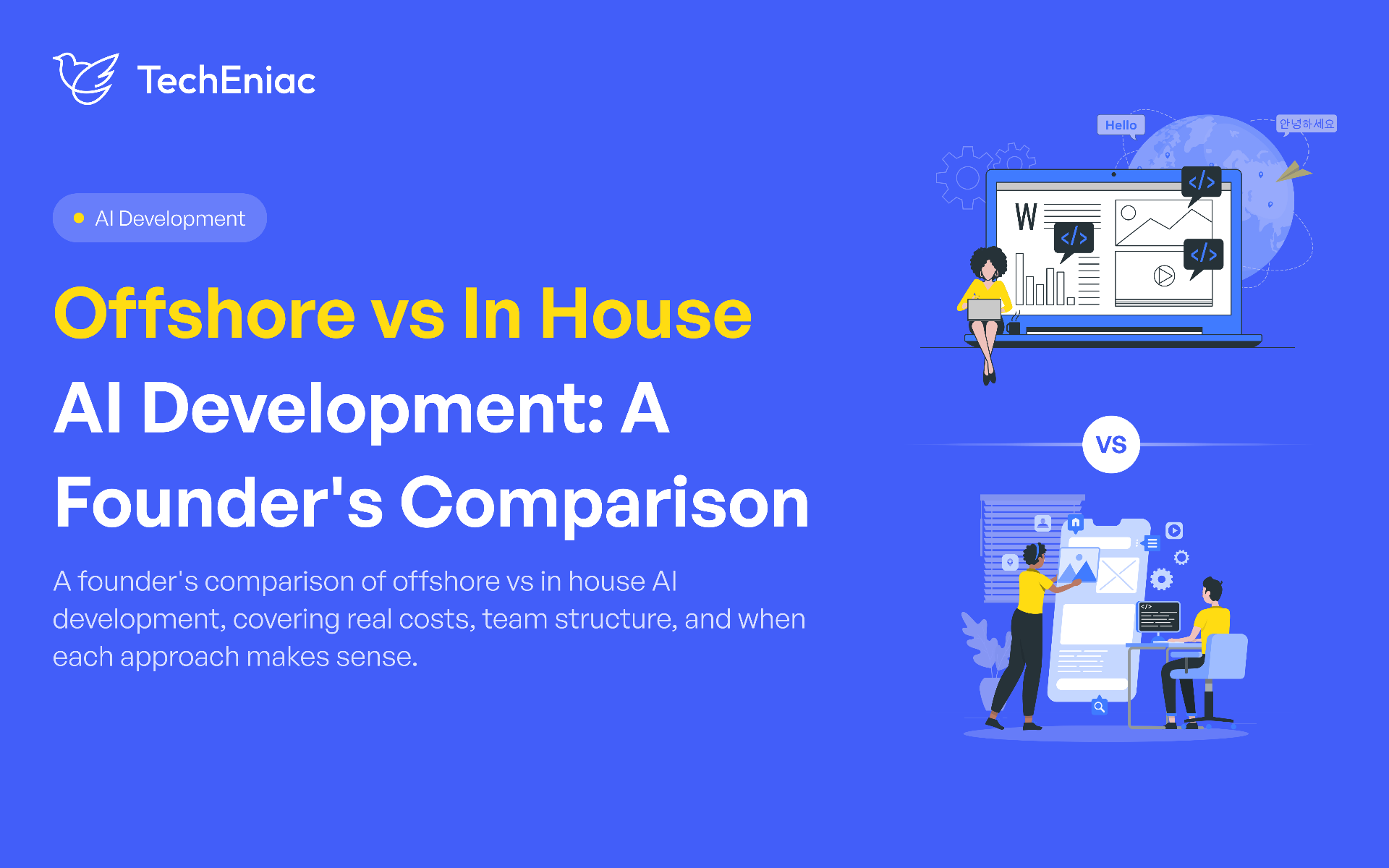
Offshore AI development and in-house AI development each suit different startup situations. Offshore teams can provide faster access to specialized engineers and flexible capacity, while in-house teams offer deeper product context, direct organizational control, and long-term internal capability. The right choice depends on your product stage, budget, AI complexity, data requirements, and how central AI is to your competitive advantage.
Key Takeaways
Offshore AI development typically costs sixty to seventy percent less than an in-house hire once salary, benefits, and infrastructure are all counted.
In house engineering makes the most sense once AI is your core product, not a feature bolted onto one.
An AI development team structure needs the same core roles regardless of where the people sit, an ML or AI engineer, a data engineer, and someone who owns evaluation and monitoring.
Most founders do not choose permanently. They validate offshore first, then bring capability in house once the product and the budget justify it.
Offshore AI development is safe for startups when the contract includes an IP assignment clause, milestone-based payments, and a data processing agreement if customer data is involved.
What Offshore vs In House AI Development Actually Means
Founders rarely ask this question in the abstract. It shows up the moment a board member asks for an AI roadmap, or a competitor ships an AI feature first. The rest of this comparison walks through what each option actually costs, what team structure either path requires, and which signals point toward one over the other.
Offshore AI development means hiring an external team, typically based in India, Eastern Europe, or Southeast Asia, to build AI features or models for your product without adding permanent headcount. You define scope, they build, and you retain full rights to the output through a proper IP assignment clause in the contract.
In house AI development means hiring AI or ML engineers directly onto your payroll. They work exclusively on your product, build deep context over time, and sit inside your existing engineering culture rather than operating as an external vendor.
The difference that matters for a founder is not quality. Reputable offshore teams in 2026 have shipped production AI systems for funded startups and enterprise clients alike. The difference is speed of start, fixed versus variable cost, and how much long-term product context the team builds up over time.
There's also a structural difference in how each model absorbs risk. An offshore engagement lets you scale a team up or down between sprints without notice periods or severance considerations, which matters enormously when you are still validating whether an AI feature is worth building at all. An in-house hire, by contrast, is a fixed cost the moment the offer is signed, regardless of whether the roadmap shifts underneath them three months later. Neither of these is inherently better. They are simply different tools suited to different amounts of certainty about what you are building.
Offshore vs In House AI Development: Cost Comparison
The gap between these two paths is larger than most founders expect until they see the numbers side by side.
Cost Factor | Offshore AI Development | In House AI Development |
|---|---|---|
Monthly cost per engineer | Roughly $3,000 to $12,000 depending on region and seniority | $12,000 to $20,000+ once salary is annualized |
Time to start | Two to four weeks | Two to four months including hiring |
Benefits and overhead | Included in vendor rate | Added on top of base salary |
Infrastructure and tooling | Often included or billed separately per project | Your responsibility to set up and maintain |
Commitment | Flexible, scale up or down per sprint | Fixed cost regardless of workload |
The U.S. Bureau of Labor Statistics puts the median annual wage for a software developer at 135,980 dollars as of May 2025, and AI or ML specific roles run meaningfully higher. Separate 2026 salary data from Glassdoor puts the national average AI and ML engineer salary at roughly 173,000 dollars, though figures vary by tens of thousands of dollars depending on whether the source uses audited employer data or self-reported compensation, so treat any single number as directional rather than exact.
Offshore rates tell a different story. Industry rate card data from 2026 shows offshore developers in India and South Asia billing in the 15 to 45 dollar per hour range, Eastern Europe running 35 to 70 dollars, and Latin America landing between 25 and 55 dollars, compared to 100 dollars or more per hour for onshore U.S. talent. AI and ML specialization typically adds a 20 to 35 percent premium on top of general rates in any region.
Offshore SaaS Development Team: What You Actually Get
Working with an offshore SaaS development team looks different from a single freelance hire, and the distinction matters for what you can realistically expect.
A defined scope and sprint cadence: Reputable offshore teams work in the same two-week sprint structure most in house teams use, with working software reviewed at the end of each cycle.
Full IP ownership: A properly structured contract assigns all code and models to you, not just a license to use the output.
Shared infrastructure knowledge: Good offshore partners bring experience across multiple AI stacks, since they are not limited to whatever one engineer happens to know.
Flexible scaling: You can add or remove engineers between sprints without the fixed cost and notice period that comes with an employee.
A documented handoff: If you eventually bring the work in house, a well-run offshore engagement leaves behind documentation an internal hire can build on.
None of this replaces the judgment call on when offshore stops being the right fit. That decision usually comes down to how central AI is becoming to your product, which the sections below get into.
In House Engineering Team Cost: The Real Line Items
In house engineering team cost rarely stops at the number in the offer letter, and founders who only budget for salary tend to get surprised six months in.
Base salary: The largest single line item, and the one most founders already account for.
Benefits and payroll tax: Typically adds 25 to 30 percent on top of base salary in the United States.
Compute and infrastructure: GPU instances for training or fine tuning can run 1,000 to 8,000 dollars a month depending on model size and frequency of use.
Model API usage: Teams calling OpenAI, Anthropic, or similar APIs at production scale often see costs jump from a few hundred dollars a month to several thousand once usage climbs.
Vector database and monitoring tools: Retrieval infrastructure and observability tooling typically add another few hundred to a couple thousand dollars a month.
Hiring and ramp time: A specialized AI hire often takes two to four months to source and another few weeks to ramp up before shipping anything.
AI Development Team Structure: Roles You Need Either Way
Whether you go offshore, in house, or hybrid, the AI development team structure that actually ships something needs a consistent set of roles.
Role | Core Responsibility | When You Need It |
|---|---|---|
AI or ML engineer | Model selection, fine tuning, integration into the product | Every AI project, from day one |
Data engineer | Data pipeline, cleaning, and quality checks feeding the model | As soon as the project depends on your own data |
Backend engineer | Connecting the AI layer to the rest of the product and infrastructure | Every AI project |
Evaluation and monitoring owner | Tracking accuracy, drift, and when a model needs retraining | Once the product is in production with real users |
Product owner | Defining the problem, success metric, and what ships when | Every AI project, regardless of team location |
A common mistake founders make is hiring one AI engineer and assuming that covers the structure above. In practice, a single generalist can prototype a feature, but production reliability usually needs at least a data engineer and an evaluation owner involved before real users depend on the output.
When Offshore AI Development Makes Sense
A handful of signals point clearly toward starting offshore rather than hiring in house.
AI is a feature, not the product. Adding intelligent search or recommendations to an existing SaaS product does not justify a full-time hire.
Runway is under eighteen months. The fixed cost of a salary is a bigger risk early than the flexibility cost of an offshore engagement.
You need a working prototype in under three months. No in house hiring process, however efficient, moves that fast.
You do not yet have a technical AI lead internally. Without someone to manage the work, an in-house hire has nobody experienced to report to.
You want to validate before committing. Offshore lets you test whether AI genuinely moves your metrics before locking in a salary.
When In House AI Development Makes Sense
The signals flip once a few specific conditions are true.
AI is your core product, not a feature. If your model is your competitive moat, outsourcing it indefinitely erodes the advantage you are trying to build.
You have crossed a revenue threshold with real runway. Once the business can absorb a fixed salary without it being an existential risk, the calculus changes.
You are working with sensitive proprietary data. Healthcare records, financial transactions, or regulated data often cannot be handed to a third party without real legal and compliance risk.
The model needs continuous, deep product context. Some AI systems evolve so tightly with the product that handoffs between an external team and internal one creates real friction.
Common Mistakes Founders Make in This Decision
A few patterns show up often enough across early-stage founders that they're worth naming directly.
Hiring in house before the product direction is clear. A senior AI hire costing well into six figures a year, brought on before anyone knows exactly what the model needs to do, tends to sit underused while the roadmap keeps shifting underneath them.
Choosing the cheapest offshore quote available. The lowest hourly rate on the market often reflects a team stretched across too many clients or lacking real production AI experience. Code that technically runs but breaks under real load costs more to fix than it saved.
Starting without a defined success metric. "We need AI in the product" is not a scope. Without a specific problem and a number that defines success, both offshore and in house paths burn budget without a clear finish line.
Assuming offshore means giving up quality. This was a fair concern a decade ago. In 2026, plenty of offshore teams have shipped production AI systems for funded startups and enterprise clients, and the quality gap has narrowed considerably where the team is vetted properly.
Avoiding these four mistakes matters more than which side of the offshore versus in house question you land on.
The Hybrid Model Most Founders Actually Land On
Most founders do not pick one side of this comparison permanently. The pattern that shows up most often looks like this: outsource the first version to validate the idea, measure whether it moves a real metric, then bring capability in house once the product and the budget justify a permanent hire.
This works because it removes the guesswork. An offshore team that documents its work well hands off a working, understood system rather than a blank slate, so the eventual in-house hire joins something real instead of starting from zero. For founders who want the speed of an external team without losing the continuity a dedicated relationship provides, Hire Dedicated Development Team USA sits between the two extremes, an embedded team that carries context forward the same way an in-house hire would, without the fixed headcount commitment.
How TechEniac Fits into This Decision
We are a small team, and we would rather be upfront about that than pretend otherwise. What that means in practice is direct engineering involvement in every engagement, not a rotating cast of junior developers assigned to your project after the sales call ends.
For founders who are not ready to commit to a full-time AI hire but need more continuity than a typical offshore project provides, Hire Dedicated Development Team USA gives you an embedded team that stays on your roadmap across multiple phases, carrying context forward the way an internal hire would, without resetting it with every new engagement.