Quick Summary
AI logistics software development replaces manual dispatch boards and static route planning with systems that assign drivers and sequence stops in real time, using live traffic, vehicle capacity, and delivery windows. Published case studies and operator interviews report fuel savings of 10% to 25% from automated route optimization, and UPS estimated its ORION routing system would cut 100 million miles and 10 million gallons of fuel a year at full deployment.
Key Takeaways
Route optimization AI processes hundreds of variables at once, traffic, time windows, vehicle capacity, driver hours, something a human dispatcher planning by hand cannot do at the same speed or scale.
Dispatch automation software earns its cost fastest in fleets already running ten or more vehicles, where manual planning is consuming real dispatcher hours every single day.
The data route optimization AI needs to train on is mostly data your fleet already generates historical routes, GPS and telematics logs, and delivery outcomes, not something you have to buy separately.
Most AI logistics platforms integrate with the fleet and TMS software you already run rather than replacing it outright.
The first month after deployment is the hardest. Drivers resist new routes before the system has learned their specific patterns, and real savings typically show up by month three to six.
What Is AI Logistics Software Development?
Dispatch and routing are decisions that logistics teams repeat many times a day, which makes them a common first place to use AI. The sections below explain how dispatch automation and route optimization work, what data they need, how they connect to existing fleet software, and what they cost.
AI logistics software development means building dispatch, routing, and fleet management systems that use AI to make real time decisions about vehicle assignments and delivery sequences. A traditional transportation management system digitizes the dispatcher's job. An AI logistics platform takes over the decision itself: which driver gets which job, and in what order the stops run. It keeps adjusting as conditions change during the route.
The difference comes down to who decides. On a digitized board, a person still assigns every job. An AI platform assigns jobs itself. It hands off to a person only when a situation falls outside set limits, such as a cancelled order, a vehicle breakdown, or a complaint that needs human judgment.
Top AI Logistics Trends in 2026
Real time dynamic routing: Routes recalculate continuously as traffic, weather, and new orders change, not just once each morning.
Driver behaviour scoring: AI coaching based on telematics data is closing a real efficiency gap between a fleet's most and least fuel-efficient drivers.
Powertrain aware routing: EV range limits and charging stop requirements are increasingly built directly into route assignment logic.
Predictive maintenance tied to routing: Vehicle health data is starting to influence which jobs get assigned to which trucks.
Margin focused adoption: Fleets are adopting AI routing less for efficiency's sake and more because rising costs make the savings a survival issue, not a nice to have.
How Dispatch Automation Software Works
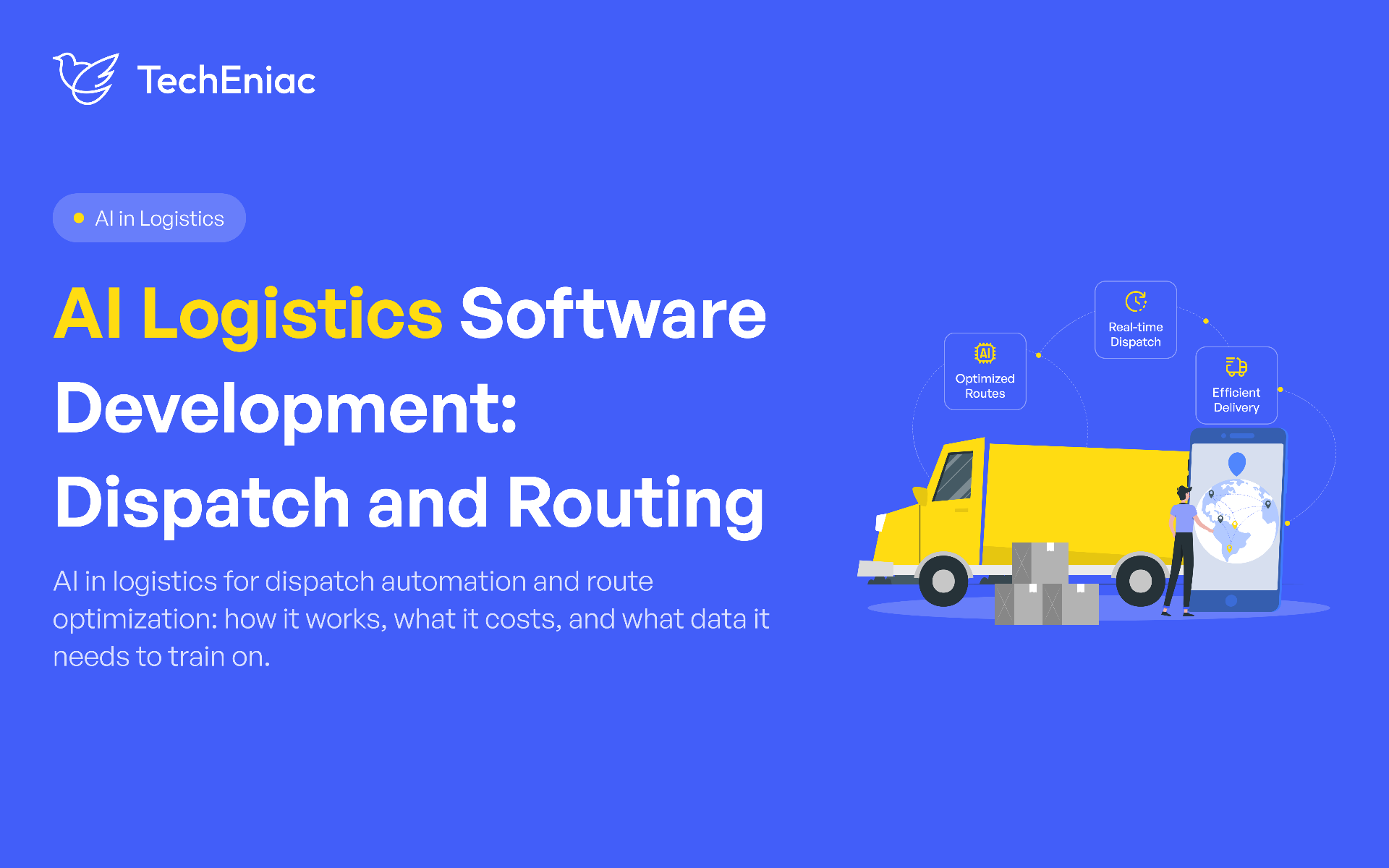
Dispatch automation software uses artificial intelligence and real-time data to automatically match, schedule, and route field workers or delivery drivers for jobs.
The system typically runs as a set of coordinated decisions rather than one big calculation. An assignment engine matches jobs to available capacity. An exception handler flags anything that doesn't fit a normal pattern, a vehicle running late, a customer unavailable, a job that needs a driver with a specific certification and routes it to a human dispatcher rather than forcing an automated decision where one shouldn't be made. This is the same pattern behind AI Agent Development more broadly: an agent handles the routine decisions end to end and escalates at defined checkpoints, rather than either doing everything autonomously or nothing at all.
Manual dispatch for a ten-driver operation typically consumes two to four hours of planning time a day. Automated systems cut that planning time by roughly 75% to 85%, freeing dispatchers to handle exceptions and customer issues instead of building the schedule from scratch every morning.
Route Optimization AI: How It Actually Cuts Fuel and Delivery Time
Route optimization AI continuously analyses traffic patterns, delivery density, vehicle constraints, and historical performance to sequence stops in an order no static map application would produce. It's not just finding the shortest path between two points, it's solving for the best order across dozens or hundreds of stops simultaneously, factoring in delivery windows, vehicle capacity, and driver hours at the same time.
Route optimization has delivered large savings at scale. McKinsey found that early adopters of AI enabled supply chain management improved logistics costs by 15% compared with slower moving competitors. Walmart reports that its own route optimization tool eliminated 30 million unnecessary miles and avoided 94 million pounds of CO2. Forbes covered those results when Walmart began offering the tool to other businesses.
UPS's ORION platform is the most widely documented example at scale. According to INFORMS, UPS estimates ORION saves roughly 100 million miles and 10 million gallons of fuel a year across its U.S. network, worth an estimated $300 million to $400 million annually in savings and cost avoidance. UPS's own Analytics 50 submission gives the same figures. That scale isn't realistic for most fleets, but the underlying mechanism, continuously reoptimizing routes rather than planning once each morning, scales down to a ten-vehicle operation just as it scales up to a national carrier.
The catch is driver compliance. The best calculated route saves nothing if a driver ignores it and runs their usual path instead. Systems that pair route optimization with turn-by-turn navigation, or with an incentive structure tied to route adherence, see the modelled savings show up in real fuel numbers. Systems that skip this step often see a gap between what the software calculated and what the fleet achieved.
AI Dispatch vs Traditional Dispatch
Factor | Traditional Dispatch | AI Powered Dispatch |
|---|---|---|
Planning basis | Dispatcher experience and memory | Historical data, live conditions, and defined constraints |
Update frequency | Once, typically each morning | Continuous, recalculated as conditions change |
Variables considered | A handful at a time | Hundreds simultaneously |
Planning time | 2 to 4 hours daily for a 10-driver operation | Reduced by 75% to 85% |
Exception handling | Every issue reaches the dispatcher | Only genuine exceptions escalate to a human |
Scalability | Adding drivers adds planning complexity linearly | Additional capacity absorbed by the same system |
The table makes the core shift clear: the dispatcher's job doesn't disappear; it moves from building the schedule to handling what the system correctly flags as needing a human judgment call.
What Data Route Optimization AI Actually Needs to Train On
Most fleets already generate the data route optimization AI needs. The gap usually isn't availability, it's whether that data is clean, accessible, and connected to one system rather than scattered across separate tools.
Historical route and stop data: Past routes, actual drive times versus planned times, and stop sequences already run.
GPS and telematics data: Real time vehicle location, speed, idle time, and driving behaviour from systems like Samsara, Geotab, or Motive.
Delivery outcome data: Which deliveries were on time, late, or failed, and why, when that reason was recorded.
Vehicle and driver constraints: Capacity limits, hours of service remaining, required certifications, and for electric fleets, range and charging requirements.
Time window and customer requirements: Delivery appointment windows, access restrictions, and any customer specific handling rule.
A fleet with clean telematics data and a few months of delivery history has enough to start. A fleet with fragmented spreadsheets across multiple depots usually needs a data consolidation phase before the optimization model can learn anything reliable, which is worth budgeting time for rather than skipping.
Building a Logistics AI Platform: Architecture That Scales
A logistics AI platform that grows past the pilot needs four parts built right from the start. Adding them later, once real traffic arrives, is harder than building them in at the beginning.
Live data feed (data layer): The platform takes in vehicle locations, orders, and fleet updates as they happen, not in an overnight batch. Fresh data keeps routes based on today's traffic, not yesterdays.
Planning engine (optimization engine): This part decides which driver gets which job and in what order. It combines proven math methods with models that learn from the fleet's own past routes.
Handoff to people (exception and escalation layer): Clear rules decide when the system acts alone and when it asks a dispatcher. A cancelled order or a broken-down truck goes to a person.
Connection to current tools (integration layer): The platform plugs into the fleet software, GPS tracking, and transport management system a company already uses, because almost no fleet starts from zero.
Getting this architecture right from the first sprint is the difference between a platform that scales cleanly as fleet size grows and one that needs a rebuild the moment a second depot or a new vehicle type gets added. AI SaaS Product Development is where that architecture decision gets made properly, and for platforms that have already launched and are hitting real growth limits, SaaS Product Engineering & Scaling is the work that gets a platform past those limits without starting over.
What It Costs to Build a Logistics App With AI
A logistics app with AI can cost from about $25,000 to $400,000 or more. Cost depends heavily on scope: a simpler, more static optimization system sits at the low end, and a fully custom, continuously learning platform integrated across multiple systems sits at the high end. The ranges below show what each level usually includes.
Scope | Typical Range | What It Usually Includes |
|---|---|---|
Focused route optimization for a single fleet | $25,000 to $80,000 | Core optimization engine, one telematics integration, basic dispatcher dashboard |
Dispatch automation with exception handling | $80,000 to $180,000 | Assignment engine, escalation logic, TMS integration, driver app |
Full logistics AI platform, multi depot or multi fleet | $180,000 to $400,000+ | Real time dynamic routing, predictive maintenance signals, multiple system integrations, scaling infrastructure |
These figures are directional. The actual number depends heavily on integration count and how much historical data needs cleanup before the model can train on it reliably. If you're not sure which tier your project falls into, an AI Consulting Services conversation is the fastest way to get a real scope instead of guessing from a range.
Common Mistakes When Automating Dispatch and Routing
Five mistakes come up most often when automating dispatch and routing, and each has a practical fix:
Skipping driver buy in: Explain why a stop order changed, give drivers a quick way to report a blocked gate or a closed road, and review route adherence together each week. A route only saves fuel when drivers follow it.
Expecting savings in week one: Savings build over the first few months, while the model learns real stop times, slow roads by hour, and how each driver works. Track miles per stop and on time delivery rate weekly from the first day.
Training on incomplete data: Collect route history, GPS logs, and delivery outcomes from every depot, and fill gaps such as missing stop times before training. A model that sees only some depots plans well for those and guesses for the rest.
Leaving out an exception path: Send cancelled orders, vehicle breakdowns, and unusual requests to a dispatcher with the order, vehicle, and driver details already attached, so the customer gets a fast answer.
Treating integration as an afterthought: Show routes inside the transportation management system dispatchers already open each morning and let changes made there flow back to the platform. The team then works from one schedule.
Conclusion: What to Look for in AI Dispatch and Route Optimization for Your Fleet
AI dispatch and route optimization follow a pattern TechEniac has built before many moving parts coordinated live, with people stepping in when it matters. On a four-hospital regional system, a multi agent platform runs bed management, surgical coordination, discharge, and capacity forecasting agents, with staff stepping in at defined checkpoints. It reduced emergency department boarding by 52% and raised operating room utilization from 67% to 81%, as the hospital operations case study shows.
The same approach carries into field operations. A workforce platform TechEniac built schedules crews to shifts, confirms them across several channels, and verifies their location on site. A fleet needs the same ingredients: assignment logic, clear escalation rules, integration with the TMS, telematics, and fleet software already in place, and checkpoints where a dispatcher decides.
If dispatch automation and route optimization are the workflows you're trying to improve, they follow the same underlying pattern as the multi-agent, real-time coordination systems we've built for other operationally intensive industries: many moving parts (drivers, vehicles, orders, traffic, time windows) coordinated live, with people stepping in when it matters.
If you're weighing whether a focused route optimization build or a fuller AI dispatch automation platform fits your fleet, that's exactly the kind of scope worth settling before committing budget.