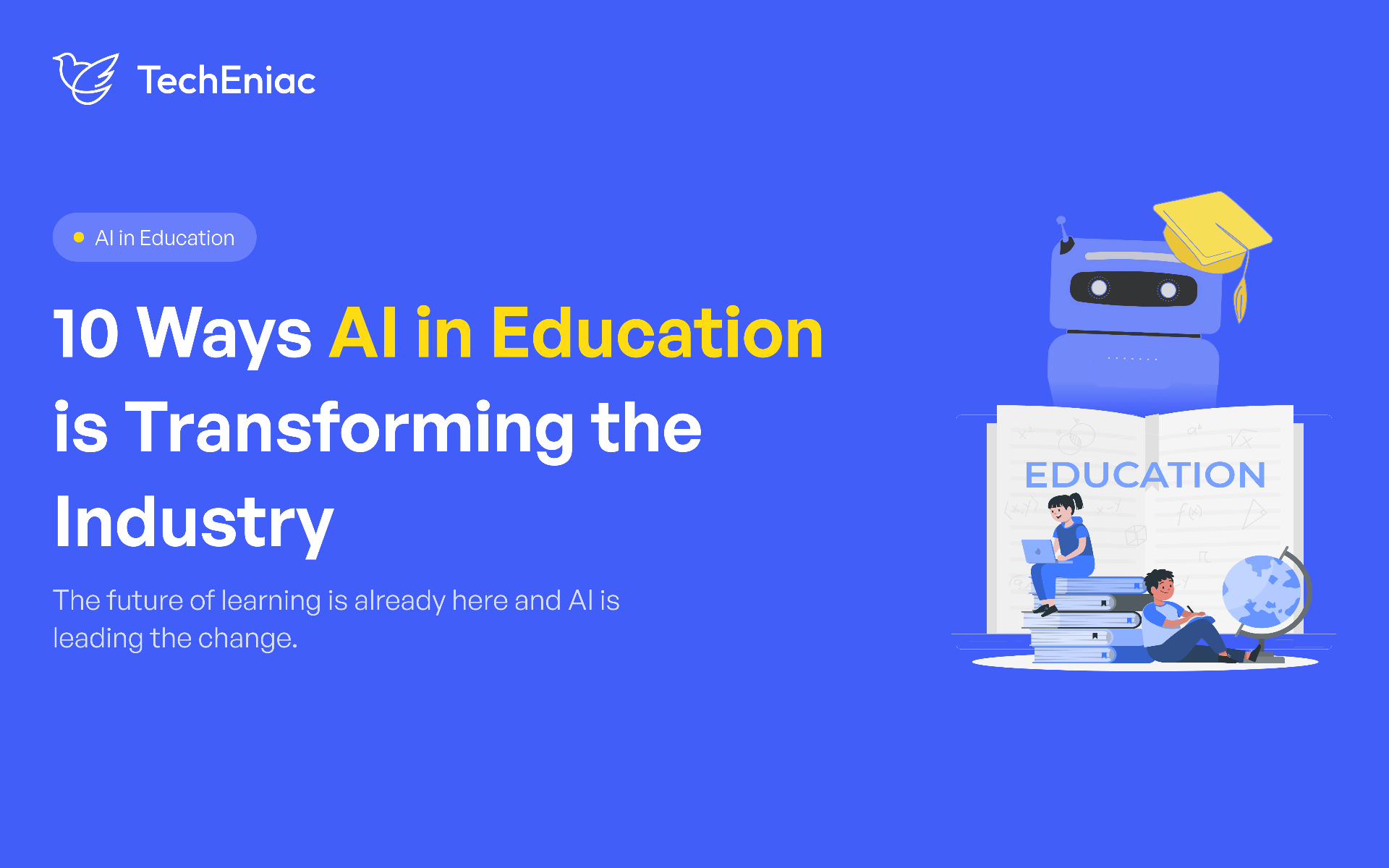
A classroom with thirty students rarely has thirty students learning at the same pace, yet most schools and platforms still teach as if it did. That mismatch one curriculum, one speed, dozens of different learners is the problem AI in education is actually built to solve, and it's why the shift is happening faster than most people outside EdTech realize.
The global AI in education market was valued at roughly $5.88 billion in 2024 and is projected to reach $32.27 billion by 2030, according to Grand View Research. That growth isn't driven by novelty. It's driven by a genuine gap: teachers are stretched thin, institutions sit on more student data than they can act on manually, and learners increasingly expect content that adapts to them instead of the other way around.
This guide breaks down ten concrete ways AI in the education industry is changing how students learn, how educators teach, and how institutions operate along with the benefits behind each one and what to watch out for before building or buying into any of it.
What Does "AI in Education" Actually Mean?
AI in education covers a fairly broad set of capabilities, all built around the same core idea: using software that learns from data to personalize, automate, or improve some part of the teaching and learning process. In practice, that includes machine learning models that predict which students are likely to struggle, natural language processing that powers AI tutors and chatbots, computer vision that supports automated grading of handwritten work, and generative AI that drafts lesson content, quizzes, and full course structures.
The strongest implementations use AI to handle the repetitive, data-heavy work grading, content drafting, progress tracking so that educators have more time for the parts of teaching that actually require a human: mentoring, judgment, and relationships with students.
10 Ways AI in Education is Transforming the Industry
These ten use cases represent the most impactful ways AI is currently reshaping education. Rather than hype, these reflect real deployments solving specific, measurable problems in classrooms, institutions, and learning platforms today.
1. Personalized Learning Paths
Every student in a class learns at a different pace, but a single lesson plan can't adapt to thirty different paces at once. Adaptive learning platforms solve this by continuously tracking how a student performs and adjusting the difficulty, sequencing, and format of content in response moving one student ahead once they've mastered a concept while giving another more practice on the same topic before advancing.
The practical effect is that students spend less time repeating material they've already learned and more time on the material that's actually holding them back, which tends to improve both outcomes and motivation at once.
2. Intelligent Tutoring and Round-the-Clock Homework Support
Office hours end. Questions don't. AI tutoring systems fill that gap by answering a student's "I'm stuck" question with a step-by-step explanation rather than just the final answer, and by offering an alternative explanation when the first one doesn't land.
This matters most for students without easy access to a private tutor or a teacher who's available outside class time an AI tutor doesn't care that it's midnight or that a lecture hall has three hundred other students in it.
3. AI-Assisted Content and Curriculum Creation
Lesson planning and course design eat up a disproportionate share of an educator's time, and building a full course modules, objectives, assessments, and materials from scratch can take weeks even for an experienced instructional designer.
This is where generative AI has made one of its most concrete contributions to EdTech. TechEniac built CourseGen AI for an instructional design consultancy that needed to cut authoring time without cutting quality: a platform that takes a topic brief and generates a complete course structure modules, learning objectives aligned to established educational frameworks, slide content, and assessments with a human approving the structure before full content generation begins. The result was a 90% reduction in authoring time and a 4.3 out of 5 quality rating from an independent panel of instructional designers, with the course output exporting cleanly to standard learning management systems. That's the difference between AI assisting course creation and AI simply generating text that still needs a full rewrite.
4. Automated Grading and Feedback
Grading multiple-choice and short-answer questions is a natural fit for automation, but the more useful application is what AI does beyond scoring: identifying patterns in the mistakes a whole class is making, not just marking individual answers right or wrong.
Used well, this doesn't replace a teacher's judgment on nuanced or essay-based work it acts as a first pass that surfaces the common errors worth addressing in the next lesson, freeing up the time a teacher would have spent on repetitive marking for actual instruction.
5. Predictive Analytics for Early Intervention
Institutions already collect enormous amounts of data attendance, grades, login activity, assignment completion but most of it goes unused until a student has already fallen far enough behind to raise a flag manually. Predictive models change that by connecting these data points to identify disengagement early: a drop in logins, a pattern of late submissions, declining quiz scores.
The shift this enables is significant: instead of a school or platform reacting after a student has already failed several assessments, it can prompt an intervention a tutoring nudge, a check-in, a schedule adjustment while there's still time for it to help.
6. Accessible and Inclusive Learning
AI has become one of the more meaningful tools for making education genuinely accessible rather than accessible in name only. Real-time captioning and transcription support students who are deaf or hard of hearing. Text-to-speech and speech-to-text tools support students with dyslexia or visual impairments. Adaptive interfaces adjust layout, contrast, and reading mode automatically based on how a student is interacting with the material.
These aren't edge-case features bolted onto a platform to check a compliance box for the students who need them, they're often the difference between being able to fully participate in a course and being left to work around a platform that wasn't built with them in mind.
7. Language Learning and Multilingual Support
AI-driven language platforms provide real-time pronunciation feedback, adjust vocabulary and grammar exercises based on where a specific learner struggles, and simulate realistic conversation practice in a way static textbooks never could.
The same underlying technology extends further than language-learning apps: in multilingual school districts and international institutions, real-time translation support helps families who are more comfortable in a language other than the one used in parent-teacher communication, closing a gap that used to depend entirely on the availability of bilingual staff.
8. Administrative Automation
Enrollment processing, scheduling, resource allocation, and routine reporting consume a significant share of administrative staff time in most schools and universities time that doesn't touch teaching or learning directly but still has to happen. AI-powered systems can automate large parts of this: matching course demand to staffing needs, flagging scheduling conflicts before they become a problem, and surfacing underused resources or subscriptions that a manual audit would take weeks to find.
The value here isn't glamorous, but it's real every hour an administrative team doesn't spend on manual scheduling is an hour that can go toward something that actually affects student experience.
9. Academic Integrity and Exam Monitoring
As generative AI tools have become trivially easy to access, academic integrity has become a genuine concern for institutions at every level. AI-based proctoring tools can flag suspicious behavior during online exams, unusual eye movement, audio irregularities, browser activity outside the exam window for human review, while AI-writing detectors highlight text that may not reflect a student's own work.
The important caveat here is that these tools are best used as a flag for a human to review, not as an automatic verdict false positives are a real risk, and institutions using this kind of monitoring need to be transparent about what's collected and how disputes get handled.
10. Grounded, Trustworthy AI Assistants for Institution-Specific Content
A general-purpose chatbot can answer questions about any topic on the internet, but it has no idea what's actually in a specific institution's course materials, policies, or curriculum and a wrong answer delivered confidently is worse than no answer at all in an educational context. The more useful pattern is an AI assistant grounded specifically in an institution's own content, answering only from what's actually been taught and citing where each answer came from.
That grounding is what separates a genuinely useful AI teaching assistant from a generic chatbot wearing a school's branding, and it's the same principle behind why AI systems built for education increasingly cite their sources rather than simply generating an answer and hoping it's right.
The Benefits of AI in Education
When AI actually works in a classroom, here's what happens:
Students get their own pace. One kid moves ahead when they actually understand something. Another gets more practice on the thing they're stuck on. No one waits, no one rushes you're not forcing thirty kids through the same lesson at the same speed anymore.
Teachers get their time back. Grading papers and marking the same mistakes over and over doesn't disappear it gets handled by the system. That's hours a week a teacher can use to actually talk to students or plan something better.
You catch problems before they spiral. Instead of finding out a student's drowning after they fail three tests, the system flags disengagement early: stopped showing up, missing assignments, grades dropping. Time to do something about it.
It's not just for typical learners anymore. Real-time captions, text-to-speech, adaptive layouts these aren't nice-to-haves. They're the difference between a student who can actually participate and one who's locked out.
Decisions stop being hunches. You're not guessing which subjects to invest in or where to hire more staff. The data shows what's actually working and what isn't.
But here's the thing: none of this happens automatically. Just slapping "AI" on a platform doesn't do it. You need a system built to solve an actual problem, trained on real data, and designed so humans still make the calls that matter for a student.
Common Challenges in Implementing AI in Education
There are some real obstacles to get right:
Student data is sensitive. You're handling information about kids—their grades, their struggles, sometimes their family situations. The system needs strong encryption, minimal data collection, and full compliance with laws like FERPA. This isn't optional.
Equity is easy to mess up. An AI tool designed for students with broadband and a laptop can actually make things worse for kids in under-resourced schools. If you're building for everyone, you need to build for the worst-case scenario.
Bias creeps in from historical data. If your training data comes from a decade of biased admissions or grading, the AI learns the bias. That's why high-stakes decisions flagging a struggling student, scoring an exam need a human review, not just an algorithm.
Teachers have to actually buy in. Even a solid system fails if educators don't understand it, don't trust it, or had no say in choosing it. Getting people trained and comfortable with the tool matters as much as the tool itself.
How to Start Implementing AI in Education
The institutions and EdTech founders who get this right tend to follow the same rough sequence. They start by naming a specific, measurable goal improve reading outcomes, reduce grading hours, close a specific accessibility gap rather than pursuing "an AI strategy" in the abstract. They audit what data and systems they already have, since that determines which use cases are realistic without a major integration effort. They run a narrow, focused pilot on one subject or one department rather than launching platform-wide, measure the results, and expand only once the pilot has proven itself. And they build in a way to measure impact from the start learning outcomes, time saved, accessibility improvements so that scaling the pilot is backed by evidence rather than enthusiasm alone.
Final Thoughts
AI in education isn't a single feature or product it's a set of distinct capabilities, each solving a specific, well-defined problem inside teaching, learning, or administration. The institutions and EdTech companies seeing real results aren't the ones chasing every new AI trend. They're the ones who picked one genuine bottleneck, built or bought a tool that actually closes it, measured whether it worked, and expanded from there.
That's also the difference between a demo that looks impressive and a system instructional designers, teachers, and students actually trust enough to use every day.