Quick Summary
AI-native SaaS is designed around AI as a core part of its primary product value and workflow. Depending on the use case, it may generate outputs, make predictions, recommend decisions, or complete tasks with varying levels of human oversight.
Key Takeaways
AI Native SaaS Definition: The model sits in the core loop of the product, and the product delivers a finished outcome.
AI Enabled SaaS Definition: AI features sit on top of a working product and assist the user, who stays in control.
Architecture: AI native products plan retrieval, model routing, evaluation, and cost controls from the first release.
Pricing: AI native products move toward usage, outcome, and platform pricing, because the value is work completed rather than seats used.
Defensibility: Proprietary data, workflow depth, and feedback loops protect an AI product better than access to a model.
Choice: Founders with an existing customer base can add AI first, and founders starting fresh can design for AI native from day one.
This guide defines AI native, compares it with AI powered products, and then walks through the core differences in architecture, data, pricing, and cost. It then explains the outcome model and the copilot model in practice and closes with the trade-offs founders face when choosing a path.
What Is AI Native?
AI native SaaS is software designed around AI from the first line of architecture, where models plan and complete work inside the product instead of sitting in a side panel. The terms AI first SaaS and AI native SaaS describe the same design stance, and an AI native startup is a company built on that stance from day one.
Analyst firms have not settled on one formal definition, so this guide uses a working one. Gartner estimates that up to $234 billion of enterprise application spend is exposed to agentic arbitrage through 2030, according to its July 2026 release. That is about 20% of enterprise application SaaS spending. Agents complete tasks across several systems, so people open fewer separate tools.
Three traits mark an AI native product in this guide:
Model in the Core Loop: Removing the AI would remove the product, not just a feature.
Outcome as the Unit of Value: The product finishes a task, such as resolving a ticket or filing a claim.
Learning From Usage: Completed tasks, corrections, and approvals add data that improves the next result.
Several AI SaaS trends point in the same direction, including agents that complete whole workflows and AI native rewrites of older software. Established companies that rebuild around these three traits belong to the same movement as new startups.
AI Native vs. AI-Powered: What's the Real Difference?
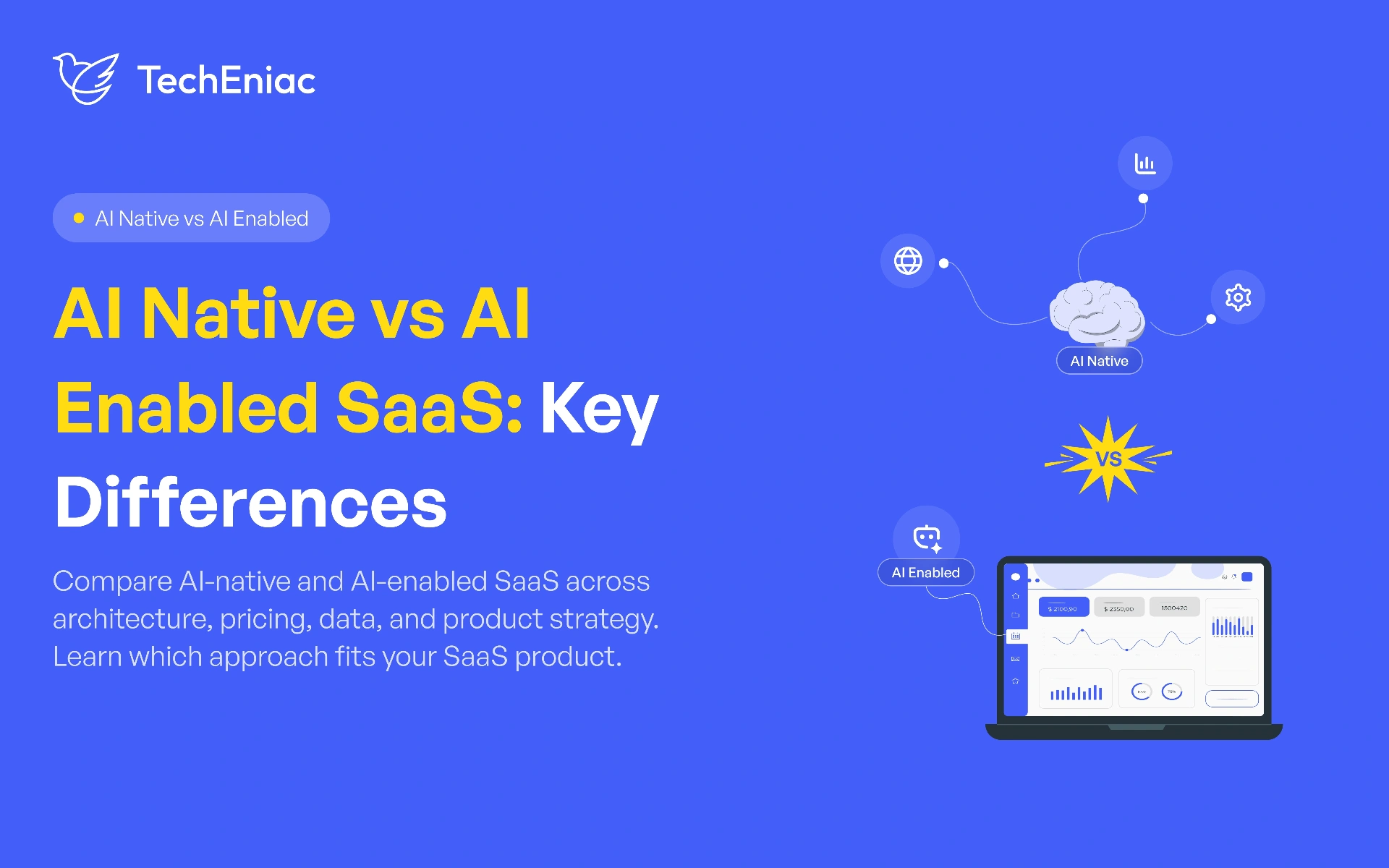
AI native products depend on AI to deliver their core value, while AI powered products, also called AI enabled products, use AI to improve a value that already existed. The table below compares the two across the areas founders weigh first.
Area | AI Native SaaS | AI Enabled SaaS |
|---|---|---|
Starting point | AI sits at the centre of the design | An existing workflow gains AI features |
Role of AI | Plans, acts, and completes tasks | Suggests, drafts, and summarizes |
Unit of value | A finished outcome | A faster user action |
Without AI | The product stops working | The product still works |
Typical pricing | Usage, outcome, or platform fee | Seats plus an AI add on or credits |
Data use | Feedback from completed tasks | Existing records with extra AI context |
Main risk | Model cost and accuracy | Low adoption and thin differentiation |
The without AI test is the fastest check. A product that still works when AI is switched off is AI enabled, and a product that stops working is AI native.
AI Native Product Architecture vs AI Enabled Architecture
AI native product architecture places the model, retrieval, and evaluation in the main request path, while AI enabled architecture calls an AI service from a single feature. The difference starts with speed. A standard database query returns in 5 to 50 milliseconds, while an LLM inference call takes 2 to 15 seconds, as TechEniac's guide to AI SaaS product architecture explains. That gap shapes streaming, queues, caching, and the way the interface shows progress.
The same guide describes four layers, and each one changes between the two models:
Presentation Layer: AI native interfaces show progress, sources, and approvals for long tasks, while AI enabled interfaces add a prompt box or a suggestion panel.
Application Layer: AI native products let an orchestrator manage multi step tasks, while AI enabled products keep standard request and response logic.
AI Service Layer: AI native products run model routing, prompt versioning, and evaluation as separate services, while AI enabled products often call one model directly.
Data Layer: AI native products use vector stores with tenant isolation, such as a collection per tenant or metadata filtering, next to a relational database.
The architecture guide lists tightly coupled AI and application layers among the common mistakes. AI native builds keep the AI service separate and swappable, so a model upgrade does not require a rewrite.
Data, Learning Loops, and AI SaaS Defensibility
AI SaaS defensibility comes from proprietary data, workflow depth, and feedback loops, because competitors can buy access for the same models. Bain's September 2025 analysis of agentic AI and SaaS describes a three-layer stack of systems of record, agent operating systems, and outcome interfaces. It names unique data with a long activity history as the part most likely to last.
TechEniac's work points to the same factors: proprietary data pipelines, accuracy engineering, deep enterprise integrations, and user-built profiles. Well-built retrieval pipeline development turns customer documents and history into context that a generic model cannot copy.
The two models differ in how they collect that advantage:
AI Native Loop: Completed tasks, corrections, and approvals feed evaluation sets and retrieval data, so each result improves the next one.
AI Enabled Loop: Usage data informs prompt changes only when the team builds a pipeline to capture feedback.
A useful defensibility check asks whether a competitor with the same model API could copy the product within a quarter.
AI Native vs AI Enabled Pricing Models
AI native products price on work done through usage, outcomes, or platform fees, while AI enabled products often add a metered or credit layer to seat pricing. McKinsey's September 2025 analysis shows two of these models in practice. Zendesk charges $1.50 per successfully resolved interaction, and Clay charges flat enterprise fees that are not tied to user counts.
Zendesk is an established support platform, so outcome pricing alone does not make a product AI native. The pricing model follows the value delivered, and the architecture decides whether the product can deliver that value.
Each model fits a different situation:
Use Seat Pricing When: A person still does the work and AI speeds it up.
Use Usage Pricing When: AI work varies widely between customers, and inference cost follows volume.
Use Outcome Pricing When: The result is countable, such as a resolved ticket, and accuracy is measured.
A hybrid plan with a volume cap on one tier is a practical way to test pricing. The AI SaaS trends research recommends this for products moving off flat prices.
Cost Structure and Margins in AI Native Products
AI native products carry inference as a core cost of goods, so margins depend on routing, caching, and token budgets from the first release. TechEniac's architecture research puts a GPT-4o query at $0.01 to $0.10. At 10,000 queries per day, that adds up to $100 to $1,000 per day.
Three controls keep that cost in check:
Model Routing: Simple requests go to smaller models, and SolidHealth AI saved 40% with Gemini and Llama routing.
Response Caching: MortgageLens AI reduced repeat costs by 60% by serving common answers from cache.
Token Budgets: Limits per tenant and per query stop heavy users from erasing margin and LLM integration development puts these limits in place from the start.
AI enabled products face the same cost, but at a smaller scale, because AI features reach only a share of users. A cap is still needed, since a flat price can lose money on the heaviest users.
AI-Native SaaS: The "Outcome" Machine
An AI native product works as an outcome machine: the customer states a goal, and the system plans, acts across tools, and returns a finished result. McKinsey describes this shift as software moving from a tool that enables work to a platform that performs and orchestrates work.
An outcome machine runs in four steps, from goal to verified result:
Step 1: Capture the Goal A user or a trigger supplies a goal, such as resolving a ticket or filing a claim.
Step 2: Plan and Retrieve The agent gathers customer specific context from the data layer and plans the actions needed.
Step 3: Act Across Systems The agent calls tools and APIs in several systems, with human approval where the risk is high.
Step 4: Verify and Learn Evaluation checks the result, and the outcome returns to the data layer to improve later runs.
TechEniac's ClaimBot follows this pattern in insurance. It cut first notice of loss time by 78%, from 22 minutes to 4.8 minutes, and AI resolved 69% of claims. Products like this rest on AI agent development work such as tool use, guardrails, and evaluation.
AI-Enabled SaaS: The "Copilot" Workflow
An AI enabled product keeps the existing workflow and adds a copilot that drafts, suggests, summarizes, or answers questions while the user stays in control. Gartner's August 2025 research describes AI assistants as embedded features that depend on human input, and as the first stage before task specific agents.
The copilot model has clear strengths:
Faster Launch: The existing app, users, and billing stay in place.
Lower Risk: A person reviews outputs before anything changes.
Familiar Experience: Users stay in screens they already know.
The trade-off is that value stays tied to seats and user activity. Gartner's July 2026 release warns incumbents that seat and dashboard models face an existential threat. It advises them to shift toward outcome-based value, embed agentic capability where work is executed, and retain customer specific knowledge. The difference between an assistant and an agent is covered in AI agents vs chatbots.
A copilot is a sound first step and a risky final state.
The Founder's Dilemma: Strategic Trade-Offs
AI native or AI enabled: which should a founder build? An AI native startup suits a new product where software can finish the core task and margins hold. A team with a working product usually adds AI first and moves toward AI first SaaS in stages.
The risk differs by case. A team with a working product risks breaking what customers already use. A team with only an idea risks building something nobody wants.
Two questions must both be yes before building AI native applications makes sense:
Task Shape: Can software finish the core task on its own and show a measurable result?
Unit Economics: Can margins hold as usage and model costs grow?
Two more questions decide where to start:
Starting Point: Is the product new, with no customer base or older system to protect?
Customer Trust: Would customers accept software acting without approval at each step?
Situation | Better Path | Reason |
|---|---|---|
Both must haves are yes, the product is new, and customers accept automation | AI native from day one | No older system to protect, and the outcome can be measured |
A working product exists, and customers want to review each result | AI enabled first | Trust and data already exist, so AI can assist where review is normal |
A working product exists, and the task can be automated safely | AI enabled first, then rebuild the core around agents in stages | Migration risk stays small while the agent layer proves itself |
The task needs open ended judgment, or margins fall as usage grows | Fix the task scope or pricing before choosing a path | Neither path works until cost and task shape are sound |
The two paths fit different conditions:
Choose AI Native When: The task repeats and can be counted, the market is open to a new entrant, and the team can fund evaluation and model usage from the start.
Choose AI Enabled When: A trusted product already exists, customers want control, or the existing data and integrations are the main asset.
An AI native build takes more design work up front. A narrow first release, scoped through AI SaaS MVP development, tests one outcome before the full platform is built.
The steps for building an AI SaaS product fit both paths. They start by checking whether AI is needed at all. If a database query or a simple rule handles the task, adding AI only adds cost.
The right path is the one that lets the product collect data and earn trust before competitors copy its features.
How TechEniac Builds AI Native and AI Enabled Products
TechEniac designs AI SaaS products for both paths, from copilot features inside existing platforms to agent driven workflows that complete tasks. The team has shipped 15 production AI SaaS products, including SolidHealth AI, MortgageLens AI, and ClaimBot.
Projects run in two-week sprints with a demo at the end of each one, and 30 days of post launch support follows the release. TechEniac's AI SaaS product development work covers architecture, retrieval, model routing, and cost controls, so the product is designed for its path from the first sprint.