Quick Summary
Most founders buy AI tools in the wrong order. They subscribe to whatever assistant is getting the most attention that month; a co-founder recommends something else a week later, and six months in, three tools are quietly doing the same job while an actual gap in the workflow goes unnoticed. This guide is built to stop that pattern before it starts. It covers the tools startups are genuinely paying for in 2026, not a 40 tool everything list, the real problems AI solves at the early stage, concrete use cases and benefits backed by current data, how AI actually fits into a startup's daily workflows, and where a startup outgrows off the shelf tools entirely and needs something built. It closes with where this is all heading next, and the key takeaways worth remembering.
The Best AI Tools for Startups in 2026
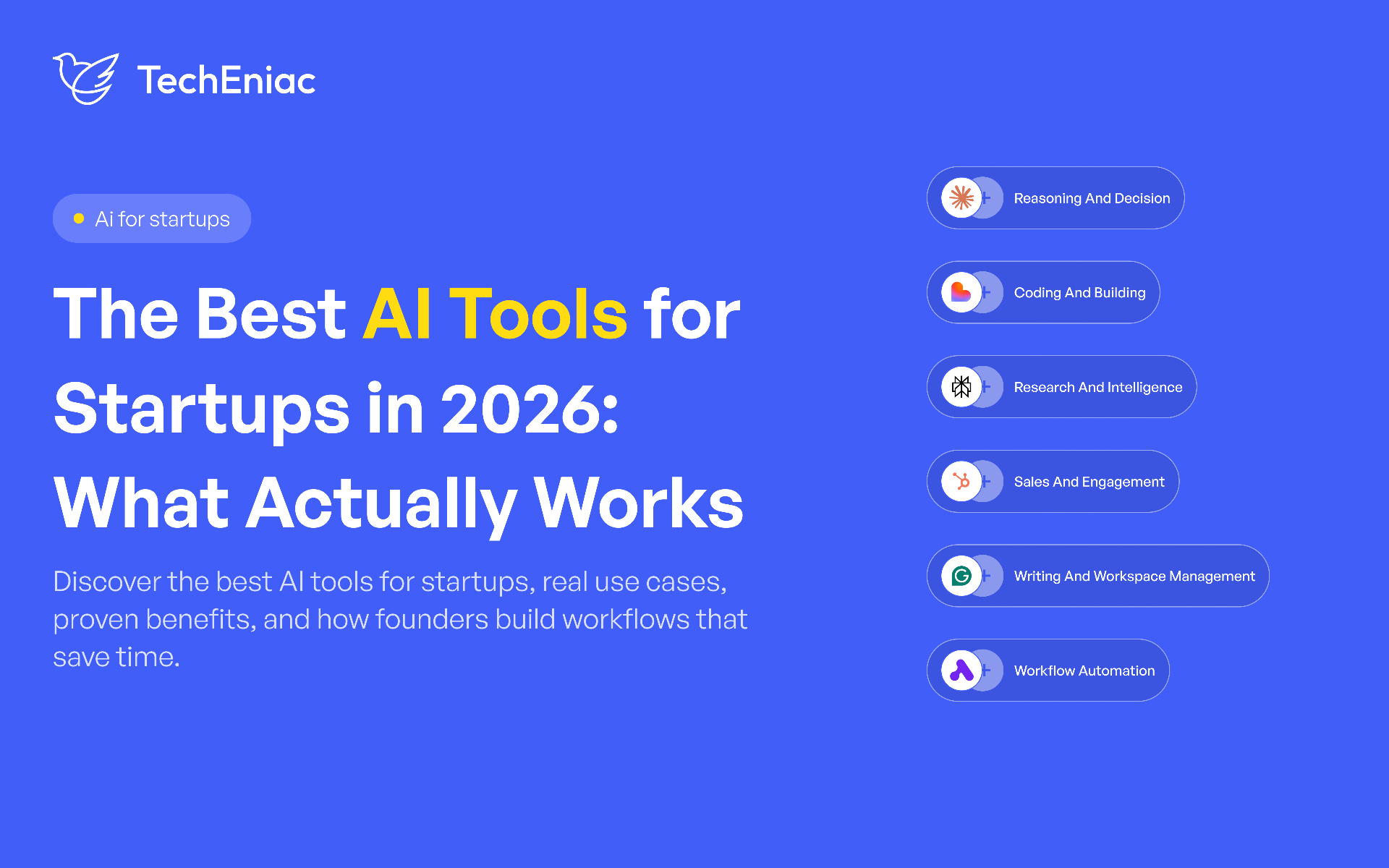
A startup's AI stack in 2026 tends to build in a predictable order: a general reasoning assistant first, a coding tool the moment there is a real product to ship, then sales, content, and operations tools layered in as the team grows past the founder doing everything alone. Here is what that stack looks like function by function, not a ranked top ten, since the right tool depends entirely on the job.
Key Takeaways
The strongest startup AI stacks are small and deliberate, the typical small business runs five tools chosen by function, not fifteen accumulated by impulse
AI solves three specific early-stage problems well, missing headcount, slow learning loops, and founder bandwidth spread across too many roles
Real, reported benefits include measurable revenue gains, meaningful time savings, and high founder confidence in continued AI adoption
The best startup workflows use AI for the first draft and first pass, while keeping a human checkpoint on anything consequential
Off the shelf tools solve most early-stage needs, but a startup whose actual product needs to be an AI system eventually needs something purpose built
The real skill emerging in 2026 is judgment about which decisions to hand to AI, not simply how many AI tools a team has adopted
1. Claude & ChatGPT: best for general reasoning and decision support
Claude and ChatGPT remain the default starting point for most founders. They're the tools you open first, before any specialist app, whether you're thinking through a hard hiring call, drafting an investor update, or just talking through a decision with no one else in the room.
Claude in particular has built a reputation among founders for careful, low-hype output, useful when the audience on the other end is an investor or a customer, not just an internal team.
How startups use Claude & ChatGPT:
Draft investor updates, board memos and internal docs in a consistent voice
Think through hiring, pricing and strategy decisions before committing
Summarize long documents, contracts or customer feedback threads
Act as a first-pass editor for anything customer- or investor-facing
The takeaway: This is the tool every other tool on this list gets layered around, general enough to handle almost anything, until a task needs something more specialized.
2. Cursor: best for AI-assisted coding
At the moment there's a real product to ship; technical founders move to a coding-specific tool. Cursor has become a standard here, giving developers AI-assisted speed without losing control of the underlying codebase, unlike fully generated, black-box output.
How startups use Cursor:
Write and refactor code faster inside a familiar editor
Debug and review pull requests with AI assistance
Onboard new engineers into an existing codebase faster
The takeaway: Cursor keeps a technical founder or small engineering team in the driver's seat while still moving at AI speed.
3. Lovable, Bolt.new & v0: best for fast MVP building
These tools have become the go-to way to turn an idea into a working product without a long build cycle. They're particularly useful for technical founders who want to validate an idea before investing in a full custom build.
How startups use Lovable, Bolt.new & v0:
Turn a product idea into a clickable, working prototype in days
Test a feature or landing page with real users before committing engineering time
Generate a starting codebase that a technical team can then take over and extend
The takeaway: These tools shorten the gap between "idea" and "something a user can actually try."
4. Bubble: best for no-code founders
For non-technical founders, no-code builders like Bubble fill the same role as Cursor and Lovable fill for technical ones: generating a working app fast. The difference is that the output stays visually editable, so a founder without an engineering background can keep shipping changes without writing code.
How startups use Bubble:
Build and launch a working MVP without hiring a developer first
Test a business model with real users before raising a seed round
Make ongoing changes to the product without depending on engineering time
The takeaway: Bubble removes the "I need a developer to test this idea" bottleneck entirely.
5. Perplexity: best for research and market intelligence
Perplexity has become the go-to for founders who need sourced, citable answers for competitive analysis or market research, rather than a confident-sounding answer with no way to verify it.
How startups use Perplexity:
Validate a market opportunity with sourced industry data
Research competitors and pull citable stats for pitch decks
Fact-check claims before they go into an investor deck or public post
The takeaway: Perplexity replaces hours of manual searching with sourced answers a founder can actually verify and reuse.
6. Apollo & HubSpot AI: best for sales prospecting and outreach
Apollo and HubSpot's AI features now handle prospecting, lead scoring, and first-touch outreach, work that used to require a dedicated SDR hire long before most early-stage teams could justify one.
How startups use Apollo & HubSpot AI:
Build and prioritize lead lists automatically
Draft first-touch outreach messages for a human to review before sending
Score and route leads so the highest-intent prospects get attention first
The takeaway: These tools compress the early sales funnel into something a founder or single sales hire can run alone.
7. Grammarly & Notion AI: best for content and workspace management
These tools handle the unglamorous but constant work of drafting, editing, and organizing internal knowledge, so it doesn't live only in one person's head.
How startups use Grammarly & Notion AI:
Edit and polish drafts before they go external
Summarize meeting notes and turn them into searchable documentation
Organize decisions and context so new hires get up to speed faster
The takeaway: Institutional knowledge stops disappearing into Slack threads and one founder's memory.
8. Activepieces: best for workflow automation
Platforms like Activepieces connect the tools above together, so a lead captured in one place automatically updates a CRM, notifies the right person, and triggers a follow-up, without someone manually shuttling information between apps.
How startups use Activepieces:
Automatically sync leads, form submissions and support tickets across tools
Trigger notifications and follow-ups without manual handoffs
Cut down the busywork of moving data between disconnected apps
The takeaway: Automation is what turns a pile of point solutions into an actual system.
The honest guidance here matters more than the list itself. According to SBE Council's 2026 Small Business Technology Use Survey, the typical small business uses five AI tools, not fifteen. Five, chosen deliberately by function, consistently outperforms fifteen, accumulated by impulse.
How Techeniac Helps Startups Beyond the Tool Stack
Off the shelf AI tools solve a real problem for a startup's first year or two. They start to strain the moment a founder's actual product needs to be an AI system, not just a company that uses AI tools internally.
At Techeniac, our AI SaaS MVP development service is built specifically for founders at that exact turning point, taking a validated idea from architecture through a working, production ready first version in weeks, not months. For startups whose product itself needs to reason, generate, or act, not just automate a routine task, our generative AI development and AI agent development work goes beyond wiring together existing tools, building systems grounded in your own data rather than a generic model's general training. And where the real bottleneck is connecting a growing product to the systems, a startup already runs on, CRM, billing, support, our AI integration and automation work handles exactly that layer.
We work the way most early-stage founders need a partner to work, pushing back on scope before development starts, not after budget is already spent.
The AI Tech Startups Are Adopting in 2026
The composition of a typical startup stack has shifted meaningfully over the past two years. Early adoption was dominated almost entirely by general purpose assistants, a single tool doing everything reasonably well. In 2026, the stack has fragmented into purpose-built tools chosen by function, a coding assistant for building, a research tool for market intelligence, a workspace tool for internal knowledge, each doing one job well rather than one tool doing five jobs adequately.
The other clear shift is toward tools that consolidate rather than fragment further. Founders who lived through the tool sprawl phase, five or six overlapping subscriptions doing similar things, are now actively choosing platforms that combine adjacent jobs, a builder that handles both AI generation and hosting, a workspace that handles both documentation and task management, rather than stitching together separate point solutions for each.
Trends and What's Coming Next for Startups and AI
A few shifts are worth watching heading into the next year. Agentic tools, ones that can complete a multi-step task rather than just answer a single question, are moving from novelty to genuinely useful for early-stage teams, though the same discipline that applies to any AI tool still applies here, a human checkpoint on anything consequential, not full autonomy from day one. Investment confidence is also not slowing down, the vast majority of small businesses surveyed by SBE Council plan to maintain or increase their AI spending over the next twelve months, suggesting this is not a temporary spike but a genuine shift in how early-stage companies expect to operate going forward.
The more interesting trend is qualitative rather than quantitative. The gap between a startup that uses AI tools well and one that does not is starting to show up less in speed and more in judgment, knowing which decisions to hand to a tool and which ones genuinely need a founder's attention is becoming the actual skill, not simply having access to the tools in the first place.