A team spent six weeks and a meaningful chunk of their seed round fine-tuning a model to answer questions about their product documentation, only to realize a month later that every doc update meant retraining from scratch. The same problem would have taken a RAG pipeline about a week to solve, and updating it would have meant editing a document, not retraining a model. Fine-tuning vs RAG isn't a question with one right answer. It's a question that depends entirely on whether what you're trying to fix is what the model knows or how the model behaves, and mixing those two up is the single most expensive mistake in this decision.
Key Takeaways
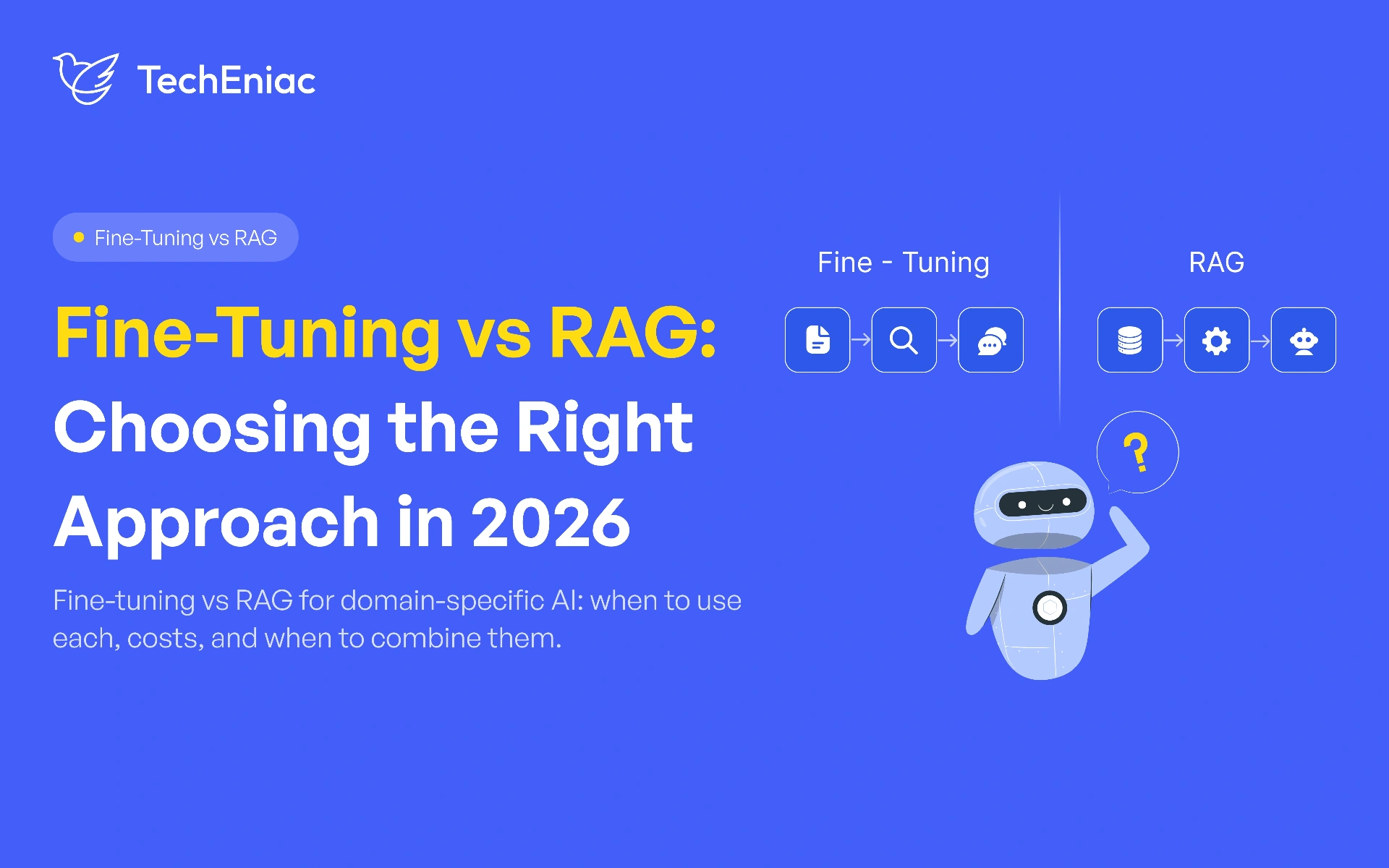
RAG changes what a model sees at the moment it answers. Fine-tuning changes the model's weights permanently. That distinction decides almost everything else.
RAG is the right default for most domain-specific AI model use cases in 2026, especially anything where the underlying facts change over time.
Fine-tuning earns its cost when you need a smaller, cheaper model that matches a frontier model's quality on one narrow task, or when you need to lock in a specific tone or output format that prompting alone won't hold.
Fine-tuning cost vs RAG isn't a simple comparison. RAG has ongoing operational costs that scale with usage. Fine-tuning has a real upfront training cost but can lower cost per query at high volume.
Most production systems in 2026 end up using both, RAG to keep the model grounded in current facts, light fine-tuning to keep its tone and format consistent.
What Fine-Tuning and RAG Actually Do Differently
Most teams ask "should we fine-tune or use RAG" as if it's a single choice. The more useful question is what specifically is broken, the model doesn't know something, or the model doesn't behave the way you need it to, because those two problems have different fixes.
Retrieval augmented generation, commonly called RAG, keeps the underlying model exactly as it is and changes what it sees before it answers. Now a user asks a question, the system retrieves relevant chunks of information from your own documents or database and feeds them into the model's context alongside the question. The model itself never changes. Only its inputs do.
Fine-tuning changes the model itself. You train the existing model further on a set of examples specific to your task, and the resulting behaviour gets baked directly into the model's weights. The knowledge or behaviour doesn't need to be fed in at query time, because it's now part of how the model responds by default.
The simplest way to hold this distinction: RAG is for knowledge that changes. Fine-tuning is for behavior that shouldn't change. A support knowledge base gets updated constantly, which points toward RAG. A requirement that every response follow a strict output format regardless of the question points toward fine-tuning.
When to Fine-Tune an LLM
Fine-tuning earns its cost in a smaller number of situations than most founders expect, but in those situations it's genuinely the right call. The common thread across all four below is that the thing you're fixing is a behavior, not a fact, which is exactly what fine-tuning is built to change.
Locking in a specific tone, style, or output format. If a product needs every response to follow an exact structure, a specific JSON schema, a particular brand voice, a strict format prompting struggles to hold consistently, fine-tuning bakes that consistency in rather than hoping the model follows instructions every single time.
Distilling a frontier model into something smaller and cheaper. A large general-purpose model can be expensive and slow for a narrow, repetitive task. Fine-tuning a smaller model specifically on that task can match or exceed the larger model's accuracy on that one job, at a fraction of the per query cost and latency.
Narrow classification or extraction tasks with a clear, stable answer format. Tasks like sorting support tickets into fixed categories or extracting specific fields from structured documents are well suited to fine-tuning, since the task itself doesn't change even as the volume of examples grows.
When your domain uses language or patterns a general model handles poorly. Highly specialized terminology, an unusual writing style, or domain specific reasoning patterns that a general-purpose model consistently gets wrong are a legitimate reason to fine-tune, provided you have enough quality examples to teach the pattern.
When RAG Is the Right Call for a Domain-Specific AI Model
RAG is the more common right answer in 2026, and for founders building a domain-specific AI model on top of their own content, it's usually the place to start.
Your underlying information changes regularly. Product documentation, pricing, policy details, and internal knowledge bases get updated constantly. RAG lets you update a document and have the model reflect that change immediately, no retraining required.
You need to show where an answer came from. RAG naturally supports citing the specific document or passage an answer was grounded in, which matters enormously for compliance heavy industries, customer trust, and simply catching when the model gets something wrong.
You want the flexibility to swap the underlying model. Because RAG doesn't change the model itself, switching from one provider's model to another is a configuration change, not a full retraining project. That flexibility has real value as model quality and pricing continue shifting year over year.
You're working with a large or growing custom AI knowledge base. RAG scales naturally with the size of your content. Fine-tuning a model to memorize an entire growing knowledge base isn't practical, retrieval is built specifically for pulling the relevant slice out of a much larger set.
Fine-Tuning Cost vs RAG: What Actually Drives the Number
Comparing fine-tuning cost vs RAG isn't a single number on either side, and any guide that gives you one exact figure is oversimplifying. What drives the cost is different for each approach.
RAG's cost is mostly ongoing and usage based: embedding your documents, hosting a vector database, and the per query cost of retrieving context and generating a response. These costs scale with how much content you're retrieving from and how many queries your product handles, and they tend to be predictable once you know your usage pattern, even if the exact dollar figure varies significantly depending on provider, document volume, and query frequency.
Fine-tuning's cost is mostly upfront: preparing a quality training dataset, the compute cost of the training run itself, and the evaluation work to confirm the fine-tuned model improved on the task. Modern fine-tuning techniques like LoRA have brought this upfront cost down considerably compared to full fine-tuning, which is now rarely the right choice outside of building an entirely new foundation model from scratch. Once trained, a fine-tuned model can sometimes be cheaper to run per query than a RAG pipeline calling a large frontier model, particularly at high volume on a narrow task.
The honest summary: RAG tends to have lower upfront cost and higher predictable ongoing cost. Fine-tuning tends to have higher upfront cost with the potential for lower cost per query at scale, on the specific task it was trained for. Which one is cheaper for your product depends on your query volume, how often your underlying data changes, and how narrow your task is, not a general rule either direction.
Building a Custom AI Knowledge Base: Where RAG Architecture Actually Lives
A custom AI knowledge base built on RAG has a consistent architecture regardless of the specific use case. Documents get broken into chunks small enough to retrieve precisely but large enough to preserve meaning. Each chunk gets converted into a vector embedding and stored in a vector database. When a user asks a question, that question gets embedded the same way, the most relevant chunks get retrieved by similarity, and those chunks get fed into the model's context alongside the original question.
The quality of a RAG system depends less on which model you're using and more on how well this pipeline is built, chunking strategy, retrieval accuracy, and how the retrieved context gets assembled before reaching the model all matter more than most founders initially expect. A poorly chunked knowledge base will produce weak answers even from the best available model.
This is also where most RAG failures happen, and it's rarely the model's fault. A support document chunked in the wrong place can split a critical instruction across two separate chunks, so neither one retrieves with the full answer intact. A retrieval step that pulls five loosely related chunks instead of the two genuinely relevant ones buries the right answer in noise the model then must sort through. Teams troubleshooting a RAG system that "seems to be giving wrong answers" often find the problem sitting in the retrieval and chunking layer, not in the language model generating the final response.
Can You Combine Fine-Tuning and RAG?
Yes, and in production systems this is increasingly the default rather than the exception. The most common hybrid pattern uses RAG to keep the model grounded in current, retrievable facts, while a lighter fine-tune handles tone, output format, or domain specific phrasing that prompting alone struggles to hold consistently.
This combination plays to each technique's actual strength. RAG handles the part of the problem that changes constantly, your knowledge base. Fine-tuning handles the part that shouldn't change at all, how the model is supposed to sound and behave regardless of what it's answering. Treating this as an either-or decision usually means picking up the weaknesses of whichever one you didn't choose.
A Quick Decision Framework
Your Situation | Recommended Approach |
|---|---|
Knowledge base changes frequently | RAG |
Need to cite sources for answers | RAG |
Want flexibility to switch models later | RAG |
Need a strict, consistent output format | Fine-tuning |
Narrow, repetitive task at high volume | Fine-tuning |
Want a smaller, cheaper model matching frontier quality on one task | Fine-tuning |
Need current facts AND consistent tone or format | Both, RAG plus light fine-tuning |
Not sure yet | Start with RAG, it's reversible and doesn't lock in a model choice |
How TechEniac Approaches This Decision
We don't default to one answer before understanding the actual problem. A founder asking for a fine-tuned model when their real issue is an outdated knowledge base ends up with an expensive retraining habit. A founder asking for RAG when they need consistent structured output ends up fighting prompt engineering indefinitely.
For teams building a domain-specific AI model grounded in their own content, RAG Pipeline Development is where we build the retrieval architecture itself, chunking, embeddings, and the assembly logic that determines answer quality. For broader work connecting a model, whether fine-tuned or general purpose, into your actual product and backend, LLM Integration & Development covers that full integration. If the goal involves generating content or structured output where a lighter fine-tune might genuinely help, Generative AI Development is the closer fit. And if you're still deciding which approach fits your specific situation before committing budget either direction, an AI Consulting Services conversation is built exactly for that decision.