Quick Summary
Over the last two years, generative AI development has become one of the most searched and most misunderstood phrases in tech. Every second product launch claims to be AI powered, yet a large share of them are little more than a thin interface sitting on top of a public API call. That is not development, that is a wrapper, and not every AI product needs to be a wrapper, the difference between the two is exactly what separates a demo from a product a business can rely on. This guide breaks down what generative AI development involves, the types of systems you can build, where it delivers real business value, and what it genuinely costs to get right.
What Is Generative AI Development?
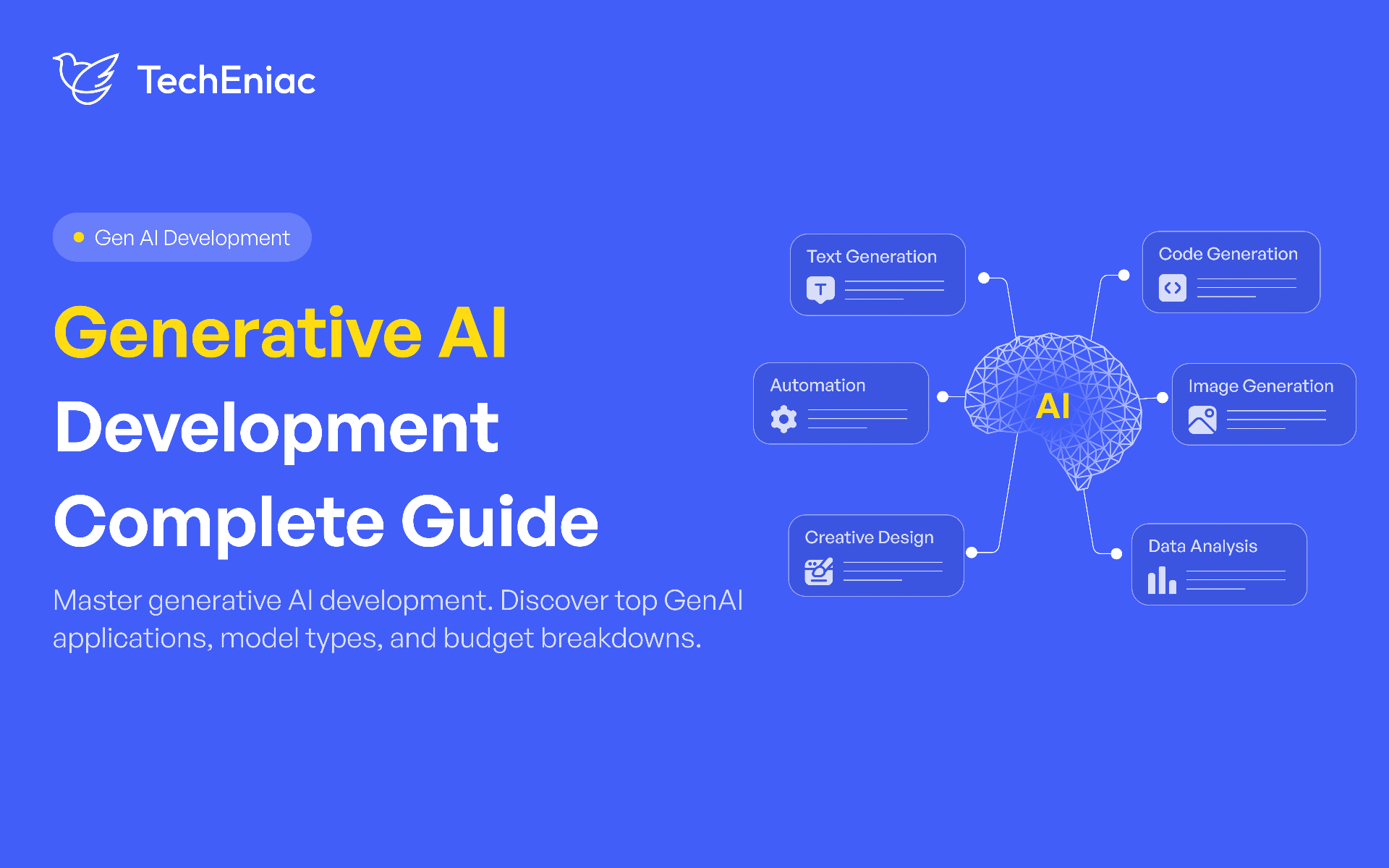
Generative AI development is the process of designing, building, and maintaining software systems that use generative models, large language models, diffusion models, or multimodal models, to produce content, automate decisions, or power interactive experiences. According to McKinsey's State of AI survey, generative AI use across organizations climbed from 33 percent in 2024 to 72 percent in 2025, a pace of enterprise adoption few technologies have matched, which is a large part of why so many businesses are now trying to build with it, often without fully understanding what "building with it" should actually involve.
It is easy to confuse this with simply calling an AI API from your app. Production grade generative AI development typically involves several layers working together.
Data engineering: collecting, cleaning, and structuring the information the model will reason over
Retrieval and context systems: ensuring the model has accurate, up-to-date information rather than relying purely on its training data
Model selection or fine-tuning: choosing (or adapting) the right model for the task, cost, and latency requirements
Evaluation and guardrails: testing outputs for accuracy, safety, and consistency before they reach a user
Integration and monitoring: connecting the system to real business workflows and tracking how it performs over time
Skip any of these layers, and you end up with something that looks impressive in a demo but breaks down the moment real users, real data, or real edge cases show up.
Types of Generative AI Development
Different business problems call for different kinds of generative AI systems. Below are the core types of generative AI development, ordered roughly by increasing complexity and control.
Prompt Engineering & API-Based Integration
The lightest form of generative AI development: connecting to an existing foundation model (like GPT, Claude, or Gemini) through its API and crafting prompts to get consistent, useful outputs. This is fast to build and ideal for early validation, but it's also where most "wrapper" products stop which is often not enough for a product meant to scale or defend itself competitively.
Retrieval-Augmented Generation (RAG) Systems
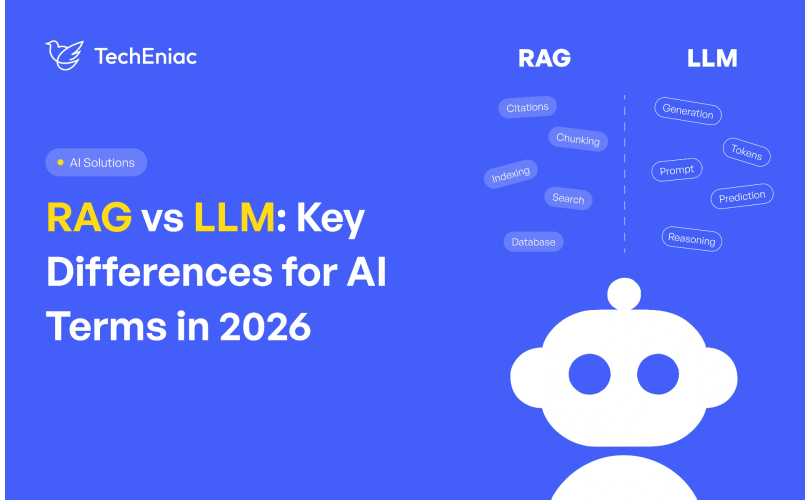
RAG connects a generative model to your own knowledge base documents, databases, product catalogues, and policy manuals so it answers using your actual data instead of guessing from general training knowledge. This is the backbone of most enterprise chatbots, internal search tools, and support assistants, because it dramatically reduces hallucination and keeps answers current without retraining a model.
Fine-Tuned or Custom Model Development
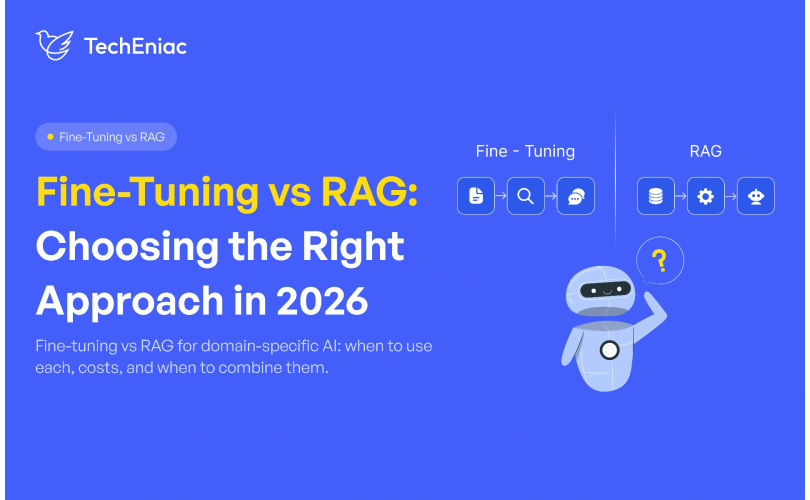
Here, a base model is further trained on domain-specific data, so it internalizes a particular tone, format, or specialized knowledge that is useful for industries with unique terminology (legal, insurance, healthcare) or when response consistency at scale matters more than general flexibility. Fine-tuning costs more upfront but can reduce long-term prompting complexity and inference costs.
AI Agents & Multi-Step Workflows
Agentic systems go beyond answering a single question; they plan, call tools, retrieve data, take actions, and loop until a task is complete. Think of an AI system that doesn't just draft a response but checks a database, verifies eligibility, and updates a record. This is where generative AI development starts to resemble traditional software architecture, with the model as one component among many.
Multimodal Generative AI
Systems that combine text, voice, and sometimes image or video such as a support assistant that can both chat and handle a phone call. Multimodal development requires additional engineering around speech-to-text, text-to-speech, and latency management, since users expect near real-time responses in voice interactions.
This layered, evaluation first approach to matching the right type of system to the right problem is central to how we work at TechEniac.
Benefits of Generative AI Development
When built properly not just bolted on generative AI development delivers measurable business outcomes, not just novelty:
Faster resolution times in support and operations, as systems retrieve and synthesize information instantly instead of requiring manual lookup
Reduced manual workload on repetitive, high-volume tasks like document review, first-line support, and data entry
Personalization at scale, where responses adapt to individual customer context instead of relying on generic templates
New product surfaces, such as voice assistants or embedded copilots, that weren't previously feasible without large teams
Better decision support, turning unstructured data emails, transcripts, PDFs, notes etc into structured, searchable, actionable information
The value compounds when these systems are designed to improve over time through feedback loops and evaluation, rather than staying static after launch.
Generative AI Applications Across Industries
Generative AI applications aren't limited to chatbots. Here's where we're seeing the most tangible impact.
Customer Support & Conversational AI
AI-driven support assistants handle tier-one queries, triage complex issues to human agents, and maintain context across a conversation reducing wait times without sacrificing accuracy when built on solid retrieval infrastructure.
Insurance & Claims Automation
Claims processing is document-heavy, repetitive, and time-sensitive; exactly the kind of workflow generative AI is suited to streamline. For example, in insurance, AI-powered claims assistants with voice capability are already reducing resolution time and manual back-and-forth. Our TechEniac's voice-enabled insurance claims chatbot case study walks through how a voice-enabled AI chatbot handles insurance claims end-to-end, from intake to status updates.
Content & Marketing Operations
Generative AI applications assist with drafting, repurposing, and localizing content at scale while still requiring human review for brand voice and accuracy, particularly in regulated industries.
Internal Knowledge & Enterprise Search
RAG-based systems turn scattered internal documentation like wikis, PDFs, Slack threads into a single searchable assistant, cutting down the time employees spend hunting for answers.
Voice-Enabled AI Assistants
Combining generative AI with speech interfaces allows businesses to automate phone-based interactions appointment scheduling, claims intake, order status without forcing customers to use a chat interface they may not prefer.
Generative AI Examples: Real-World, Not Hypothetical
To ground this in practice, here are concrete examples of generative AI systems in production rather than theoretical use cases:
Voice-enabled claims chatbot: captures claim details over a phone call, transcribes and structures the information, and updates the claims system automatically.
RAG-powered internal assistant: answers employee questions by retrieving directly from internal policy documents, reducing dependency on HR or IT tickets.
Multi-step AI agent for order support: checks order status, verifies return eligibility against policy, and initiates a refund workflow without human intervention for straightforward cases.
Fine-tuned content assistant: generates first drafts in a company's specific tone and format, trained on that company's existing content library rather than generic web text.
Multimodal document assistant: extracts information from scanned PDFs and images (like insurance forms or invoices) and converts it into structured, query able data.
Cost of Generative AI Development
There's no single number that answers "how much does generative AI development cost?" but there are clear cost drivers worth understanding before you scope a project, along with rough ranges based on the type of system:
System Type | Typical Cost Range | Notes |
|---|---|---|
Prompt engineering / API-based integration | $5,000 – $20,000 | Fastest to launch; ongoing per-token usage costs scale with volume |
RAG systems | $20,000 – $60,000 | Cost driven by data cleanup, vector database setup, and freshness pipelines |
Fine-tuned / custom models | $30,000 – $100,000+ | Higher upfront investment; can lower long-term inference costs at scale |
AI agents & multi-step workflows | $40,000 – $120,000+ | Complexity scales with number of tools, systems, and decision points involved |
Multimodal (text + voice/image) | $50,000 – $150,000+ | Adds speech-to-text, text-to-speech, and latency engineering on top of the base system |
These figures are directional and vary based on scope, data readiness, and integration complexity but they give a realistic starting point instead of a single misleading number.
Key cost drivers to understand:
Model choice: Using a hosted API (pay-per-token) is cheaper to start but scales with usage; fine-tuning or self-hosting an open-source model has higher upfront cost but can lower long-term inference costs at high volume.
Data preparation and RAG infrastructure: Building a reliable retrieval system includes cleaning data, setting up vector databases, and maintaining freshness which causes often the largest hidden cost in a generative AI project.
Integration complexity: Connecting the AI system to existing tools (CRMs, ticketing systems, databases, phone systems) typically takes as much engineering effort as the AI component itself.
Evaluation and monitoring: Ongoing testing for accuracy, safety, and drift isn't optional for production systems, but it's a recurring cost that protects against silent failures.
Build vs. partner: In-house teams offer control but require sustained AI engineering expertise; partnering with a specialized development team can reduce time-to-launch and avoid common architectural mistakes early on.
The honest answer is cost scales with how much reliability and scale you need, not with how impressive the demo looks.
Build vs. Wrapper: Why Architecture Matters
It's worth repeating: a large share of "AI products" in the market today are wrappers which is a UI in front of an unmodified API call, with no retrieval layer, no evaluation, and no defensibility. They're fast to build and just as fast to become obsolete once the underlying model provider changes pricing or capability.
Real generative AI development treats the model as one component in a larger system with your data, your workflows, and your evaluation criteria built around it. That's the difference between a product that survives a model update and one that breaks with it. For a closer look at the practical signs a product might be a wrapper and how to architect around it, see TechEniac's guide to building AI products that aren't just wrappers.
How TechEniac Approaches Generative AI Development
Generative AI projects at TechEniac start by mapping the workflow the AI needs to fit into, then working backward to the simplest architecture that reliably solves it. Retrieval and evaluation typically come before fine-tuning is even considered, and testing against real edge cases happens before a system goes live, not after. Solving the problem reliably takes priority over building the most complex system possible.
This is the same principle behind our ClaimBot build: a voice-enabled insurance claims assistant that had to handle messy, real-world phone conversations and not scripted demo inputs.
If you're evaluating a generative AI initiative whether it's a support assistant, an internal tool, or a customer-facing product, our generative AI development services are built around this same evaluation-first approach.
Key Takeaways
Generative AI development means building complete systems with retrieval, evaluation, and integration, not just calling an API.
The right type of system, whether RAG, fine-tuned, agentic, or multimodal, matters more than which model you choose.
Real business value comes from faster resolution, reduced manual work, and better use of unstructured data, not novelty.
Cost is driven mainly by data preparation and integration and typically ranges from a few thousand dollars for a simple API build to well over $100,000 for fine-tuned or agentic systems.
Systems built as thin wrappers break easily. Properly architected systems are built to last.