Healthcare organizations are moving fast toward AI powered software, and for good reason. Diagnostic assistants, patient engagement chatbots, clinical documentation tools, and remote monitoring dashboards all promise faster care and lower costs. But every one of these products touches protected health information, which means every one of them must be built with HIPAA in mind from day one.
If you're building an AI healthcare SaaS product, HIPAA compliance isn't optional. Whether you're creating an AI medical scribe, patient portal, telemedicine platform, or healthcare chatbot, your application must protect patient data from day one.
The challenge is that HIPAA compliance isn't something you add before launch. It influences your architecture, infrastructure, security, user access, AI workflows, and even the third-party tools you choose.
Quick Summary
Aspect | Detail |
|---|---|
What this guide covers | HIPAA's administrative, physical, and technical safeguards; encryption and access control best practices; HIPAA compliant AI and chatbot development; a step-by-step build process; cost drivers; BAA and vendor selection |
Who should read this | Healthcare SaaS founders, product leaders, CTOs, engineering teams building AI features, and anyone evaluating a development partner for a HIPAA compliant product |
What Is HIPAA Compliant SaaS Development?
HIPAA, the Health Insurance Portability and Accountability Act, sets national standards for protecting patient health information in the United States. Any SaaS platform that creates, stores, processes, or transmits protected health information, commonly called PHI, falls under HIPAA if it serves a covered entity such as a hospital, clinic, insurer, or a business associate working on their behalf.
PHI includes names, dates connected to a patient, medical record numbers, diagnoses, treatment notes, insurance details, and any other identifier that links health information back to a specific person. The moment that information enters a database, a log file, an API call, or a machine learning prompt, everything touching it falls inside HIPAA's scope.
HIPAA compliant SaaS development, then, is the practice of designing a software product so that every layer the infrastructure, the application code, the third-party vendors, and the internal processes meets HIPAA's Security Rule, Privacy Rule, and Breach Notification Rule. It is not a single feature or a checkbox. It is a continuous discipline that spans engineering, operations, and legal.
This article is intended as general guidance to help teams scope their build. It is not legal advice, and every organization should confirm specifics with qualified compliance counsel.
The Three Categories of HIPAA Safeguards
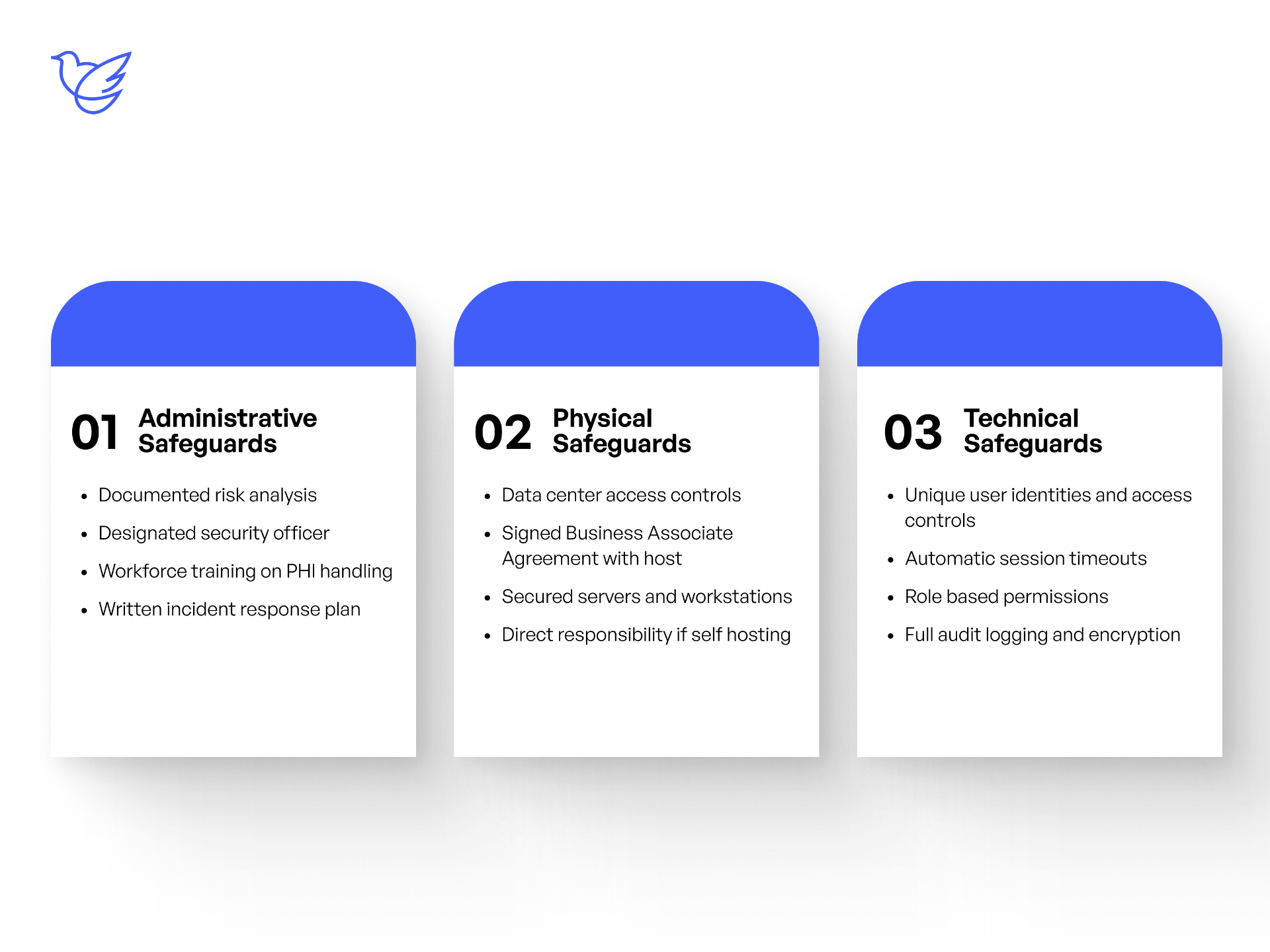
HIPAA's Security Rule organizes its requirements into three groups of safeguards. Understanding each one helps translate a legal requirement into an engineering task.
Administrative Safeguards
These cover the policies, training, and oversight that surround your software. A HIPAA compliant SaaS company needs a documented risk analysis, a designated security officer, workforce training on PHI handling, and a written incident response plan. Administrative safeguards are often the most overlooked part of compliance because they live outside the codebase, yet auditors and enterprise healthcare clients ask for them first.
Physical Safeguards
Physical safeguards control who can physically access the servers, workstations, and devices where PHI lives. For most modern SaaS teams, this responsibility is largely inherited from a cloud provider's data centre controls, if the provider is covered under a signed Business Associate Agreement. Teams that self-host or manage their own hardware carry this responsibility directly.
Technical Safeguards
This is where most of the engineering work happens. Technical safeguards include access controls, audit logging, transmission security, and encryption. A SaaS product needs unique user identities, automatic session timeouts, role-based permissions, and a complete trail of who accessed what data and when. Every technical decision, from the database engine to the logging library, should be evaluated against this standard.
Data Encryption Best Practices for HIPAA Compliant SaaS
Encryption sits at the center of almost every HIPAA conversation, and for good reason. Properly implemented encryption is one of the strongest defenses against a data breach becoming a reportable incident.
Encrypt data in transit. Every connection that carries PHI from the browser to your API, from your API to your database, and from your servers to any third-party service should use TLS 1.2 or higher. Plaintext PHI should never travel across a network, internal or external.
Encrypt data at rest. Databases, file storage, backups, and even temporary caches that might hold PHI should be encrypted using strong, industry-standard algorithms such as AES-256. This includes vector databases and embedding stores if your product uses AI features that reference patient records.
Manage encryption keys properly. Keys should be rotated on a schedule, stored separately from the data they protect, and accessible only to services that genuinely need them. A managed key management service from your cloud provider is usually a safer choice than building key handling in house.
Encrypt logs and backups too. Teams frequently encrypt the primary database and forget that debug logs, error traces, and backup snapshots can contain the same sensitive fields. A HIPAA compliant SaaS development process treats every copy of the data with the same seriousness as the original.
Apply field-level encryption for the most sensitive fields. Even within an encrypted database, adding a second layer of encryption on fields like social security numbers or diagnosis codes limits exposure if any single layer is ever compromised.
Access Control and Audit Logging
Encryption protects data from being read if intercepted, but access control decides who is allowed to see it in the first place. A well-built HIPAA compliant SaaS product should include the following.
Unique login credentials for every user, with no shared accounts.
Role-based access so a billing employee cannot see clinical notes and a nurse cannot see financial records.
Multi-factor authentication for any account that can view PHI.
Automatic session expiration after a period of inactivity.
Detailed audit logs recording who accessed which record, what action they took, and when.
Regular review of those logs to spot unusual patterns before they become incidents.
Audit logs themselves need protection. They often contain metadata that hints at PHI, so they should be stored securely, retained for the period your compliance policy requires, and never exposed in plain text to systems outside your security boundary.
Business Associate Agreements and Vendor Selection
Every vendor that touches PHI on your behalf your cloud hosting provider, your email service, your analytics tool, your AI model provider needs a signed Business Associate Agreement, commonly called a BAA, before any patient data reaches them. Without a BAA, using that vendor with real PHI is a compliance violation regardless of how good their security is.
Not every plan or tier from a given vendor is covered. Major cloud and AI providers often offer BAAs only for specific enterprise tiers or configured services, not their default consumer endpoints. Before sending PHI anywhere, confirm in writing exactly which service and tier is covered.
HIPAA Compliant AI Development: What Changes When You Add a Model
Layering artificial intelligence on top of a healthcare SaaS product introduces a new set of risks that traditional software does not have. HIPAA compliant AI development requires attention to a few specific problem areas.
PHI inside prompts. The instant a clinical note, a patient message, or a diagnosis code becomes part of a prompt sent to a language model, that prompt is now PHI. Debugging tools, prompt logs, and observability platforms can quietly become PHI stores if this is not accounted for.
Training and fine-tuning data. Using PHI to train or fine-tune a model means that data becomes embedded in an artifact you now must protect indefinitely. Most teams are better served keeping PHI out of training pipelines entirely and relying on retrieval methods instead.
Third-party model providers. Sending data to an external AI API means PHI leaves your infrastructure boundary. This is only acceptable when the provider offers a BAA for that exact endpoint and confirms your data will not be retained or used to train shared models.
No-train and retention settings. Enterprise AI APIs commonly provide a setting to disable training on customer inputs and to limit how long data is retained. These settings must be explicitly enabled and verified rather than assumed.
De-identification as a first line of defence. Removing or masking identifiers before data ever reaches a model can take much of an AI workload outside HIPAA's scope entirely. This is not foolproof, since free text clinical notes can hide identifiers in unexpected places, but a validated de-identification step remains one of the lowest-risk architectural choices available.
Building a HIPAA Compliant Chatbot
Patient-facing chatbots are one of the fastest growing categories of healthcare AI, and they deserve special attention because they sit directly in front of the patient, often collecting sensitive information in casual conversation.
A HIPAA compliant chatbot needs the same foundation as any other part of your SaaS product: encrypted transport, encrypted storage, strict access control, and a signed BAA with whichever model provider powers the conversation. Beyond that baseline, a few additional practices matter.
The chatbot should only retrieve the records the requesting patient or clinician is already authorized to see, never operate with broad database access. Conversation transcripts, since they frequently contain PHI, need the same encryption and retention policy as any medical record. Any integration with a third-party messaging platform, such as SMS or a web widget, should be checked for its own HIPAA readiness, since a chatbot backend can be perfectly compliant while the delivery channel is not.
Teams should also plan for graceful escalation. A chatbot handling anything beyond simple scheduling or general information should have a clear, tested path to hand the conversation to a human when a patient asks something sensitive or urgent.
Who Needs HIPAA Compliant SaaS Development?
Not every health-adjacent product falls under HIPAA, and not every team building one realizes it applies to them until a client or partner asks for proof. As a rule, if your product creates, stores, processes, or transmits PHI on behalf of a healthcare organization, HIPAA compliance is not optional.
Covered entities. Hospitals, clinics, physician practices, insurers, and health plans that build or commission their own software fall directly under HIPAA. Any SaaS product they operate internally needs to meet the Security and Privacy Rules in full.
Business associates. This is where most SaaS founders find themselves. If your product is used by a covered entity and PHI passes through your systems at any point, you are a business associate under HIPAA, even if you never interact with a patient directly. This includes:
Clinical documentation and EHR-adjacent tools.
Patient engagement platforms, portals, and appointment schedulers.
Telehealth and remote monitoring software.
Medical billing, claims, and insurance processing tools.
AI diagnostic assistants, clinical decision support tools, and healthcare chatbots.
Analytics or reporting platforms that ingest patient-level data.
Digital health startups building for consumers. Even products that sell directly to patients, such as symptom checkers, mental health apps, or chronic condition trackers, can fall under HIPAA if they partner with a covered entity, integrate with an EHR, or receive PHI from a provider on a patient's behalf. Selling direct to consumer does not automatically place a product outside HIPAA's scope.
Who generally does not need it. General wellness apps that never touch identifiable health data tied to a specific person, and software that only handles de-identified or aggregate data, typically fall outside HIPAA. The distinction is often narrower than teams expect, so this is worth confirming with compliance counsel rather than assuming.
The earlier a team identifies which category it falls into, the earlier compliance can be designed into the architecture instead of bolted on after a client's security review flags the gap.
Step by Step: How to Build a HIPAA Compliant SaaS Product
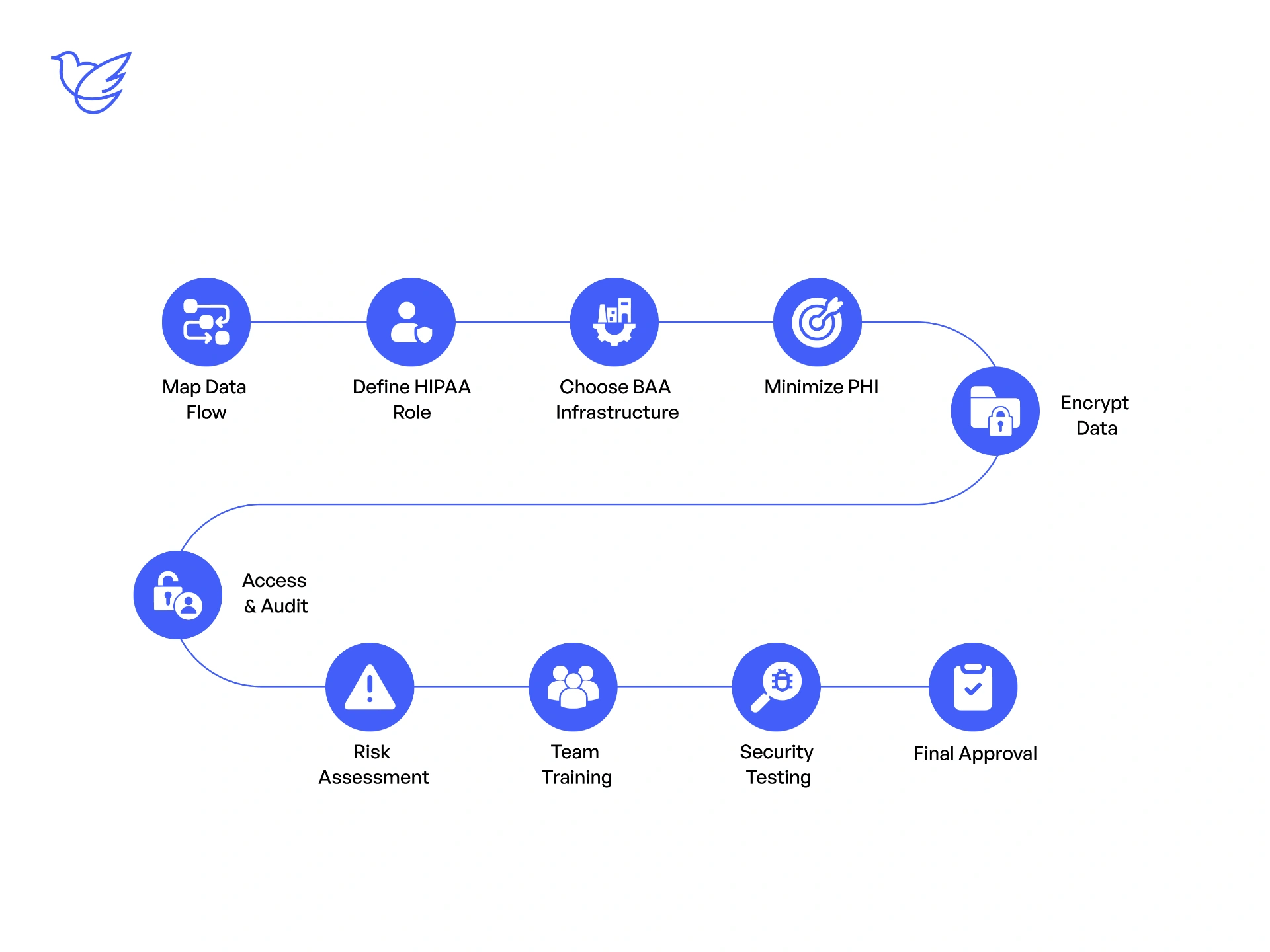
Map your data flow. Document exactly where PHI enters your system, where it travels, where it is stored, and where it exits. You cannot secure what you have not mapped.
Confirm your compliance role. Determine whether your organization is a covered entity, a business associate, or both, since obligations differ slightly between the two.
Choose infrastructure with BAA coverage. Select a cloud provider and any supporting services that offer a signed BAA for the exact configuration you plan to use.
Design for minimization. Collect and expose only the PHI each feature genuinely needs. Less data in a system means less risk if something goes wrong.
Build in encryption from the start. Retrofitting encryption after launch is far more expensive and error-prone than designing it in from the first sprint.
Implement access control and logging early. These are foundational, not optional add-ons for later.
Run a documented risk analysis. This is a HIPAA requirement on its own and should happen before launch, then be repeated periodically.
Train your team. Everyone who touches the system, including support staff, should understand what PHI is and how to handle it.
Test with real world scenarios. Validate encryption, access control, de-identification, and breach response procedures against realistic data before going live.
Get sign-off from security, compliance, and legal. No HIPAA compliant SaaS product should ship without this final review.
How Much Does HIPAA Compliant Software Cost to Build
Cost varies widely depending on scope, but a few factors consistently drive the budget for HIPAA compliant SaaS development. A simple patient-facing tool with modest data handling and a managed, BAA-covered cloud stack will cost far less than a platform handling clinical decision support, multiple integrations, and custom AI features.
The biggest cost drivers are the depth of the compliance work itself, including risk assessments and audits, the complexity of access control across different user roles, the number of third-party integrations that each require their own BAA review, and whether the product includes AI features that need de-identification pipelines or private model deployment. Teams that plan compliance in from the beginning generally spend less overall than teams that try to retrofit it after an MVP has already been built without these safeguards in place.
Is AWS or Azure HIPAA Compliant by Default
No major cloud platform is HIPAA compliant simply because you sign up for an account. AWS, Azure, and similar providers offer specific services that are eligible for a Business Associate Agreement, and using those services correctly with the right configuration, encryption settings, and access controls can result in a compliant environment. But the responsibility to configure that environment correctly always sits with your team, not the cloud provider. Confirm in writing which exact services fall under the BAA before any PHI touches them, and never assume a general-purpose service is covered just because a related product from the same vendor is.
Choosing a Development Partner for HIPAA Compliant SaaS
Building a compliant product in house requires a security and compliance function that already understands the Security Rule, along with engineers who have shipped systems under this kind of scrutiny before. Many healthcare founders instead choose a partner who has already designed these safeguards into real products, so the architecture is right from the first release rather than patched together after a near miss.
At Techeniac Services LLP in Ahmedabad, our teams have worked closely with healthcare founders building AI SaaS products for the healthcare industry, designing the encryption, access control, and audit logging into the architecture from the very first sprint. Our AI SaaS MVP development service is built around exactly this kind of compliance-first approach, helping teams launch a working product without cutting corners on patient data protection.
One example of this approach in practice is our work on SolidHealth, where a HIPAA-aware architecture was designed around encrypted data stores, scoped access, and careful vendor selection from the earliest stage of the project.
If you are planning a healthcare AI product and want the safeguards designed in rather than retrofitted later, our team would welcome the conversation. Reach out to discuss your data flow, your vendor choices, and the architecture that will keep your product both compliant and genuinely useful for the patients and clinicians who will rely on it.
Key Takeaways
HIPAA compliance is not a feature of any single tool or model. It is the result of disciplined engineering across encryption, access control, logging, and vendor management.
Encrypt PHI in transit and at rest, including logs, backups, and any AI-related storage such as embeddings.
Sign a Business Associate Agreement with every vendor that touches patient data and confirm in writing which specific service tier is covered.
Adding AI features introduces new risks around prompts, training data, and third-party model providers, all of which need deliberate safeguards.
A HIPAA compliant chatbot needs scoped access, encrypted transcripts, and a clear escalation path to a human when needed.
Plan compliance in from the very first sprint rather than retrofitting it later, since this is consistently faster and less expensive.
Working with a development partner experienced in healthcare SaaS can help teams design these safeguards correctly from day one.