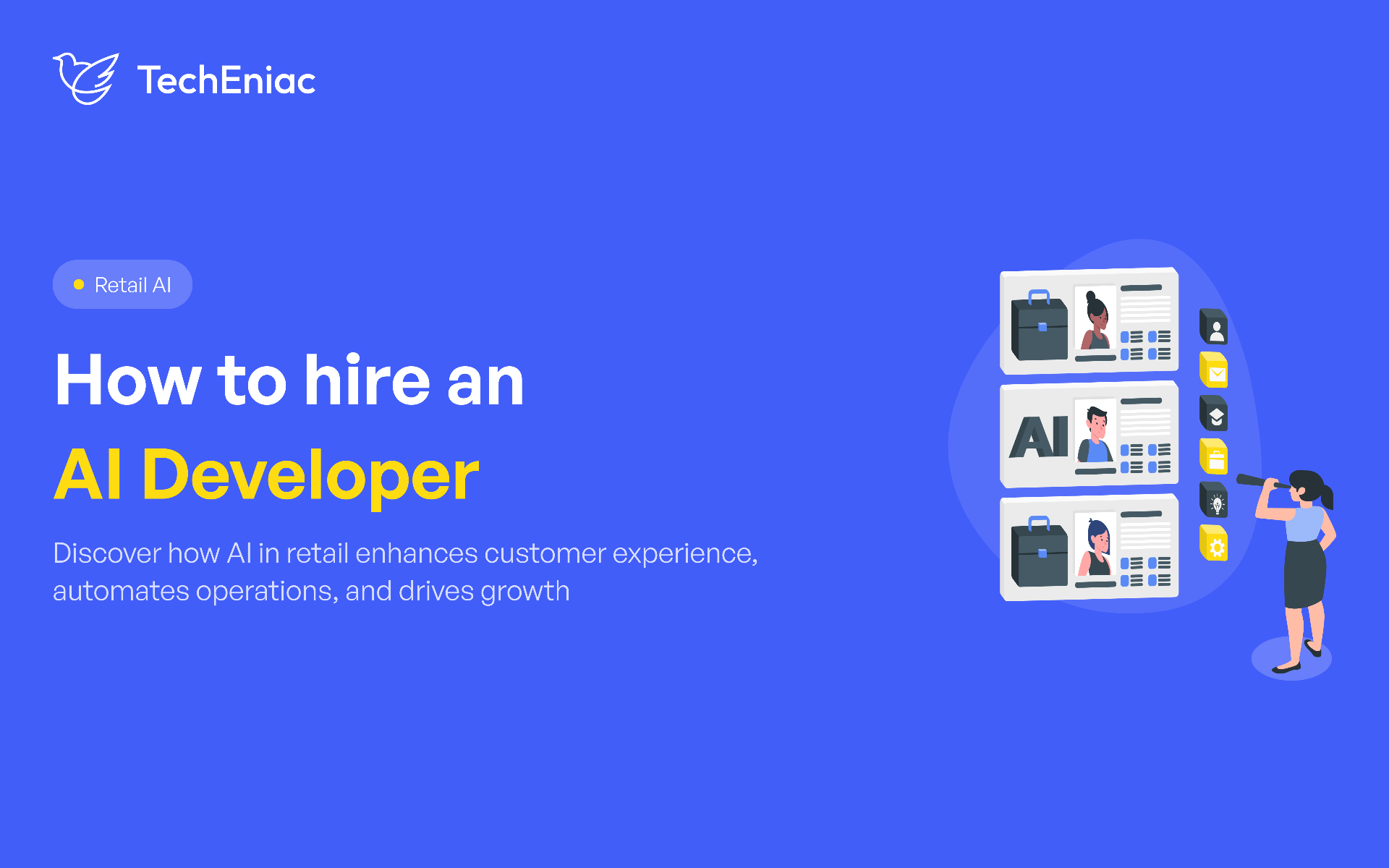
Hiring an AI developer is not just about finding someone who knows Python or machine learning. You need someone who can understand your business problem, choose the right AI approach, integrate it into your product, and keep it reliable after launch. This guide explains how to hire an AI developer, which skills to look for, where to find qualified candidates, what questions to ask during interviews, how much AI developers cost, and when hiring an individual makes more sense than working with a development partner.
Do You Actually Need to Hire an AI Developer?
Not every automation problem needs a dedicated AI hire. Sometimes better data organization, a no code automation tool, or a pre-built API is enough to solve the immediate need. Bringing in a specialist too early, before the problem is even clearly defined, often results in a skilled person with nothing concrete to build.
The signal that it is time to hire AI developers usually looks like one of these situations.
Your product depends on predictions, recommendations, or pattern detection that generic tools cannot handle well
You have enough clean, structured data to train or fine tune something useful
A prototype or proof of concept has proven the idea works, and now it needs to be built properly for production
Your existing engineering team can ship software well but has no background in model training, evaluation, or deployment
If your data is still messy, disorganized, or scattered across spreadsheets, that is worth fixing first. A skilled AI developer cannot compensate for a weak data foundation, and hiring one before that foundation exists usually means paying someone to wait on data cleanup rather than build anything meaningful.
Key Skills to Look for When You Hire an AI Developer
A strong AI developer blends technical depth with an understanding of the business problem they are solving. Screening only for technical trivia misses half of what matters.
Technical Foundation
Python remains the standard language for most AI work, though experience with SQL, R, or Java is a reasonable signal of broader engineering maturity. Look for hands on experience with core frameworks such as TensorFlow, PyTorch, or Scikit-learn, along with fluency in the tooling that has become standard for large language model work, including LangChain, Hugging Face, and direct experience calling LLM APIs from providers like OpenAI or Anthropic. If the role touches retrieval augmented generation, ask specifically about experience building RAG pipelines and working with vector databases such as Pinecone, Weaviate, or pgvector, since grounding a model in real data is a very different skill from prompting one in isolation.
Beyond model building, a capable developer understands deployment and what happens after launch. Comfort with Git, Docker, and cloud platforms such as AWS, Azure, or Google Cloud tells you whether someone can ship a working system rather than a notebook that only runs on their own laptop. Increasingly, this also means MLOps experience, knowing how to version models, automate retraining pipelines, and monitor a system once it is live, rather than treating deployment as the finish line. API integration skill matters just as much, since most AI features need to connect cleanly with your existing product, CRM, or data warehouse.
Applied Judgment
Technical skill alone does not guarantee a good hire. The strongest candidates can explain trade-offs in plain language, walk through how they evaluate a model before launch (precision and recall, hallucination rate, latency under real load, not just accuracy on a clean test set), and describe how they would test for bias or failure before it reaches a user. Ask how they would handle a model that performs well in testing but breaks on live data, and what monitoring they would put in place to catch that kind of drift before a customer does. Their answer tells you far more than a whiteboard exercise ever could.
Domain Awareness
If your product touches healthcare, finance, or another regulated space, a developer who understands the relevant compliance context (patient data handling, financial transaction security, or similar) will save you significant rework later. This kind of awareness rarely shows up on a resume, so it needs to come out in conversation.
Where to Find AI Developers
Once you know what you are looking for, the next question is where to find qualified candidates. A few channels consistently produce better results than a generic job posting.
Specialized platforms and communities. GitHub shows what a developer has built, which tells you more than any resume. Kaggle highlights people who treat data problems seriously and enjoy the work. Developer communities focused on machine learning or generative AI often surface people already deep in the kind of problems you are solving.
Vetted freelance and staffing platforms. These can work well for a scoped proof of concept or a short-term project, though quality and availability vary widely, so review actual past work rather than relying on platform ratings alone.
Referrals from your existing network. A developer recommended by someone whose judgment you trust is often a faster and safer path than a cold search, particularly for senior or lead roles.
Development partners and agencies. For anything beyond a small experiment, especially a production feature touching real users or sensitive data, a development partner with an existing team of engineers, along with people who have already handled data pipelines, model deployment, and ongoing maintenance together, is usually a more reliable path than assembling individual freelancers one role at a time.
Should You Hire an AI Developer, Build an In-House Team, or Work with a Development Partner?
There is no universally correct answer here. The right choice depends on how central AI is to your product and how quickly you need to move.
A freelancer makes sense for a small, well scoped experiment, testing whether an idea works before committing further budget. The trade-off is limited availability and inconsistent depth once the project grows beyond the original scope.
An in-house hire makes sense when AI is becoming a permanent, central part of your product and you want full control along with deep, ongoing collaboration with your existing team. The tradeoff is a slower hiring process and the cost of building out supporting infrastructure and processes around a single person.
A development partner or agency makes sense when you need production grade delivery without spending months assembling and managing a team yourself. A good partner brings engineers who have already worked together, existing experience with deployment and data handling, and the ability to scale the team up or down as your project's needs change.
Step by Step Process to Hire an AI Developer
Define the problem clearly. Write down exactly what the feature needs to do and what data it will use. A vague brief attracts vague candidates and wastes everyone's time.
Check your data readiness. Confirm the data exists, is accessible, and is reasonably clean before you start interviewing anyone.
Decide on an engagement model. Choose between a freelancer, an in-house hire, or a development partner based on how central this feature is to your product and your timeline.
Source candidates from the right channels. Use platforms, communities, referrals, or a trusted partner rather than a single generic job posting.
Review real work, not just resumes. Ask for examples of systems they have shipped and kept running, not just models that worked once in a notebook.
Ask scenario-based questions. Present a real situation from your own use case and see how they reason through it, rather than relying on abstract trivia questions.
Check for communication fit. Have them explain a past project to someone on your team who is not technical. If that person understands it clearly, that is a strong signal.
Agree on success metrics upfront. Decide what "done" looks like, whether that is model accuracy, processing speed, or a specific business outcome, before work begins.
Start with a small, well scoped first task. This applies whether you are hiring an individual or a partner. A short-paid trial reveals far more than any interview.
Questions to Ask Before Hiring an AI Developer
A short, honest conversation reveals more than a long list of certifications. A few questions worth asking directly.
Can you walk me through a project you built that is still running in production today?
How would you approach a model that performs well in testing but fails on real world data?
What would you need from us in terms of data access and infrastructure before you could start?
How do you decide when a model is accurate enough to launch, and what happens if it drifts afterward?
How do you handle a situation where the business goal and the technical approach start to pull in different directions?
Candidates who answer with specific stories, including things that went wrong and how they fixed them, are usually more trustworthy than candidates who only describe smooth successes.
AI Developer Cost: What to Expect
What Does It Actually Cost to Hire an AI Developer?
AI developer cost varies significantly based on location, experience level, and project complexity, so treating it as a single fixed number rarely reflects reality.
By region: Developers based in North America and Western Europe generally charge higher hourly rates, typically 80 to 200 dollars an hour in North America and 70 to 150 dollars in Western Europe, often reflecting deep experience with enterprise systems and regulated industries. Developers in India and other parts of the Asia Pacific region frequently offer strong technical skill at a more accessible cost, usually 25 to 70 dollars an hour, which is part of why many growing companies build their AI teams there.
By project scope: A small proof of concept, such as a simple chatbot or a basic recommendation feature, typically runs 5,000 to 20,000 dollars, considerably less than a full production system integrated across multiple parts of your product, which commonly starts around 60,000 dollars and climbs from there. Complexity, data volume, and the number of integrations required all push the number up.
Beyond the initial build: Ongoing costs matter just as much as the upfront number. Cloud infrastructure for training and running models, periodic retraining as data patterns shift, security review, and the time needed for your team to learn and adopt the new system typically add another 15 to 25 percent of the original build cost each year. Budgeting only for the initial build and ignoring these ongoing costs is one of the most common planning mistakes teams make.
How Long Does It Take to Build an AI Feature
Timelines depend heavily on scope, but a few general ranges hold true across most projects.
A focused proof of concept, testing whether an idea is technically feasible, typically takes a few weeks. A mid complexity feature integrated into an existing product, with real data pipelines and proper testing, usually takes a couple of months. A full production grade AI platform, with multiple integrations, compliance considerations, and ongoing monitoring built in, can take several months to build properly.
Rushing this timeline to hit an arbitrary launch date is one of the most common ways AI projects fail after launch. Skipping proper testing and bias evaluation to save a few weeks often costs far more time later, once a poorly validated model starts producing bad predictions in front of real users.
Common Mistakes When Hiring an AI Developer
A few patterns show up repeatedly across teams that struggle with their first AI hire.
Hiring purely on cost. The cheapest available developer often produces something that technically runs but does not solve the actual business problem, which usually costs more in rework than it saved upfront.
Ignoring what happens after launch. Models need monitoring, retraining, and occasional adjustment as data patterns shift. A developer or team with no plan for this leaves you with a system that quietly degrades over time.
Skipping proper testing. Rushing a model into production without validating it against real world data, including edge cases and different user groups, is how biased or unreliable predictions reach actual users.
Underestimating integration work. Building a model is often a smaller part of the project than connecting it cleanly to your existing product, data sources, and workflows. Teams that plan only for the model building phase are frequently surprised by how much integration work remains.
Choosing the Right Partner to Hire AI Developers
For teams building an AI powered SaaS product rather than a one-off internal tool, working with a partner who has already assembled a team, rather than hiring individuals one role at a time, is often the faster and more reliable path.
At Techeniac Services LLP in Ahmedabad, our teams work directly with founders and product leaders through our AI SaaS product development service, helping shape the right approach from the first architecture decision through to a working, production ready feature. As products grow beyond an initial launch, our SaaS product engineering and scaling service supports teams through the integration, performance, and reliability work that a growing user base demands.
If you are trying to figure out whether to hire an AI developer, build an in-house team, or bring in a partner for your next feature, our team is happy to walk through your specific situation and help you land on the right approach. Get in touch with us to talk through your project.
Key Takeaways
Confirm your data is clean and accessible before hiring, since even a strong developer cannot compensate for a weak data foundation.
Screen for applied judgment and communication skill alongside technical ability, not just framework familiarity.
Look for candidates through specialized platforms, communities, referrals, and trusted development partners rather than a single generic job posting.
Choose between a freelancer, an in-house hire, and a development partner based on how central AI is to your product and how quickly you need to move.
Budget for ongoing costs such as monitoring, retraining, and infrastructure, not just the initial build.
Rushing timelines to hit an arbitrary launch date is a common cause of AI features failing after launch.
A development partner with an existing team, such as Techeniac Services LLP, can help you move faster and avoid common hiring mistakes on your first AI feature.