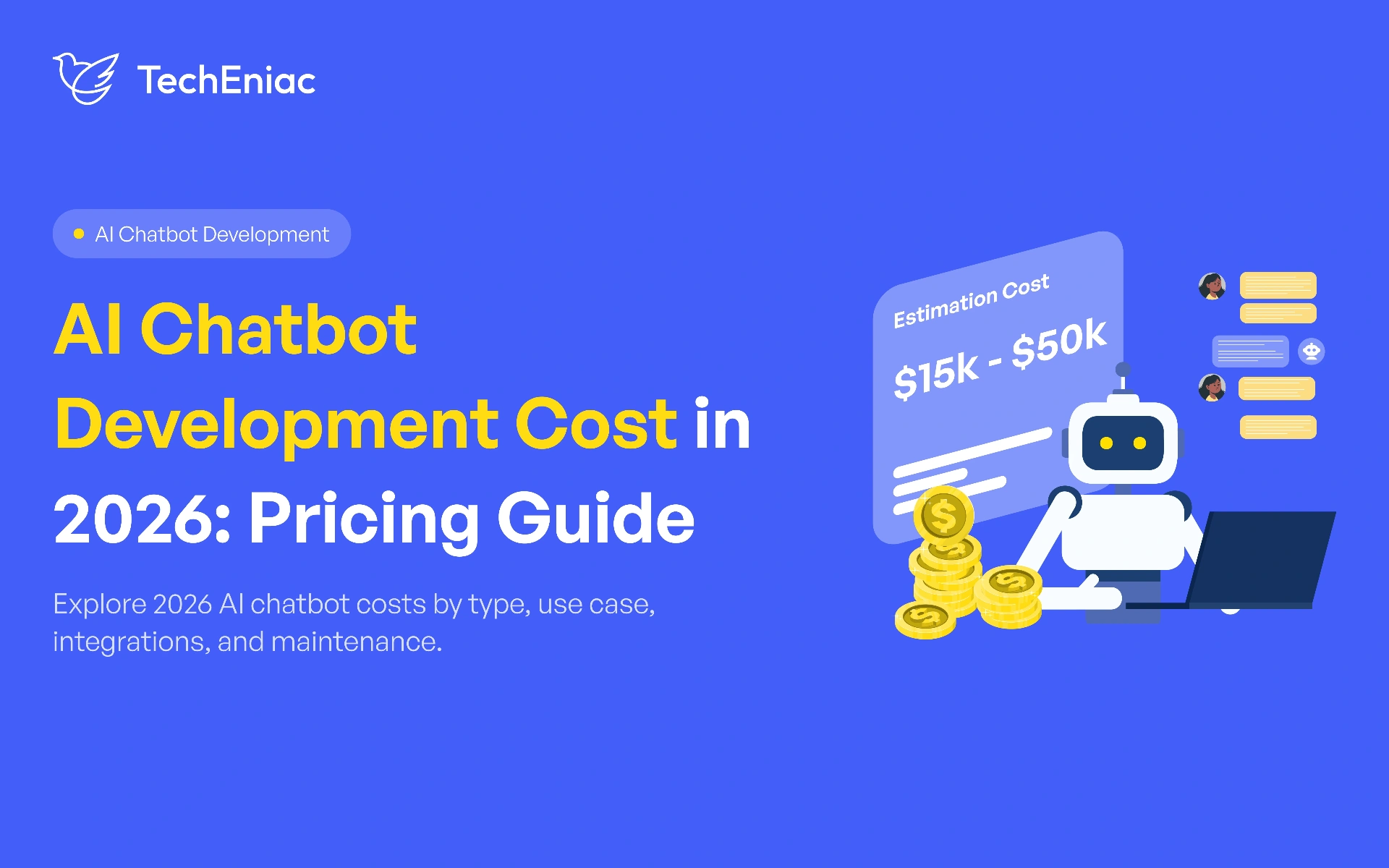
AI chatbot development typically costs $15,000–$35,000 for a focused knowledge chatbot, $25,000–$50,000 for a chatbot with advanced integrations, and $50,000–$80,000 for a more complex chatbot with compliance controls and voice capabilities, based on TechEniac's stated pricing ranges. Larger enterprise AI projects can cost significantly more. The final budget depends on data sources, integrations, security requirements, conversation volume, and ongoing maintenance.
Key Takeaways
AI chatbot development cost: A focused knowledge chatbot costs $15,000 to $35,000, an advanced chatbot $25,000 to $50,000, and an enterprise build with compliance and voice $50,000 to $80,000.
Cost to build an AI chatbot: Chatbot type sets the base price, and integrations, compliance rules, and a voice channel add to it.
LLM chatbot cost: Model usage grows with conversation volume, so run costs depend on traffic as well as build quality.
AI chatbot ongoing costs: Yearly upkeep of 10% to 20% of the build cost comes on top of usage, hosting, and channel fees.
Build or buy: Off the shelf tools suit simple FAQ needs, and custom builds suit chatbots that connect to core systems.
AI Chatbot Development Cost in 2026: Market Ranges and Typical Budgets
Chatbot cost depends on what the chatbot answers from, what it connects to, and how it runs after launch. The sections below cover price by chatbot type and use case, the cost breakdown, LLM and enterprise costs, and ongoing monthly costs. They continue with build versus buy, timelines, and a five-step budget method, followed by answers to common questions.
AI chatbot development cost starts near $15,000 for a focused knowledge chatbot and reaches $80,000 for a compliance heavy build with voice. Broader market data sits higher. GoodFirms' 2026 survey of software companies puts AI MVPs at $50,000 to $125,000, medium AI builds at $125,000 to $250,000, and large or enterprise AI builds above $250,000 (GoodFirms, September 2026).
The gap comes from scope. The survey covers full AI products from firms of different sizes and regions, while a chatbot usually covers one domain, one knowledge base, and a small set of channels. Hourly rates add another spread, with 56.3% of surveyed companies charging $20 to $50 and 7.8% charging above $250.
Budgets for conversational AI are growing. A Gartner survey of 199 service and support leaders found that AI spending rose 38% while overall function budgets grew 2% (Gartner, August 2026).
Pricing for AI chatbot development follows five drivers: chatbot type, data sources, integrations, channels, and compliance scope. The sections below price each one.
Cost to Build an AI Chatbot by Chatbot Type
The cost to build an AI chatbot rises in three steps: a focused knowledge chatbot, an advanced chatbot with integrations, and an enterprise chatbot with compliance and voice. The ranges follow TechEniac's published AI SaaS MVP tiers and chatbot timelines.
Chatbot type | What it covers | Price range | Timeline |
|---|---|---|---|
Focused knowledge chatbot | Answers from one knowledge base with source citations, one channel, escalation to a person | $15,000 to $35,000 | 8 to 10 weeks |
Advanced chatbot with integrations | Retrieval across several sources, conversation memory, CRM or helpdesk connections, analytics | $25,000 to $50,000 | 10 to 14 weeks |
Enterprise chatbot with compliance and voice | Regulatory controls, audit logs, system integrations, voice channel, multi-level escalation | $50,000 to $80,000 | 14 to 20 weeks |
A voice channel adds $10,000 to $15,000 and 2 to 3 weeks when it joins a lower tier. The enterprise row already includes it.
A rule-based chatbot with fixed menus costs less than an AI version, but it answers only the questions its flows anticipate. Moving from a rule-based bot to an AI bot later costs 50% to 70% of building the AI version from scratch. TechEniac's guide to chatbots that go beyond FAQ therefore recommends the AI version when the use case needs open questions.
A knowledge chatbot grounded in company documents uses retrieval augmented generation. It answers from approved content and cites its sources, which makes it the base layer of business chatbots.
Custom Chatbot Pricing by Use Case
Custom chatbot pricing by use case follows the compliance rules, integrations, and channels that each industry needs. The table maps common use cases to the closest tier above.
Use case | Scope that sets the price | Closest tier |
|---|---|---|
SaaS onboarding support | Product documentation, top 20 onboarding questions, behaviour triggered prompts | Focused knowledge chatbot |
Education tutoring | FERPA safeguards, per course document collections, source citations | Advanced chatbot with integrations |
Healthcare patient intake | HIPAA controls, protected health information handling, medical accuracy guardrails | Enterprise chatbot with compliance |
Financial services support | FCA aligned responses, advice and guidance classification, decision logging | Enterprise chatbot with compliance |
Insurance claims intake | Claim type questions, document upload, claims system integrations, audit logs, voice | Enterprise chatbot with compliance and voice |
An AI onboarding chatbot sits at the low end of this range. TechEniac scopes a focused onboarding chatbot with retrieval grounded answers at $20,000 to $35,000 over 6 to 8 weeks. The build centres on the 20 questions behind the largest share of new user tickets.
Regulated industries cost more because the compliance work touches design, testing, and logging, not only the final review. A healthcare or insurance chatbot therefore carries a larger budget than a documentation chatbot of the same size.
AI Chatbot Cost Breakdown: Where the Budget Goes
An AI chatbot budget splits into seven kinds of work, and the team doing that work accounts for 50% to 70% of total cost in GoodFirms' survey of custom software projects.
Discovery and conversation design: Mapping the top 20 user intents, the tone of replies, and the rules for handing a conversation to a person.
Knowledge base preparation: Cleaning, structuring, and indexing documents, which takes 1 to 2 weeks depending on volume.
Model and retrieval setup: Choosing the language model, building the retrieval pipeline, and adding source citations.
Integrations: Connecting CRM, helpdesk, claims, or scheduling systems so the chatbot can read and write records.
Channels: Web widgets, mobile apps, WhatsApp, and voice, each with its own provider setup.
Testing: Accuracy, hallucination, prompt injection, edge case, and escalation checks before launch.
Deployment and monitoring: Cloud setup, analytics, and dashboards that track resolution and escalation.
Itemized quotes show which of these lines a vendor includes. When two proposals differ widely for the same chatbot, the first question is which line the lower quote leaves out.
LLM Chatbot Cost: Model Usage, Retrieval, and Testing
LLM chatbot cost splits into a build cost and a usage cost, and the usage cost grows with traffic. Each conversation sends text to a language model, and the provider charges by the volume of text processed, counted in tokens.
Three choices set the usage bill. Model size matters because larger models cost more per token. Conversation memory matters because each reply resends earlier messages. Retrieved context matters because each passage added to a prompt adds tokens.
Model choice follows the job. TechEniac builds on Claude Sonnet for compliance sensitive work, GPT-4o for complex reasoning, and Gemini for multimodal input, and the choice affects both quality and per conversation cost.
Gartner expects usage costs to rise over time. It predicts that GenAI cost per resolution in customer service will exceed $3 by 2030 (Gartner, January 2026). Gartner cites rising data centre costs, vendors moving toward profitability, and complex use cases that consume more tokens.
Design keeps usage predictable. Simple questions can route to a smaller model, retrieval can return fewer passages, long histories can be trimmed, and repeated answers can be cached. Testing for hallucination and prompt injection also belongs in this line, because a wrong answer costs more than the tokens that produced it.
Enterprise Chatbot Cost: Compliance, Integrations, and Scale
Enterprise chatbot cost starts where a chatbot must meet regulatory rules, connect to core systems, and serve high volume. In the GoodFirms survey, large or enterprise AI builds sit above $250,000, and TechEniac's compliance heavy chatbot tier runs $50,000 to $80,000 for a single domain.
Five factors push a chatbot into enterprise pricing:
Compliance controls: HIPAA for protected health information, FCA rules for financial advice, and FERPA for student records each add guardrails, logging, and review.
Audit trails: Timestamped records of each interaction show what was said and when.
System integrations: Core platforms such as claims, CRM, and medical record systems need validated connections with queues for failed submissions.
Escalation design: Confidence thresholds, topic boundaries, and complexity checks decide when a person takes over.
Scale and availability: Serverless cloud setups on AWS or GCP handle traffic spikes and round the clock service.
Scope grows again when a chatbot starts taking actions, such as updating records or triggering workflows. That step moves the build toward an agent, and the chatbot vs AI agent comparison shows where the line sits. Budgets for action taking systems need the same discovery work as enterprise chatbots, plus permission and approval design.
Features That Increase AI Chatbot Cost
Voice, write access to business systems, compliance controls, multilingual support, and document processing add significant scope to a chatbot.
Voice channel: Speech to text and text to speech add $10,000 to $15,000 and 2 to 3 weeks. Whisper handles transcription, and ElevenLabs or Azure Speech voices the replies.
Write access to systems: Reading a record is simple, while updating a claim or CRM entry needs validation, queues, and error handling.
Compliance controls: Audits, guardrails, and decision logging add design and testing time.
Multilingual support: Each added language needs accuracy testing and interface work.
Document processing: Uploads processed with vision or OCR tools extend the pipeline and the test set.
Conversation memory: Persistent context across a session improves answers and raises token use.
Launching with the features that serve the top 20 intents and adding the rest after real usage data keeps the first budget contained.
Build or Buy: Which Chatbot Option Costs Less?
Off the shelf chatbot platforms cost less at the start, and custom builds cost less once a chatbot needs deep integrations or strict data control. The table compares the two options.
Factor | Off the shelf platform | Custom build |
|---|---|---|
Upfront cost | Low, with a recurring subscription | $15,000 and up, one time |
Model and data control | Limited to vendor options | Free choice of model, hosting, and data handling |
Integration depth | Prebuilt connectors | Custom connectors to core systems |
Compliance | Vendor certifications | Controls designed to the regulation |
Launch speed | Fast setup | 8 to 20 weeks |
Subscription fees recur for as long as the tool is used, while a custom build is a onetime cost-plus upkeep. TechEniac's guidance for SaaS products is that 50 or more support tickets a week point toward building, and fewer than 20 points toward waiting.
Teams that choose a custom build usually work with an AI development company that covers retrieval, integrations, and testing in one scope. A fixed scope for the first release keeps the price comparable across vendors.
How to Plan an AI Chatbot Budget in Five Steps
Planning an AI chatbot budget takes five steps, and the first is listing the questions the chatbot must answer.
Step 1: List the Top 20 User Intents
Write down the 20 questions or tasks that generate the largest share of conversations. This list sets the knowledge base size and the first release scope.
Step 2: Match the Scope to a Tier
Compare the use case with the tiers above. A single knowledge base and one channel point to the focused tier, and regulated data or voice points to the enterprise tier.
Step 3: List Integrations and Compliance Rules
Name each system the chatbot must read or write, and each regulation that applies. Each item adds design, build, and test time.
Step 4: Add the Run Budget
Set aside 10% to 20% of the build price for yearly upkeep and add a usage estimate based on expected monthly conversations.
Step 5: Pilot With Real Traffic
Launch to a small group and track resolution rate, escalation rate, and satisfaction. Pilot data replaces estimates with measured usage costs before a full rollout.
How TechEniac Builds Production Chatbots
TechEniac builds chatbots on retrieval grounded answers, defined escalation rules, and testing for accuracy, hallucination, and prompt injection. The ClaimBot project shows the approach at enterprise scale.
For ClaimBot, a UK insurance claims intake product for brokers, TechEniac built an insurance claims chatbot with a voice channel. The agent cut first notice of loss handling time by 78%, from 22 minutes to 4.8 minutes, and resolved 69% of claims without human involvement. The other 31% went to specialists for multi-party disputes, injury claims, and judgment calls.
Fields collected by the AI passed Guidewire and Duck Creek validation 94% of the time on first submission, and intake runs around the clock. The build uses LangChain, Claude Sonnet, Google Cloud Vision, Whisper, and ElevenLabs on AWS.