Quick Summary
How do you prepare a SaaS product for a technical audit? Start with an internal review: map the architecture, resolve known security and dependency issues, gather the required documentation, and rehearse the walkthrough. Gartner highlights that unmanaged open-source components can introduce security and compliance risks, while late discovery can make remediation more costly and time-consuming.
Key Takeaways
SaaS technical audit preparation starts with scope: who is reviewing, what they must decide, and which systems are in view.
A codebase health check run by the team itself surfaces dependency, test, and build issues while there is still time to fix them.
A software due diligence checklist works best as one shared folder holding the architecture diagram, access list, license inventory, and incident history.
Investors in technical due diligence look at architecture, code quality, security, data handling, ownership, cost, and team process.
A rehearsed walkthrough turns known issues into managed risks, because each one arrives with an owner and a plan.
What Is a SaaS Technical Audit?
The sections below follow the order a team usually works in: what an audit is, what reviewers check, what AI products add, six preparation steps, and what shapes time and cost.
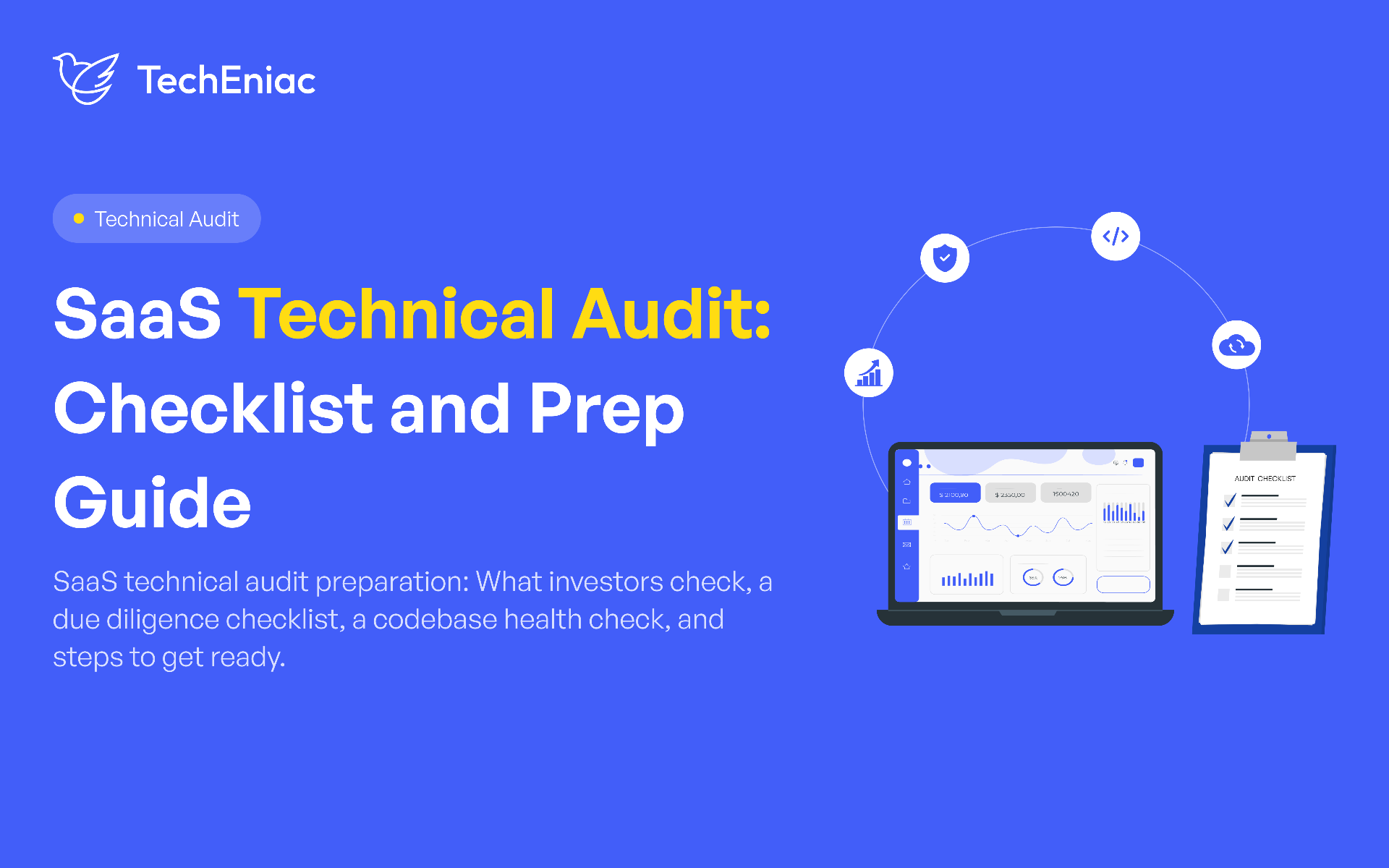
A SaaS technical audit is a structured review of a product's architecture, code, security, infrastructure, and engineering practices, carried out by someone outside the daily team. The reviewer may be an investor, an acquirer, an enterprise customer, or an independent consultant, and the goal is to judge whether the product is sound and ready to grow.
The scope changes with the reviewer, so the four common types differ in who asks and what they need to decide:
Type | Who asks | Main question | Typical timing |
|---|---|---|---|
Pre-fundraise technical review | Investors and their technical advisors | Can the product support the plan and the growth behind it? | During investor due diligence |
Acquisition technical due diligence | A buyer | What is being bought, and what will it cost to run and improve? | Late in a deal process |
Enterprise security review | A large customer's security team | Is it safe to trust this product with company data? | Before a contract is signed |
Internal codebase health check | The team or a consultant | Where is the product slow, risky, or hard to change? | Any time, ideally ahead of the other three |
An internal codebase health check also helps prepare for the other three reviews, since many of the same questions around architecture, security, dependencies, and code quality arise in each.
Software Due Diligence Checklist: What Reviewers Check and What to Have Ready
Investors want to know if the technology can deliver the business plan. Buyers and enterprise security teams ask much the same things. Seven areas cover the ground, and each one has proof worth gathering before the review starts.
Architecture and scalability: Reviewers look at how the system is built and where it could break first. An architecture diagram and a data flow diagram help, along with a short list of known limits and what the team plans to do about each.
Code quality and testing: The question here is how safely the team can change the code. A repository overview, a description of the review process and an honest list of technical debt answer most of it.
Security and access: Reviewers want to see who can reach what and how secrets are kept. Bring an access list by role, the latest scan results and the process for fixing what a scan finds.
Data and privacy: This covers where customer data lives, who can see it and how it gets deleted. A data inventory, the retention and deletion rules, and a note on how tenants are kept apart cover it.
Open source and ownership: Reviewers check which outside code the product depends on and who owns what the team built. A license list and signed employee and contractor agreements settle both.
Infrastructure and cost: Hosting, backups and monitoring come up here, along with what each customer costs to serve. A cloud cost breakdown, restore test results and the incident history show how the product runs day to day.
Team and process: Reviewers want to know how the team plans, reviews and releases, and whether one person holds all the knowledge. Release history, runbooks, an onboarding document and a map of who owns what make the answer easy to see.
Products with AI features get extra questions, which the next section covers.
A short note on why each choice was made, and what would change as usage grows, goes a long way. Context helps reviewers trust the files.
What Extra Questions Do AI Features Raise in a Technical Audit?
AI features add questions about models, data, and cost, because reviewers cannot see from the code alone how an AI answer was produced or what it cost. Five topics come up:
Model providers and contracts: Which providers handle customer data, and which agreements cover it, such as a data processing agreement or, for health data, a BAA.
Evaluation evidence: A fixed test set with results over time, so a change after a model or prompt update shows up as a number.
Cost per feature: Token and hosting spend for each AI feature, plus the limits that keep a few heavy users from driving the bill.
Data separation: How each customer's documents and embeddings stay isolated from other customers.
Review of generated code: Which AI coding tools the team uses and how reviewers check what they produce.
Data separation is simplest to prove when the product follows a clear AI SaaS product architecture that keeps AI logic apart from customer data from the first release.
How to Prepare a SaaS Product for a Technical Audit in 6 Steps
Preparation takes six steps, and each one produces something a reviewer will ask to see.
Step 1: Find Out What the Reviewer Will Check
Ask the reviewer for their scope, questionnaire, or checklist before doing anything else. An investor, a buyer, and an enterprise security team each focus on different areas, so a one-page scope note keeps the work pointed at the right questions. Write down the systems in scope, the deadline, and the person who answers each type of question. When the scope is unclear, an AI Consulting Services conversation can help define it before the review begins.
Step 2: Run a Codebase Health Check
Review the product the way an outside engineer would, starting from the repository and nothing else. Five checks give a fast picture of codebase health:
Dependency scan: List every third-party package with its version and any known issues.
Clean build: Confirm that a new engineer can build and run the product from the repository and README alone.
Test run: Run the full test suite and note which critical flows it does not cover.
Hot spots: List the modules the team avoids changing and the reason for each.
Release history: Track how often releases ship and how often one needs a rollback or hotfix.
Step 3: Fix the Security Basics
Use the OWASP Top 10:2025 as the reference list for security checks. It ranks broken access control first, security misconfiguration second, and software supply chain failures third. Check permissions for each user role and review cloud settings for public storage or default credentials. Remove secrets from the repository, rotate any that were ever committed, and require multi factor authentication on admin accounts.
Reviewers also look for controls they can test. On the Silverback workforce platform, every token refresh is checked against the stored token, and a mismatch invalidates it and forces a new sign in. Products that handle health data face further questions, which the guide to building a HIPAA compliant AI SaaS product covers.
Step 4: Gather the Documents Reviewers Ask For
Collect the documents reviewers request into one shared folder with a named owner. A complete pack holds the architecture diagram, data flow diagram, infrastructure overview, and access list. It also holds the vendor and sub processor list, runbooks, incident log, release history, and a roadmap showing the technical priorities. Date every file and retire outdated ones, because current documents let reviewers trust everything else in the folder.
Step 5: Check Open-Source Licenses and Code Ownership
Build a license inventory of every third-party component. Check it for copyleft licenses such as GPL and AGPL, which can place conditions on how a product is distributed or offered. Confirm that employees and contractors have signed agreements assigning the code they wrote to the company.
AI coding tools add one more item. Black Duck's 2026 report notes that AI models may reproduce code governed by restrictive licenses, so teams should record which tools they use and keep human code review in place. TechEniac's engineers use tools such as Claude and Cursor alongside QA sign off on every story, and clients receive full repository access and 100% IP ownership from day one.
Step 6: Practice the Audit Walkthrough
Choose two engineers to present, one for architecture and one for security and operations, and practice with a colleague who asks hard questions. Prepare answers on what would fail first at several times today's usage, where customer data lives, and what the team would fix with another month. Close with a short list of known issues, each with an owner, an effort estimate, and a plan. A known issue with a plan reads as a managed risk, while an unknown one reads as a surprise.
How to Respond When a Technical Audit Finds Issues
Sort every finding into one of three groups: fix now, schedule with a date, or accept with a reason. This keeps the conversation with reviewers focused on a plan instead of a list of problems.
Fix now: Issues that expose customer data or block a release, such as open storage, exposed secrets, or broken permission checks.
Schedule with a date: Structural items such as a dependency upgrade, a missing test layer, or a data model limit, each with an owner and a target sprint.
Accept with a reason: Low risk items the team chooses to leave, written down with the reasoning so the decision is on record.
Share the plan in writing during the review window. Reviewers see how the team responds as well as what was found.
What Affects the Time and Cost of a Technical Audit?
Four things drive the time and cost of a technical audit: system size, review depth, compliance scope, and how quickly the team supplies documents and answers.
Factor | Smaller scope | Larger scope |
|---|---|---|
System size | One application and one database | Several services and many integrations |
Review depth | Automated scans and a document review | Code reading, interviews, load and security testing |
Compliance scope | General security hygiene | Regulated data, SOC 2 or HIPAA evidence |
Team readiness | Documents ready and owners named | Documents created during the review |
Preparation is the part a team controls. A ready document pack and named owners shorten the schedule, because reviewers spend their time on findings instead of requests for access. Findings that need engineering time, such as untangling a data model or adding tenant isolation, are the work covered by SaaS Product Engineering & Scaling.
How TechEniac Approaches Technical Audits
On rescue engagements, the codebase audit comes first at TechEniac. What is salvageable stays, what is not gets rebuilt, and an honest assessment shows which path saves more time and money before new work begins. On scaling work, the diagnosis covers architecture, data model, infrastructure, AI usage, and cost per customer and per feature, and it ends in a prioritized roadmap with quick wins first.
Delivery habits support this as well. Two-week sprints end with a working demo, and a QA engineer signs off every story. A DevOps engineer owns deployment pipelines and monitoring, which builds a release history reviewers can read. The full process is on the How We Work page.