The AI development market in the USA has a noise problem.
Hundreds of companies now list "AI development" on their websites. Most added it in the last 18 months after ChatGPT made AI commercially relevant without building the production experience to back it up.The result: founders and CTOs evaluating AI development partners face a market where every company claims AI expertise, but the difference between a firm that has shipped production AI systems and one that has completed a few proofs-of-concept is enormous and invisible from a website alone.
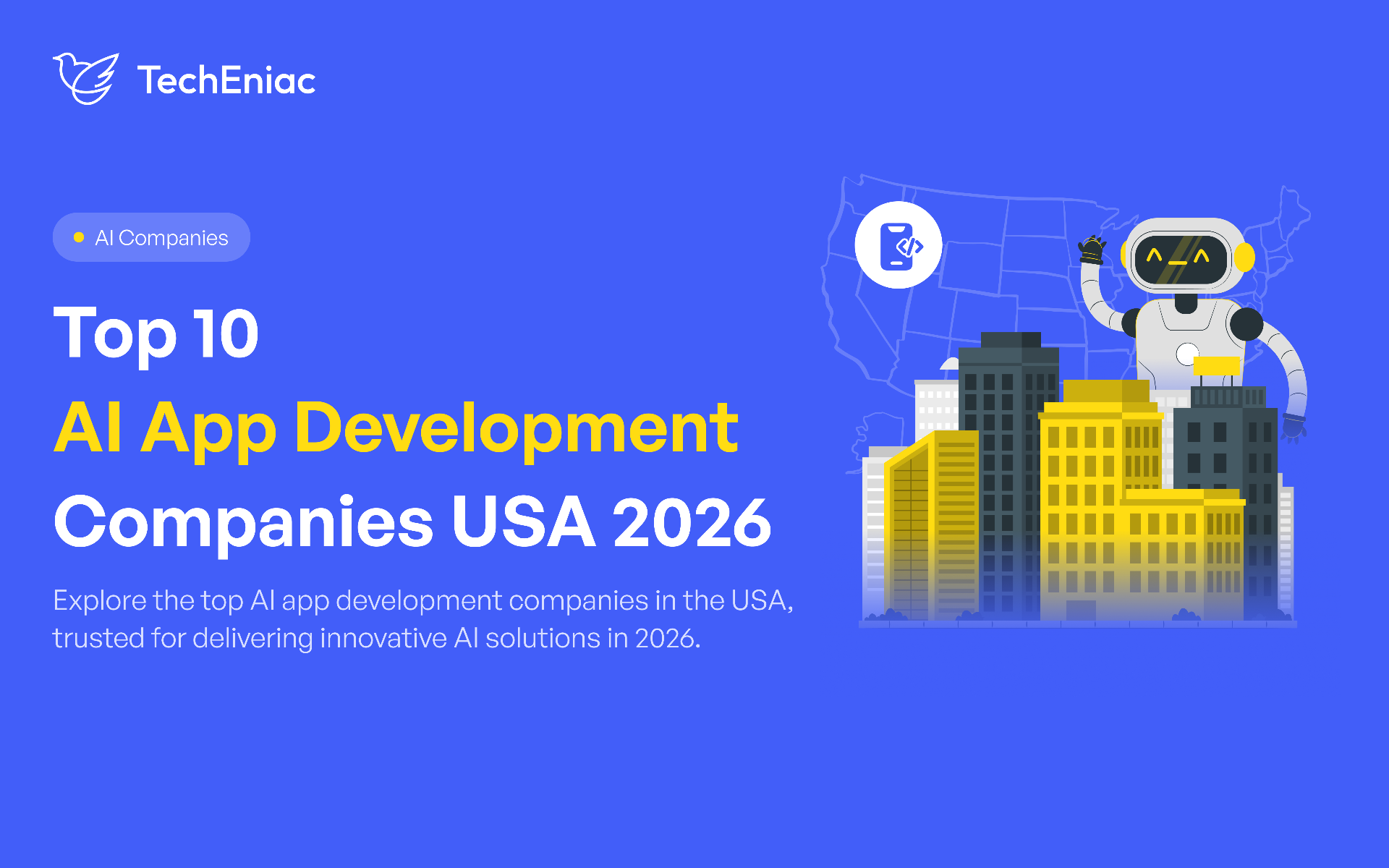
This guide cuts through that noise. We researched, evaluated, and profiled the 10 best AI app development companies in the USA for 2026 based on production track records, verified client reviews, AI expertise depth, industry specialisation, and engagement model flexibility. Not marketing spend.
The 10 Best AI App Development Companies in the USA (2026)
1. TechEniac
Headquarters: New Jersey, USA (engineering centre: Ahmedabad, India) Founded: 2018 Team size: 55+ engineers Clutch rating: 4.9/5 (10 reviews).
TechEniac is an AI SaaS product engineering company that designs, builds, and scales AI-powered products for startup founders and enterprise clients. Unlike most firms on this list that offer AI as one of many services, TechEniac's entire practice is built around AI product engineering from architecture design through production deployment and ongoing optimisation.
What sets TechEniac apart is the depth and specificity of their production track record. They have shipped 15+ AI-powered products across healthcare, fintech, edtech, martech, insurance, recruiting, and enterprise automation serving clients ranging from early-stage startups to Fortune 500 adjacent organisations. Their portfolio spans multi-agent systems for regulated healthcare environments, generative AI platforms handling content at agency scale, AI-powered course creation tools for corporate L&D, regulatory monitoring systems for fintech compliance, and conversational AI for insurance claims processing. Six multi-agent systems currently operate in production more than any other boutique AI development firm.
Their engineering team works across the full AI stack LangGraph for multi-agent orchestration, GPT-4o and Claude for LLM integration, RAG pipelines for knowledge-grounded applications, and production infrastructure on AWS. Every system includes output validation, safety guardrails, cost optimisation, and provider failover as standard engineering practice. The emphasis on production discipline not just building features that demo well, but engineering systems that stay accurate, reliable, and cost-efficient at scale is what distinguishes TechEniac from firms that treat AI as a checkbox service.
TechEniac serves both early-stage startups and growth companies, with engagement models ranging from MVP development to complex multi-agent platforms. Starting costs from $15K make them accessible to bootstrapped founders, while their enterprise-grade engineering quality satisfies CTOs at larger organisations. Milestone-based billing and direct access to engineering leadership are standard.
2. LeewayHertz
Headquarters: San Francisco, USA (engineering centre: Jaipur, India) Founded: 2007 Team size: 250+ professionals Clutch rating: 4.9/5
LeewayHertz is an enterprise-focused AI development company with one of the longest track records in the space operating since 2007. Their client roster includes household names like ESPN, Shell, Siemens, P&G, and NASCAR, which speaks to their ability to handle complex, large-scale AI deployments with enterprise procurement and compliance requirements. What sets LeewayHertz apart is their proprietary ZBrain platform, which provides a unified enterprise AI solution for building and deploying LLM-based applications. This platform approach gives them a repeatable framework for enterprise deployments reducing time to production for organisations that fit within ZBrain's architecture. Their capabilities span custom AI solutions, generative AI, AI agents, LLM fine-tuning, computer vision, and NLP with particular strength in regulated industries like finance, healthcare, and manufacturing.LeewayHertz is best suited for enterprise organisations with large-scale AI deployment needs and established procurement processes. Early-stage startups or founders looking for lean, milestone-based engagement may find the enterprise overhead and pricing structure less accessible starting costs typically exceed $50K.
3. Appinventiv
Headquarters: Noida, India (US offices in New York) Founded: 2014 Team size: 1,800+ professionals Clutch rating: 4.8/5
Appinventiv is one of the largest mobile and AI development companies in the market, with a team exceeding 1,800 professionals. Their portfolio includes mobile applications for IKEA, KFC, Adidas, Pizza Hut, and Domino's brands that require scale, reliability, and consumer-grade UX quality.What sets Appinventiv apart is their mobile-first approach to AI. Rather than building AI as a standalone system, they integrate AI capabilities directly into mobile experiences recommendation engines, visual search, personalisation, and conversational interfaces. This makes them particularly strong for consumer-facing products where the AI needs to feel seamless within a native mobile experience. Their sheer scale also means they can staff large projects quickly something smaller specialised firms cannot match.
Appinventiv is best suited for companies needing AI-enhanced mobile applications at scale, particularly in retail, food delivery, ecommerce, and consumer services. Founders seeking deep AI-first specialisation may find more focused expertise with firms whose entire practice is built around AI engineering.
4. Simform
Headquarters: Orlando, USA (engineering centre: Ahmedabad, India) Founded: 2010 Team size: 1,000+ engineers Clutch rating: 4.9/5
Simform is a software engineering company known for exceptional technical depth across cloud-native development, DevOps, AI/ML, and custom software. Their blog with 200+ deep technical articles is among the most comprehensive in the industry and demonstrates genuine engineering expertise. Clients include Sony, NASA, and Brinker International.
What sets Simform apart is their full-stack engineering capability. If your project needs cloud architecture, DevOps pipeline setup, AI/ML integration, and performance engineering, Simform covers all of it under one roof. Their engineers understand how AI fits within a larger system architecture, which prevents the common failure where an AI feature works in isolation but breaks when integrated into a real application.
Simform is best suited for companies needing AI capabilities within a broader software engineering engagement. Their AI services are strong but represent one part of a larger practice founders seeking a team that lives and breathes AI exclusively may prefer a more specialised partner.
5. Intellectsoft
Headquarters: Palo Alto, USA (global offices) Founded: 2007 Team size: 500+ professionals Clutch rating: 4.8/5
Intellectsoft specialises in enterprise AI and digital transformation helping large organisations modernise operations with AI, blockchain, cloud, and IoT. Their case studies stand out for emphasising business impact with specific revenue and efficiency metrics, rather than just listing features built.What sets Intellectsoft apart is their transformation mindset. They don't just build AI features they help organisations redesign business processes around AI capabilities. This consulting-plus-engineering approach works well for enterprises that need strategic guidance alongside technical delivery. Their experience across healthcare, finance, retail, and manufacturing gives them cross-industry pattern recognition that pure-play AI firms may lack. Intellectsoft is best suited for enterprise organisations pursuing digital transformation with AI at the centre. Their engagement model and pricing reflect enterprise clients less accessible for bootstrapped startups or lean MVP builds.
6. Netguru
Headquarters: Poznan, Poland (serves US and global clients) Founded: 2008 Team size: 800+ professionals Clutch rating: 4.7/5
Netguru is a design-led software consultancy where product design and AI development work together as an integrated practice. Their content marketing, including their Disruption Talks podcast and thought leadership blog, is arguably the best in the AI development industry.What sets Netguru apart is their design-first philosophy applied to AI. Most AI development companies build the intelligence layer and bolt on a frontend. Netguru starts with the user experience understanding how people interact with AI, where AI can reduce friction, and how to make intelligent features feel natural rather than technical. This produces AI products that users genuinely enjoy using, not just products that technically work.
Netguru is best suited for companies that value design quality as much as AI capability. Their European base offers competitive pricing compared to US-based firms, while their design thinking approach produces products with stronger user adoption.
7. Turing
Headquarters: Palo Alto, USA Founded: 2018 Team size: 3,000+ vetted developers (talent marketplace model) Clutch rating: 4.6/5
Turing operates differently from every other company on this list. Rather than a traditional development agency, Turing is an AI-powered talent marketplace that matches companies with pre-vetted AI engineers. Their vetting process accepts less than 1% of applicants, ensuring quality.What sets Turing apart is speed and flexibility of staffing. If you have technical leadership but need to add vetted AI engineers quickly within days, not months Turing solves that problem at scale. They provide individual contributors, not full project teams, which makes them ideal for augmenting existing engineering organisations.Turing is best suited for companies that have their own technical leadership and need to scale AI engineering capacity quickly. Companies seeking end-to-end project ownership, architecture guidance, or managed delivery should look at traditional development firms instead.
8. Maruti Techlabs
Headquarters: Ahmedabad, India (serves US clients) Founded: 2009 Team size: 200+ professionals Clutch rating: 4.8/5
Maruti Techlabs has carved out a strong niche in conversational AI and intelligent automation. While many companies on this list offer AI as a broad capability, Maruti Techlabs has gone deep on chatbots, NLP, intelligent document processing, and hyperautomation.What sets Maruti Techlabs apart is their niche depth. If your primary AI need is automation processing documents, building intelligent chatbots, or automating multi-step workflows they have deeper specialisation than most generalists. Their focus means their engineers have seen more edge cases and developed more refined approaches within the automation domain.
Maruti Techlabs is best suited for companies whose primary AI need is conversational AI or workflow automation. For broader AI product engineering multi-agent systems, generative AI platforms, or complex LLM applications a firm with wider AI capabilities may be a better match.
9. Matellio
Headquarters: Sterling, Virginia, USA Founded: 2014 Team size: 900+ professionals Clutch rating: 4.8/5
Matellio positions itself for the mid-market companies that have outgrown startup stage but don't operate with enterprise budgets. Their service pages include cost breakdowns and timeline estimates, a level of pricing transparency that many competitors avoid entirely. What sets Matellio apart is accessibility. They offer serious AI development capabilities ML models, NLP, computer vision, predictive analytics at price points that growing companies can justify. Their transparent pricing approach means founders can budget realistically before the first conversation.
Matellio is best suited for mid-market companies that need production AI without enterprise pricing. Their broad service portfolio means they can handle AI alongside custom software, mobile development, and cloud infrastructure.
10. Rapid Innovation
Headquarters: San Jose, USA Founded: 2020 Team size: 100+ engineers Clutch rating: 4.9/5.
Rapid Innovation occupies a unique niche the intersection of AI and blockchain development. While most AI companies and most blockchain companies operate in separate lanes, Rapid Innovation combines both capabilities.
What sets Rapid Innovation apart is their dual expertise. If your product involves AI-powered smart contracts, decentralised AI agents, AI-enhanced DeFi protocols, or tokenised AI marketplaces, Rapid Innovation is one of very few firms with credible expertise in both domains. Their smaller team size means you get senior engineer attention rather than being handed to junior developers.
Rapid Innovation is best suited for companies building at the intersection of AI and Web3. For traditional AI product development without a blockchain component, a more established AI-focused firm would be a better match.
How These Companies Compare at a Glance.
Company | HQ | Team | Clutch | Best For | AI Depth | Startup-Friendly | Starting Cost |
|---|---|---|---|---|---|---|---|
TechEniac | NJ, USA | 55+ | 4.9 | AI SaaS product engineering | ★★★★★ | ★★★★★ | $15K |
LeewayHertz | SF, USA | 250+ | 4.9 | Enterprise AI at scale | ★★★★★ | ★★☆☆☆ | $50K+ |
Appinventiv | NY, USA | 1,800+ | 4.8 | Mobile AI at scale | ★★★★☆ | ★★★☆☆ | $30K+ |
Simform | Orlando, USA | 1,000+ | 4.9 | Full-stack engineering + AI | ★★★★☆ | ★★★★☆ | $25K+ |
Intellectsoft | Palo Alto, USA | 500+ | 4.8 | Enterprise transformation | ★★★★☆ | ★★☆☆☆ | $50K+ |
Netguru | Poland | 800+ | 4.7 | Design-led AI products | ★★★☆☆ | ★★★★☆ | $30K+ |
Turing | Palo Alto, USA | 3,000+ | 4.6 | Hiring vetted AI engineers | ★★★★☆ | ★★★☆☆ | $5K/mo |
Maruti Techlabs | India | 200+ | 4.8 | Chatbots and automation | ★★★★☆ | ★★★★☆ | $15K+ |
Matellio | Virginia, USA | 900+ | 4.8 | Mid-market AI development | ★★★☆☆ | ★★★★☆ | $20K+ |
Rapid Innovation | San Jose, USA | 100+ | 4.9 | AI + blockchain | ★★★☆☆ | ★★★★☆ | $15K+ |
Choosing the Right Partner for Your Stage and Needs
The comparison table gives you capabilities at a glance, but the right choice depends on where you are and what you're building.
If you're a pre-seed or bootstrapped founder building your first AI product, your priority is startup-friendly pricing, milestone-based billing, and a team that understands MVP scope discipline. TechEniac, Matellio, and Rapid Innovation all serve this segment well with starting costs under $20K and engagement models designed for founders who need to validate before they scale. The key question at this stage isn't "who has the biggest team?" it's "who will help me ship the right V1 without overbuilding?"
If you're a growth-stage company adding AI capabilities to an existing product, your priority shifts to integration expertise. You already have a codebase, a user base, and an architecture. The AI partner needs to work within your existing systems, not rebuild them. Simform, Maruti Techlabs, and Netguru are strong choices here they understand how to embed AI into existing products without disrupting what already works. Simform's full-stack engineering depth is particularly valuable when the AI integration touches cloud infrastructure and DevOps.
For enterprise organisations deploying AI at scale across multiple departments or business units, the requirements include formal procurement processes, compliance documentation, and the ability to staff large teams. LeewayHertz, Intellectsoft, and Appinventiv operate at this level with enterprise client rosters, established governance frameworks, and teams large enough to handle multi-track engagements simultaneously.
If your need is specifically about hiring AI engineers rather than engaging a full development partner, Turing's marketplace model provides the fastest path to vetted talent. This works when you have technical leadership in-house and need to add specialised AI capability without the overhead of a full agency engagement.
The pricing column in the comparison table tells an important story. Enterprise firms start at $50K+ because their processes, compliance overhead, and team structures are built for large organisations. Startup-focused firms start at $15K–$20K because they've optimised for lean engagements. Neither is better in absolute terms the right price point is the one that matches your stage, your budget, and the complexity of what you're building.
Final Thoughts
The AI development market in 2026 is split between two types of companies: firms that built production AI experience over years of real deployments, and firms that added "AI development" to their service pages after ChatGPT went viral. Both types appear identical on a Google search results page. The difference becomes apparent only when you dig deeper.
The single best indicator of a reliable AI development partner is specificity. Can they name the AI products they've built? Can they share production metrics accuracy percentages, cost reductions, user counts that you can verify? Can they connect you with a client who shipped an AI product with them?
Vague claims like "we have deep AI expertise" and "our team of skilled professionals" tell you nothing. Specific claims named products, measured outcomes, verifiable references tell you everything. Every company on this list earned their place by demonstrating real AI capability. But the right partner for your project depends on your stage, your budget, your industry, and the complexity of what you're building. Use the comparison table to narrow the field. Use the detailed profiles to understand each company's strengths. And use the specificity test to verify claims before you commit.
The decision of who builds your AI product shapes everything that follows your accuracy, your costs, your timeline, and ultimately whether your product succeeds in production. Make it carefully.
Frequently Asked Questions
What does an AI app development company do?
An AI app development company designs, builds, and deploys software applications powered by artificial intelligence including LLM integration, multi-agent systems, chatbots, computer vision, NLP, predictive analytics, recommendation engines, and generative AI. The best companies provide end-to-end services from AI strategy and architecture through production deployment and ongoing optimisation.
How much does AI app development cost in the USA?
Costs vary significantly based on complexity. A single AI feature like a chatbot or recommendation engine typically costs $15,000–$30,000. A production AI product with multi-model routing, RAG, and safety guardrails costs $30,000–$80,000. A complex AI platform with multi-agent systems, compliance, and enterprise integrations costs $80,000–$200,000+. Ongoing inference costs at scale range from $500–$5,000 per month.
How long does it take to build an AI application?
A single AI feature takes 4–8 weeks. An AI-powered MVP takes 8–12 weeks. A production AI product with compliance requirements takes 12–24 weeks. A complex multi-agent platform takes 16–32 weeks. The companies that ship fastest are the ones that scope ruthlessly building one core feature well before adding complexity.
Should I choose a large or small AI development company?
It depends on your needs. Large companies with 1,000+ team members offer scale, diverse expertise, and enterprise processes but your project may receive junior engineers while senior talent works on bigger accounts. Smaller specialised companies with 50–200 team members typically assign senior engineers to every project, offer deeper domain expertise, and provide more direct access to leadership but may have capacity constraints for very large engagements.
How do I verify an AI development company's claims?
Ask three questions. First, name the specific AI products you've built not "a Fortune 500 client," but named products with measurable outcomes. Second, let me speak with a client who shipped an AI product with your team. Third, explain your approach to accuracy testing, hallucination prevention, and cost optimisation. Companies that answer all three clearly and specifically are the ones worth shortlisting.
What is the difference between an AI development company and a traditional software company?
Traditional software companies build applications with deterministic logic the same input always produces the same output. AI development companies build applications with probabilistic components the AI reasons, generates, and makes decisions based on patterns rather than fixed rules. This requires specialised expertise in prompt engineering, model evaluation, accuracy testing, hallucination prevention, cost optimisation, and safety guardrails that traditional development teams typically lack.