Quick Summary
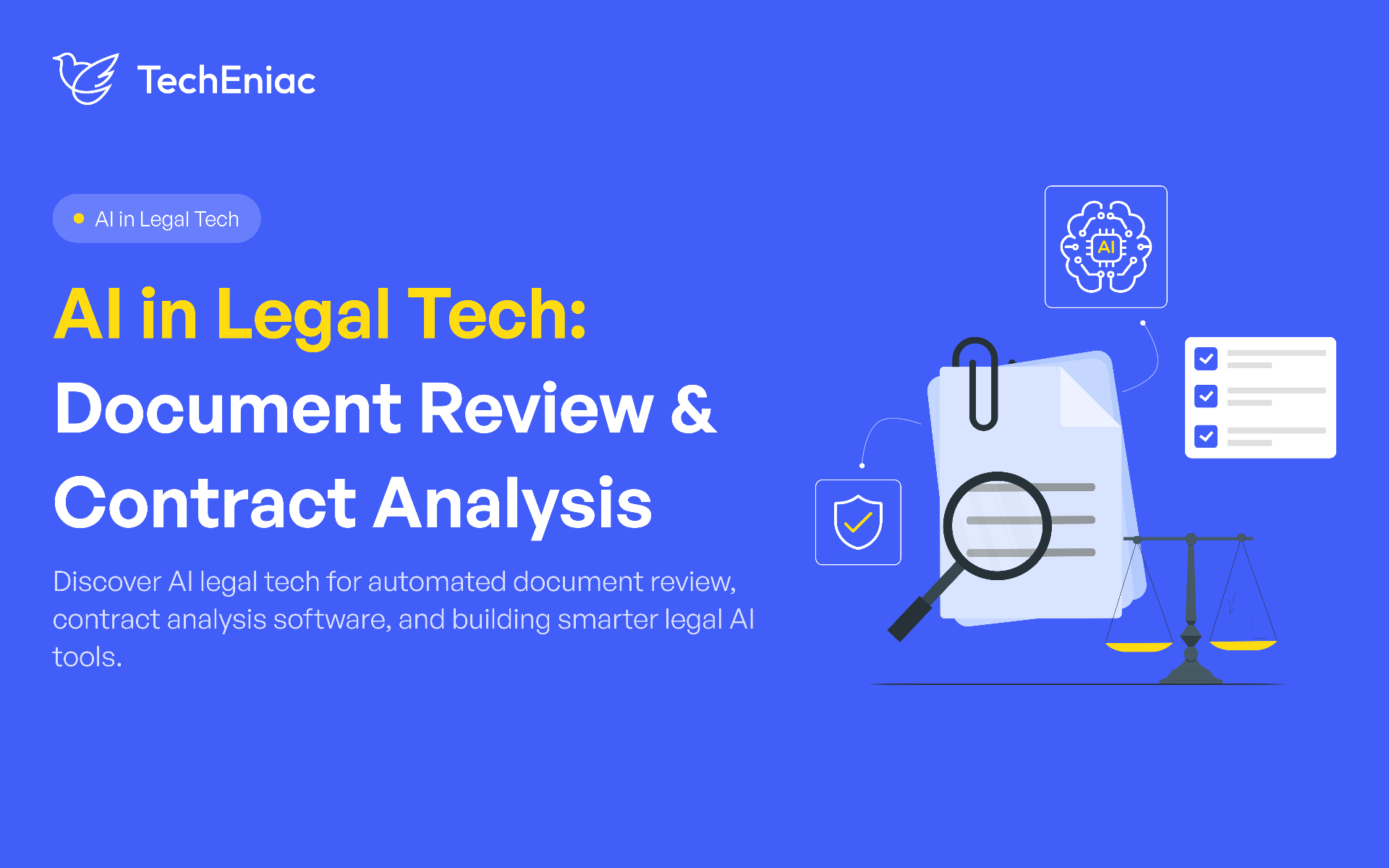
AI in legal tech is the use of machine learning and language models to read, search, draft and check legal work, from AI legal tech document review and contract analysis to research and compliance. The Vals Legal AI Report found that at least one AI tool beat the lawyer baseline on 4 of 7 legal tasks. A focused legal AI tool typically costs $15,000 to $80,000 to build.
Key Takeaways
AI legal tech covers contract analysis, document review, research, due diligence, compliance and drafting, not one task alone.
AI legal tech document review works best on high volume, rule-based work, with a lawyer approving every output.
AI contract analysis software suits teams with common contract types, while a custom build suits teams with specific playbooks or data rules.
LegalTech AI development depends on cited answers, tenant isolation, audit logs, and human review from day one.
Build a legal AI tool in stages, starting with one contract type, one playbook, and one measurable goal.
What Is AI in Legal Tech?
Legal work is built on documents, and documents are where AI delivers value first. The sections below define legal AI, map its main use cases, explain contract analysis and automated document review in detail, and cover how legal AI tools are built, secured and priced.
AI in legal tech refers to software that uses natural language processing, machine learning and large language models to handle tasks that once needed manual reading and drafting. Examples include finding clauses in a contract, summarizing a deposition, searching case law, and flagging regulatory changes.
The aim is to move routine reading and sorting to software, so lawyers spend their time on judgment, negotiation, and advice.
Core Technologies Behind Legal AI
Technology | What It Does | Legal Example |
|---|---|---|
Natural language processing (NLP) | Reads and classifies text | Labeling a clause as indemnity or termination |
Machine learning (ML) | Learns patterns from past data | Predicting which documents are relevant to a matter |
Large language models (LLMs) | Summarize, answer, and draft in plain language | Answering "Who owns the IP?" from a contract |
Retrieval-augmented generation (RAG) | Finds the source passage first, then answers from it | Providing a cited answer with the relevant clause quoted |
OCR and document intelligence | Turns scans and tables into structured data | Reading a scanned lease with schedules |
Workflow automation | Routes tasks and approvals | Sending flagged clauses to the right reviewer |
AI Legal Tech Use Cases Across the Legal Workflow
Legal AI reaches well beyond contracts. Eight use cases account for most of the activity today.
Contract Analysis and Review: Software extracts clauses, compares them with a playbook and flags missing protections. This is the most common starting point because contracts follow repeatable patterns.
Document Review and Electronic Discovery: AI sorts large document sets by relevance, privilege and issue, which shortens the first pass in litigation and investigations.
Legal Research: Language models summarize cases and statutes and point to sources. Accuracy needs close checking, as the studies below show.
Due Diligence: During mergers and financing, AI reads hundreds of agreements for change of control terms, liabilities and renewal dates, then reports them in a single table.
Compliance and Regulatory Monitoring: Tools track rule changes and map them to internal policies, so compliance teams see what needs updating.
Drafting and Report Generation: Models built through generative AI development produce first drafts of summaries, memos and standard clauses for lawyer review.
Litigation Analytics: Predictive models study past rulings, timelines, and outcomes to inform case strategy. They support a lawyer's view and do not replace it.
Client Intake and Virtual Assistants: Chat assistants collect matter details, answer routine questions, and route requests to the right team.
Benefits of AI in Legal Tech
The benefits show up in speed, consistency and visibility:
Faster first pass: hours of reading are reduced to minutes of review.
Consistent checks: every contract is measured against the same playbook.
Searchable portfolio: obligations, renewal dates, and liabilities can be found across thousands of agreements.
Better use of lawyer time: attorneys focus on negotiation, strategy and advice.
Audit trail: each flagged item links back to the clause behind it.
What to Plan for When Adopting Legal AI
Legal AI adoption goes smoothly when four points are planned early:
Clear scope: one contract type and one question set give the team a result it can measure in weeks.
Lawyer ownership: a named reviewer for each workflow keeps accountability where the profession expects it.
Source citations: every answer shows the passage behind it, which makes checking fast and builds trust with the team.
Policy alignment: firm and client rules on AI use, data location and billing are written down before launching, in line with the duties ABA Formal Opinion 512 describes.
Teams that settle these points first spend their pilot time improving the tool and not renegotiating its boundaries.
AI Contract Analysis Software: Capabilities and Selection
AI contract analysis software reads agreements, extracts key terms and compares them with a company's preferred positions. The table lists the capabilities that matter most.
Capability | What It Does | Lawyer Role |
|---|---|---|
Clause extraction | Finds and labels terms, renewals, liability caps, and indemnities | Confirms unusual wording |
Playbook checks | Compares clauses with the preferred position | Decides which deviations to accept |
Missing clause detection | Flags absent protections | Judges how serious the gap is |
Obligation tracking | Lists dates, notice periods, and duties | Acts on deadlines |
Summaries and Q&A | Answers questions with a cited passage | Verifies the citation |
Redlining suggestions | Proposes replacement language | Rewrites for the deal |
Buy vs. Build AI Contract Analysis Software: Which Is Right for You?
The choice depends on how standard the contracts are:
Use readymade software when: the contract types are common; the playbook is standard and speed to launch matters most.
Use a custom build when: the company has unusual contract structures, strict data residency rules, or needs the tool inside its own platform or product.
A short AI consulting engagement can compare both paths against real contracts and requirements.
Automated Document Review: How the Workflow Runs
Automated document review follows five stages from upload to lawyer decision:
Ingestion: files are collected, scanned pages are read with OCR, and structure such as headings, tables and schedules are kept.
Classification: Each document is labeled by type, such as NDA, supplier agreement or lease.
Extraction: clauses, parties, dates, and amounts are pulled into structured fields.
Checks: extracted terms are compared with the playbook, and gaps are flagged with the supporting passage.
Human review: a lawyer accepts, edits or rejects each flag, and the decision is logged.
Accuracy of AI Legal Tech Document Review
The Vals Legal AI Report, updated in February 2025 compared legal AI tools with a lawyer baseline on seven tasks. At least one tool beats the lawyers on data extraction, document Q&A, summarization, and transcript analysis. On document Q&A, the leading tool scored 94.8% against a lawyer baseline of 70.1%. Lawyers led on redlining with 79.7%.
Two points shape how to read these results. The vendors chose which tasks to join, and the tasks were specific formats, not complete matters.
Legal research tools show the risk of unchecked answers. A 2024 Stanford RegLab study found that two leading research tools produced incorrect or misleading answers between 17% and 33% of the time. Design choices that force a tool to cite its source, and to decline when it cannot, address this directly.
LegalTech AI Development: Architecture and Security
LegalTech AI development combines retrieval, language models, review workflows, and security controls. Each layer affects accuracy and trust.
Retrieval Grounded Architecture
Retrieval decides whether answers are correct. A strong setup combines semantic search with keyword matching, splits documents along their own sections and sends only the matching passages to the model. A well-built RAG pipeline also quotes the clause behind each answer and declines when the contract is silent.
Confidentiality and Professional Ethics
In July 2024 the American Bar Association issued Formal Opinion 512, its first ethics guidance on generative AI tools. It addresses competence, confidentiality, client communication, and fees. A lawyer stays responsible for the output and for protecting client information.
Five design choices support that duty:
Tenant isolation: each client's documents sit in a separate space, enforced at the database level, a pattern used in AI SaaS product architecture.
Encryption: data is encrypted in transit and at rest.
No training on client data: contracts are processed to answer a question and are not used to improve a shared model.
Retention limits: documents and extracted text are deleted on a schedule the client controls.
Access logs: every view, query and export is recorded.
Human Review Controls
Each result carries a status of accepted, edited or rejected by a named reviewer, along with the model version that produced it. Reviewer corrections have become the best source of new test cases.
How to Build a Legal AI Tool in 6 Steps
A legal AI tool takes 6 steps to build, from picking one contract type to monitoring live results.
Step 1: Define One Contract Type and One Playbook
NDAs, vendor agreements, and leases are common starting points. The 10 to 15 clauses that matter, and the company's accepted position on each, become the specification the tool is judged against.
Step 2: Ingest Documents and Keep Their Structure
Contracts contain numbered sections, defined terms, and cross references. Keeping that structure lets the model connect "the Supplier" in clause 12 to its definition on page two.
Step 3: Build Retrieval and Cited Answers
Search, chunking and citation rules come before any interface works. The tool quotes the clause it relies on and says so plainly when the contract does not address the question.
Step 4: Add Review Workflow and Drafting Features
Reviewer queues, comments, status tracking and, where useful, suggested language turn extraction into a daily tool.
Step 5: Test on Real Contracts
A test set built from the company's own agreements, with lawyer-marked answers, measures three things: whether the right clause was found, whether the answer was correct, and whether the tool declined when it should have.
Step 6: Monitor, Log and Improve
Usage dashboards, audit logs and scheduled test runs catch quality changes after launch, since models and document types shift over time.
Legal AI Tool Development Cost and Timeline
A legal AI tool typically costs $15,000 for a lean proof of concept, $25,000 to $50,000 for a standard product and $50,000 to $80,000 for a complex one. These ranges follow TechEniac's published MVP pricing for AI products, and the final figure depends on scope and data readiness.
Tier | Typical Scope | Cost | Timeline |
|---|---|---|---|
Lean | One contract type, clause extraction, and cited Q&A | $15,000 | Under 8 weeks |
Standard | Several contract types, playbook checks, review workflow, and user roles | $25,000–$50,000 | 8–12 weeks |
Complex | Portfolio search, system integrations, advanced security, and redlining support | $50,000–$80,000 | 14–24 weeks |
Four factors move a project between tiers:
Number of contract types: each one needs its own playbook and test set.
Document quality: scanned, handwritten or poorly formatted files add processing work.
Security and hosting: private deployment and audit requirements add engineering time.
Integrations: connecting document management or signature tools through AI integration and automation adds scope.
Most of the budget goes to ingestion, retrieval, testing and the review interface, not to the model itself, and a full product with accounts, billing and multiple clients is usually phased as AI SaaS product development.
How TechEniac Builds Legal and Document AI
TechEniac builds retrieval systems that answer long, structured documents with citations attached. MortgageLens, a mortgage guideline assistant, reads regulatory documents of 500 pages and more. It answered over 90% of a 150-question test set correctly and declined about 8% of questions instead of risking an unsupported reply. The same approach applies to contracts, policies, and case files.
Projects run in two-week sprints that each end with a working demo. QA signs every release, and clients own 100% of the intellectual property. Related work is available in the case studies.